

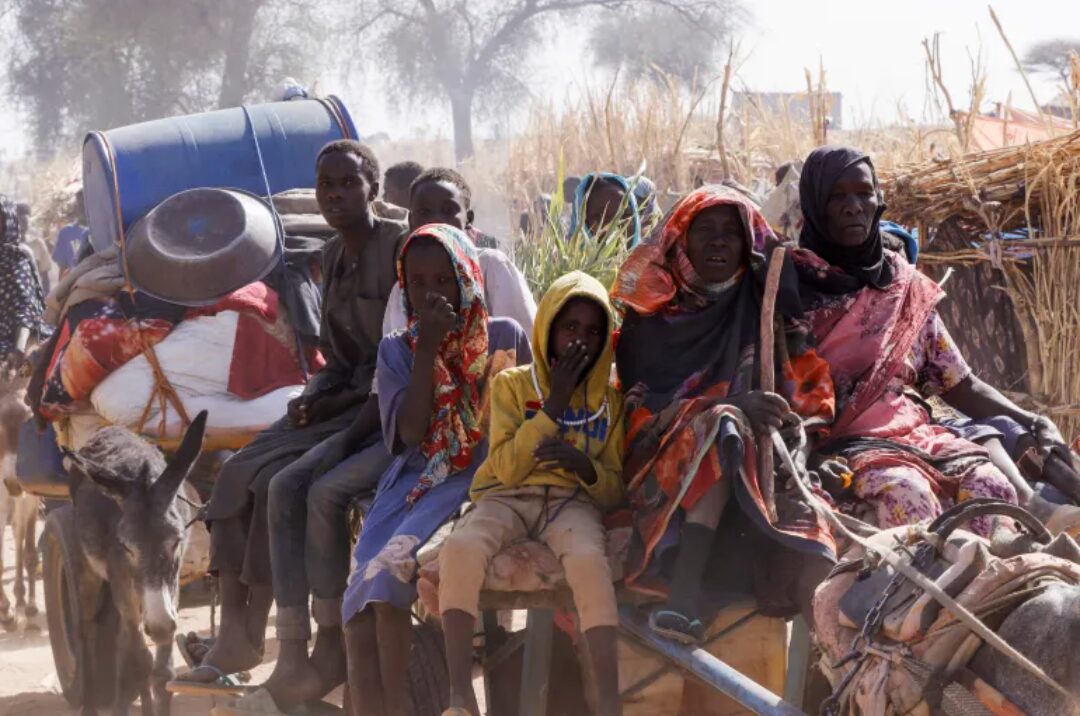

The World Food Programme (WFP) has warned that thousands of families trapped in the besieged city of el-Fasher in western Sudan are at risk of starvation as the country’s brutal civil war rages on. Since May last year, el-Fasher, the capital of North Darfur state, has been under siege by the paramilitary Rapid Support Forces (RSF), which has been at war with the government-aligned Sudanese armed forces (SAF) since April 2023.
The RSF has encircled the city, blocking all major roads and trapping hundreds of thousands of civilians, who have dwindling food supplies and limited humanitarian access. “Everyone in el-Fasher is facing a daily struggle to survive,” said Eric Perdison, the WFP’s regional director for East and Southern Africa. “People’s coping mechanisms have been completely exhausted by over two years of war. Without immediate and sustained access, lives will be lost.”
The situation on the ground is dire, with prices for staple foods like sorghum and wheat reaching as much as 460 percent higher in el-Fasher than in other parts of Sudan. Markets and clinics have been attacked, and community kitchens that once fed displaced families have largely shut down due to a lack of supplies. Desperate families are reportedly surviving on animal fodder and food waste, while acute malnutrition is soaring, especially among children.
According to the UN, nearly 40 percent of children under five in el-Fasher are now acutely malnourished, and 11 percent are suffering from severe acute malnutrition. The rainy season, which peaks in August, is further hampering efforts to reach the city as roads rapidly deteriorate. Last year, famine was first declared in Zamzam and later spread to two other nearby camps – al-Salam and Abu Shouk – and some parts of southern Sudan.

The war has killed tens of thousands of people, displaced millions, and created what the UN describes as the world’s largest displacement and hunger crises. The country is effectively split in two, with the army controlling the north, east, and center of Sudan and the RSF dominating nearly all of Darfur and parts of the south.
UNICEF has warned that funding cuts are driving an entire generation of children in Sudan to the brink of irreversible harm amid a scaling-back in support. “Children have limited access to safe water, food, healthcare. Malnutrition is rife, and many good children are reduced to just skin, bones,” said Sheldon Yett, UNICEF’s representative in Sudan. “We are on the verge of irreversible damage being done to an entire generation of children in Sudan.”
The humanitarian crisis in Sudan is exacerbated by the lack of funding, with only 23 percent of the $4.16 billion global humanitarian response plan for Sudan funded. Jens Laerke of the UN Office for the Coordination of Humanitarian Affairs (OCHA) emphasized the need for immediate access to el-Fasher, saying, “It has been one year since famine was confirmed in Zamzam camp, and no food has reached this area. El-Fasher remains under siege. We need that access now.”

Meanwhile, a cholera outbreak in North Darfur has further added to the desperation of families there, with deaths due to the water-borne disease rising to 191 in the region. The situation in Sudan demands immediate attention and action to protect the lives and rights of its civilians.
About The Author
