


Syria Tadamon massacre arrest has entered a defining phase after authorities confirmed the capture of Amjad Youssef, a former intelligence officer accused of orchestrating the killing of at least 288 civilians in Damascus.
Officials described the operation as precise and deliberate, signaling a rare moment of accountability tied to crimes committed during the rule of Bashar al-Assad.
According to Reuters, security forces carried out a “carefully executed security operation” to apprehend Youssef near Hama, ending years of speculation about his whereabouts.
The arrest is being viewed internationally as a breakthrough in the long-stalled pursuit of justice over atrocities committed during the Syrian civil war.
Background to the massacre
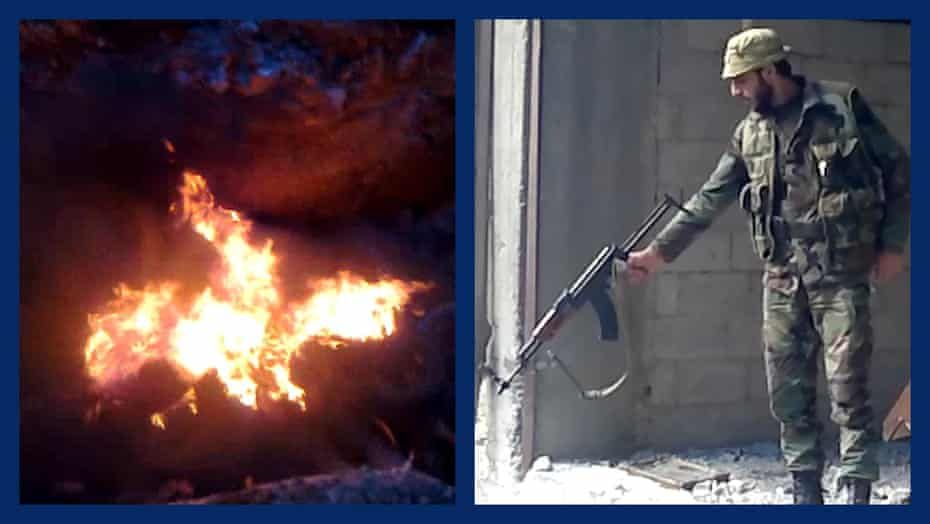
The Tadamon massacre Syria case dates back to 2013, when civilians in a Damascus neighborhood were rounded up, executed, and buried in mass graves.

Evidence later revealed that victims were blindfolded and shot in a systematic manner, with perpetrators documenting the killings themselves.
Investigators described the footage as “clear evidence of organized mass killing,” highlighting the structured and repeated nature of the executions.
Researchers Annsar Shahhoud and Uğur Ümit Üngör were instrumental in identifying those involved, linking Youssef directly to the crimes through extensive analysis.
Reuters reported that Western governments, including the United States and the European Union, imposed sanctions on Youssef following the revelations.
Witness accounts paint a grim picture of life in Tadamon during that period. One survivor said, “People were taken in groups, and none of them came back.”
The arrest and its significance
The Syria Tadamon massacre arrest represents one of the few instances where a high-profile suspect has been detained in connection with alleged Assad regime atrocities.
Authorities confirmed that Youssef was captured without resistance and is now in custody awaiting further legal proceedings.
A government statement said, “He has been taken into custody following a carefully executed security operation,” reinforcing the official narrative of a coordinated arrest.
Reuters quoted regional analysts who said the move “could open the door to wider prosecutions,” especially as new political structures emerge.
Human rights organizations welcomed the development cautiously. Amnesty International stated, “This arrest sends a signal that impunity cannot last forever.”
However, legal experts warned that accountability will depend heavily on transparency and adherence to international standards.
Global reaction and justice prospects
The Syria Tadamon massacre arrest has triggered renewed international focus on war crimes committed during the Syrian conflict.
The United Nations has previously classified such acts as potential crimes against humanity, emphasizing the need for accountability mechanisms.
A UN official noted, “Justice is essential for any sustainable peace process in Syria.”
Reuters cited diplomats who believe the arrest could “reignite global efforts to document and prosecute war crimes tied to the Assad era.”
For survivors and families of victims, the arrest carries deep emotional significance.
A resident of Tadamon said, “We have waited years for this moment. Justice may be slow, but it matters.”
Despite this optimism, analysts caution that one arrest alone does not guarantee systemic accountability.
Comparative accountability and global context
The Syria Tadamon massacre arrest can be compared to post-conflict justice efforts in Bosnia and Rwanda, where prosecutions took years but eventually expanded.
Experts say such cases often begin with individual arrests before evolving into broader legal frameworks.
A legal analyst told Reuters, “This could be the beginning of a longer process, not the end.”
Unlike those cases, Syria faces unique political and institutional challenges that could complicate proceedings.
Role of investigative reporting
The exposure of the Tadamon massacre underscores the importance of investigative journalism in uncovering hidden crimes.
The Guardian played a key role in bringing the story to global attention, publishing detailed findings and interviews that helped identify suspects.
One investigator said, “Without documentation, these crimes would have remained invisible.”
Reuters also noted that evidence gathered by journalists and researchers has been critical in advancing international awareness.
Challenges ahead
Despite the breakthrough, significant challenges remain in ensuring justice is delivered.
Legal systems in Syria are still evolving, and concerns persist about due process and the credibility of trials.
Amnesty International emphasized, “Justice must not only be done but must be seen to be done.”
There are also fears that political considerations could influence the outcome of proceedings.
Broader implications
The Syria Tadamon massacre arrest could influence Syria’s future by reinforcing the importance of accountability.
Analysts suggest that visible justice efforts may help rebuild trust in institutions among affected communities.
However, experts stress that prosecutions must be accompanied by broader reconciliation measures, including truth-telling and reparations.
Reuters quoted a regional expert saying, “Accountability is one step, but rebuilding society requires a comprehensive approach.”
So far in the news
The Syria Tadamon massacre arrest marks a significant moment in the pursuit of justice for one of the most documented atrocities of the Syrian conflict.
While the capture of Amjad Youssef represents progress, the path toward full accountability remains uncertain.
For victims and their families, the arrest offers a measure of hope that justice, though delayed, is still possible.
Read also: Trump Strait of Hormuz order to “shoot and kill” boats triggers military action as US claims control and Iran tensions deepen
Will this arrest lead to real accountability or fade into another unresolved chapter? Drop your thoughts in the comment box.