Global financial markets remained volatile on Friday, with European stocks fall back even as Asian indices posted gains and Wall Street touched new highs.

The divergence between stock markets and the U.S. dollar underscores growing investor anticipation of a potential U.S. Federal Reserve interest rate cut next week.
Analysts say the rally in equities is being driven by expectations that lower borrowing costs will fuel corporate growth, while the strength of the dollar reflects cautious positioning ahead of key policy announcements from major central banks.
On Thursday, Wall Street surged to record levels after fresh U.S. economic data reinforced optimism that the Federal Reserve will finally ease its monetary tightening cycle.
Inflation numbers, combined with jobless claims figures, pointed to a cooling economy, creating room for policymakers to reduce rates.
“Stock markets are at record highs on hopes for falling interest rates,” said Derren Nathan, head of equity research at Hargreaves Lansdown.
“Investors are increasingly confident that a rate cut is around the corner, which could unlock further growth opportunities.”
The Dow Jones Industrial Average closed 1.4 percent higher at 46,108 points, while the broader S&P 500 and tech-heavy Nasdaq also posted notable gains.
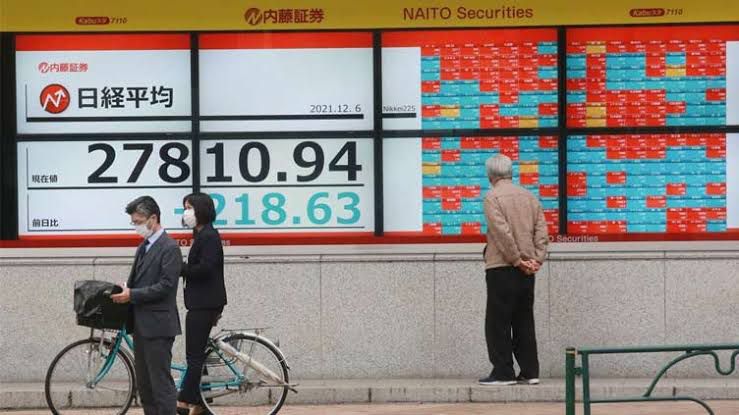
Asia followed Wall Street’s lead, with Tokyo’s Nikkei closing at a record 44,768 points, up 0.9 percent. Seoul’s stock market also reached new milestones during the week.
Hong Kong’s Hang Seng Index gained 1.2 percent to 26,388, fueled largely by a more than five percent surge in Alibaba’s shares.
The Chinese e-commerce giant’s U.S.-listed stock had jumped eight percent on Thursday following its latest ventures into artificial intelligence, a sector increasingly driving global investor attention.
Shanghai’s Composite Index, however, slipped 0.1 percent to 3,870, reflecting lingering concerns over China’s sluggish domestic recovery and ongoing property sector woes.
European equities told a different story. While London’s FTSE 100 managed to inch 0.3 percent higher to 9,328, most other major indices fell. Paris’ CAC 40 lost 0.5 percent, closing at 7,788, while Frankfurt’s DAX shed 0.2 percent to end at 23,648.
Analysts attributed London’s resilience to sterling weakness and gains in energy and financial stocks, which helped offset broader economic concerns.
“While the UK economy stalled in July, the pound’s decline and strong performance from key sectors have provided support to the FTSE,” explained Joshua Mahony, chief market analyst at Scope Markets.
Gold, traditionally seen as a safe haven during times of uncertainty, climbed to fresh record highs this week. Escalating geopolitical tensions, particularly in the Middle East and Eastern Europe, have pushed investors toward safer assets.
The ongoing Israel-Gaza conflict and Russia’s war in Ukraine continue to rattle investor confidence, amplifying the appeal of commodities like gold and crude oil.
Brent crude prices rose 0.8 percent to $66.90 per barrel, while West Texas Intermediate climbed 0.7 percent to $62.78.
Investors are also closely monitoring policy moves from global central banks. Russia’s central bank trimmed its key interest rate to 17 percent on Friday in a bid to cushion the economy from slowing growth.
The Bank of England, expected to meet next week, is widely anticipated to hold rates steady. Policymakers face the challenge of balancing stagnant economic growth with persistent inflationary pressures.
Similarly, the European Central Bank chose to keep rates unchanged on Thursday, pointing to controlled eurozone inflation and easing trade tensions.
Yet, political instability in France remains a potential risk factor for the bloc’s economy.
In currency markets, the euro edged higher against the dollar, trading at $1.1740 compared to $1.1732 on Thursday.
The pound slipped against the greenback, dropping to $1.3553 from $1.3580, reflecting weaker UK growth.
The dollar gained against the yen, rising to 147.81 from 147.18, signaling investor demand for the U.S. currency amid global uncertainty.
While equity rallies in Asia and the U.S. reflect optimism about monetary easing, the dollar’s strength and gold’s record run highlight lingering caution.
Investors remain wary of potential shocks from geopolitical tensions, sluggish economic data, and unexpected central bank decisions.
Market experts note that the coming week will be critical in shaping global financial direction.
A U.S. Federal Reserve rate cut would likely spark further equity gains, but any delay or hesitation could unsettle markets.
“Investors are positioned for easing, and if that expectation is not met, we could see sharp corrections,” warned Nathan.
The divergence between global equities and the dollar captures the delicate balance of hope and caution defining today’s financial markets.

As investors await the Federal Reserve’s next move, the interplay between interest rates, currency strength, and geopolitical risks will continue to set the tone for global trading in the weeks ahead.
About The Author