

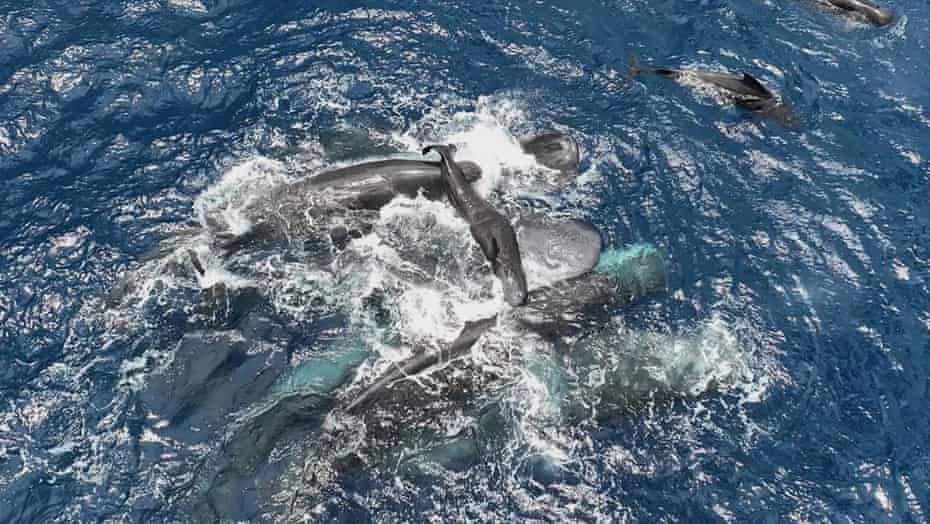
Scientists have captured an extraordinary moment in the wild: a whale giving birth while other whales actively helped both the mother and her newborn survive.
The rare event was documented by researchers from Project CETI, an international effort to understand whale communication, near the Caribbean island of Dominica in July 2023. Their findings were later published in the journals Scientific Reports and Science.
The subject of the observation was a 19-year-old sperm whale named Rounder, who was surrounded by a pod of 11 whales as she prepared to give birth to her second calf. Over more than five hours, scientists monitored the group using drones, underwater audio recordings, and direct observation from a nearby boat. The actual birth lasted about 34 minutes.
What made the event especially significant was the coordinated support from other whales. During labour, several adult females positioned themselves beneath Rounder, often turning upside down and aligning their bodies close to her.
Immediately after the calf was born, the entire pod became highly active. Researchers observed the whales physically supporting the newborn, lifting it toward the surface to breathe, and gently guiding it through the water. This assistance is crucial because newborn whales initially sink and must be helped to reach the surface for their first breaths.
Among the roughly 93 known cetacean species—including whales, dolphins, and porpoises—only a handful have ever been observed giving birth in the wild. Even more remarkable is that some of the assisting whales were not directly related to the mother. This represents the first recorded evidence of birth assistance among non-primate species.
Whales have unique adaptations that help them survive birth in the ocean. Calves are born tail-first to reduce drowning risk, and although they are already about four metres long, they still need immediate support to swim.
These behaviours are believed to be deeply rooted in the evolutionary history of cetaceans, which returned to life in the ocean after their ancestors had adapted to land millions of years ago.
Scientists also recorded significant changes in whale vocalisations during the birth. These sounds appeared to help the group coordinate their behaviour and possibly protect the newborn. Such findings support the broader goals of Project CETI, which aims to better understand how whales communicate.
Sperm whales have one of the longest pregnancies in the animal kingdom, lasting up to 16 months. After birth, calves rely on their mother’s milk for at least two years, while other pod members help care for the young. The newborn observed in this study was later spotted alive more than a year after birth, indicating it is likely to survive into adulthood.
This rare footage provides powerful insight into the intelligence, cooperation, and social bonds of whales. It challenges assumptions about animal behaviour and highlights the complexity of life beneath the ocean surface. It also reinforces the importance of protecting marine ecosystems, as such intricate social behaviours depend on stable and healthy oceans.
Read also:Russia supplying drones to Iran alarms European intelligence agencies
About The Author
