

A previously unreleased photograph of the late British physicist Stephen Hawking has emerged from the Hawking Epstein Files, showing him reclining on a sun lounger while sipping a cocktail during a 2006 Caribbean science event.
The image, which has drawn attention worldwide, features Hawking alongside two women identified as his long-term carers, supporting him in his daily needs due to motor neurone disease, the degenerative condition he battled for over five decades.
The photograph was included in documents released by the US Department of Justice as part of its ongoing investigation into convicted sex offender Jeffrey Epstein.
Taken at the Ritz Carlton Hotel in St Thomas, US Virgin Islands, the image coincided with a symposium on quantum cosmology where Hawking delivered a lecture. While Hawking’s name appears hundreds of times across the Epstein files, legal experts emphasize that inclusion in the documents does not suggest wrongdoing.
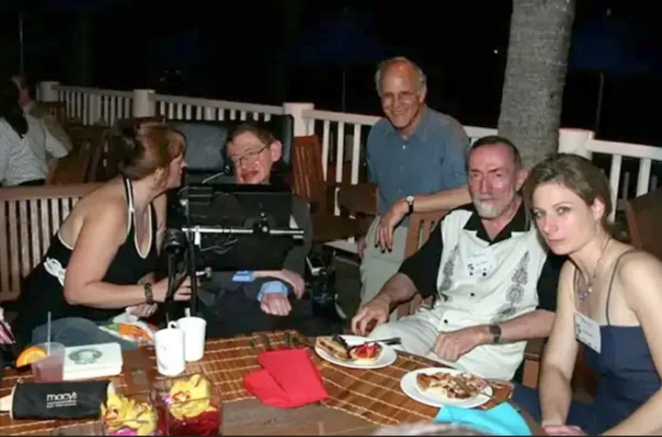
The undated photograph shows Hawking’s cocktail being held steady by one of his carers, highlighting the practical challenges the scientist faced daily. Sources confirm that the image reflects a social moment during the symposium, when Hawking and other invited guests visited nearby Epstein properties, including his 75-acre private island, Little Saint James.
Hawking was among 21 scientists who participated in events designed to foster discussion about theoretical physics and cosmology in a relaxed environment.
Historical records and prior photographs show Hawking visiting Epstein’s Caribbean properties in 2006 and 2008.
A 2015 image, also from the Justice Department files, shows Hawking in his wheelchair at an outdoor dinner on Little Saint James, surrounded by several colleagues.
Another image reveals Hawking touring a submarine, reportedly modified to allow him access to the vessel, which explored the seabed near Epstein’s private island. These appearances have been repeatedly cited in media coverage, often sparking speculation despite no evidence of inappropriate behavior.
A spokesperson for the Hawking family commented: “Professor Hawking made some of the greatest contributions to physics in the 20th century while being the longest-known survivor of motor neurone disease, a debilitating condition that left him reliant on a ventilator, voice synthesizer, wheelchair, and round-the-clock care.
Any insinuation of inappropriate conduct is wrong and far-fetched in the extreme.” The family statement was issued following renewed media interest in the newly released photograph.
Legal experts have noted that documents in the Hawking Epstein Files mention financial incentives offered by Epstein to associates of Virginia Giuffre, an Epstein accuser, to disprove false allegations involving Hawking.
These claims, however, have been explicitly discredited, and no credible evidence ties Hawking to criminal activity. The documents primarily highlight Epstein’s attempts to manipulate witnesses and create confusion around high-profile visitors to his properties.
Despite the controversy, Hawking’s scientific legacy remains untarnished. Renowned for his pioneering work on black holes, general relativity, and the origins of the universe, Hawking’s intellectual contributions continue to shape modern cosmology.
Colleagues emphasize that his appearance in social photographs, including those at the Ritz Carlton symposium or on Little Saint James, should be understood in the context of scientific engagement, not personal misconduct.
Observers also point out the broader implications of releasing such high-profile files. While the US Department of Justice aimed to provide transparency in the Epstein investigation, the inclusion of renowned scientists like Hawking raises questions about public perception and media responsibility.
Experts warn that casual associations with Epstein can easily be misinterpreted, necessitating careful reporting and nuanced context.
Hawking’s visits to the Caribbean islands were part of structured science events organized by the Jeffrey Epstein VI Foundation. In 2012, the foundation described gatherings where attendees “discuss, relax on the beach, and take trips to nearby private islands” to explore theoretical questions about gravity. Such events attracted top-tier academics and were intended to foster interdisciplinary dialogue, though their association with Epstein later complicated public narratives.
The images from Little Saint James, including Hawking in the submarine, demonstrate the lengths organizers went to accommodate distinguished guests with specific needs.
Modifications to the submarine and careful planning ensured Hawking could participate fully despite his severe physical limitations, reinforcing that his presence was grounded in academic interest rather than any inappropriate activity.
Public reaction to the photograph has been mixed. While some expressed surprise at seeing Hawking in a relaxed social setting on Epstein’s island, others cautioned against drawing conclusions without corroborating evidence.
Historians of science note that Hawking often attended international gatherings, retreats, and symposiums, making such images unsurprising in the context of his extensive engagement with the global scientific community.
As the Hawking Epstein Files continue to receive attention, the Hawking family’s spokesperson reaffirmed: “Professor Hawking’s enduring achievements in theoretical physics, combined with his resilience in facing a life-limiting disease, define his legacy far more than the isolated circumstances of a photograph.” The statement underscores the distinction between casual presence and criminal implication.
While speculation persists, independent analysts stress that Hawking’s name appearing in hundreds of DOJ documents reflects procedural thoroughness rather than evidence of wrongdoing.
Investigative journalists and legal scholars alike emphasize the importance of interpreting the Hawking Epstein Files within their proper legal and historical framework, separating verified facts from rumor and conjecture.
The photograph, now public, offers both a glimpse into Hawking’s personal experiences and a reminder of the complexities surrounding public figures in the Epstein investigation.
It illustrates the intersection of scientific brilliance, human vulnerability, and the challenges posed by associations with controversial figures, highlighting the ongoing tension between transparency, reputation, and historical record.

Hawking Epstein Files reveal a moment of relaxation for a legendary scientist amid a high-profile Caribbean symposium, with images showing Hawking accompanied by carers, attending formal dinners, and touring modified vessels.
Across all accounts, the focus remains firmly on his scientific contributions and the extraordinary personal resilience he exhibited in the face of motor neurone disease, reaffirming his status as one of the 20th century’s most influential physicists.
Read also: Anti-drone nets reshape Ukraine’s frontline defence as Kyiv races to shield supply routes and cities
About The Author


