The Federal Government has unveiled a new birth registration policy designed to transform how children are admitted into schools across Nigeria.
The reform seeks to connect official birth records with school enrolment processes, a move authorities say will significantly improve data accuracy and long-term educational planning.
The initiative follows a formal partnership between the Federal Ministry of Education and the National Population Commission (NPC).
Under the arrangement, demographic records maintained by the commission will be systematically integrated into school admission systems nationwide.
Officials believe the collaboration will help eliminate inconsistencies in pupil data and provide a clearer national picture of school-age children.

According to a statement released by the Ministry’s Director of Press and Public Relations, Boriowo Folasade, the Minister of Education, Dr. Olatunji Alausa, emphasised that reliable population statistics are central to effective governance in the education sector.
He noted that planning without accurate figures often leads to overcrowded classrooms in some regions and underutilised facilities in others.
The minister explained that linking birth registration to school entry requirements would ensure that pupils are placed in classes appropriate to their age.
Beyond age verification, he said the measure would strengthen the credibility of academic documentation and reduce cases of manipulated records.
He further stated that credible demographic data supports rational decisions in areas such as school construction, teacher recruitment, and equitable distribution of textbooks and learning materials.
Without dependable numbers, projections for enrolment growth and infrastructure needs become speculative rather than strategic.
While the policy introduces a new compliance requirement, the government has assured citizens that enforcement will not begin immediately.
Dr. Alausa clarified that authorities will first expand access to registration services nationwide to avoid placing undue burden on families, particularly those in rural or hard-to-reach communities.
At present, the NPC operates thousands of registration centres across the country.
Chairman Aminu Yusuf reaffirmed the commission’s statutory responsibility to manage Nigeria’s Civil Registration and Vital Statistics system.
He disclosed that over 4,000 centres are functional and that digital upgrades are ongoing to improve efficiency and public accessibility.
The strengthened collaboration between both institutions will also see the creation of a Joint Technical Working Group.
This body will harmonise verification procedures and establish interoperability between education and civil registration databases.
The aim is to enable seamless confirmation of pupil records during admission exercises.
Education experts have long argued that weak data systems contribute to planning gaps in Nigeria’s schooling framework.
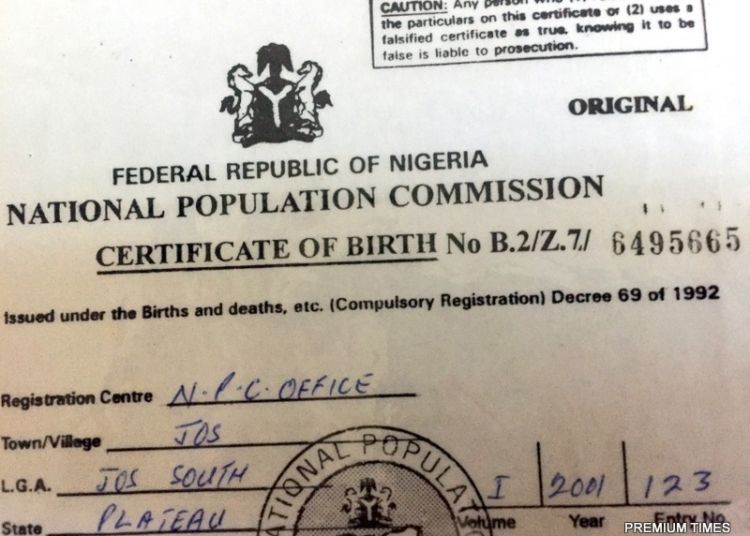
By embedding birth registration into enrolment processes, policymakers expect to build a more dependable foundation for tracking student populations from early childhood through secondary education.
Digital integration forms a key component of the reform. The ministry believes that synchronised databases will enhance transparency and accountability across federal and state education systems.
Authorities will be able to monitor enrolment trends in real time, detect unusual spikes or declines, and identify potential dropout cases earlier than before.
The reform is also expected to assist in addressing age falsification, a recurring challenge in some academic settings.
When official records are aligned with school data, discrepancies become easier to detect and correct. This contributes to maintaining standards and fairness within the system.
Stakeholders say the broader impact of the birth registration initiative could extend beyond education.
Accurate civil data strengthens national planning in healthcare, social services, and economic development.
When the number of children in each age bracket is clearly known, governments can allocate resources more effectively across sectors.
Nonetheless, observers stress that public awareness will be crucial to the success of the policy. Families must understand the importance of early registration and the long-term benefits it offers.
Outreach campaigns, mobile registration units, and community engagement strategies may play an important role in ensuring compliance.
Officials insist that no child will be unfairly excluded from schooling during the transition phase.
The ministry reiterated its commitment to inclusive education, stating that safeguards will be implemented to prevent unintended barriers while systems are being expanded.
In the coming months, the Joint Technical Working Group will begin aligning technical frameworks and establishing secure data-sharing protocols.
This step is considered vital to protecting personal information while enabling effective coordination between agencies.
By placing birth registration at the centre of school enrolment procedures, the Federal Government hopes to close longstanding data gaps that have hindered planning efforts.
The reform signals a shift toward evidence-based decision-making in the education sector.
Ultimately, authorities believe that a stronger data ecosystem will support balanced teacher deployment, fair funding distribution, and better monitoring of academic outcomes.
As implementation progresses, the success of the policy will depend on expanded infrastructure, technological readiness, and sustained collaboration between institutions.
Ireport247news