

Saudi-backed government forces have retaken multiple cities in southern Yemen, reshaping battlefield dynamics and exposing deepening fractures between Riyadh and Abu Dhabi within the coalition.
The operation marks one of the most consequential territorial shifts in months, reversing gains made by UAE-backed separatists during a rapid expansion late last year.
Yemeni officials said the offensive was carried out by Homeland Shield forces aligned with the internationally recognised government and operating with Saudi military support.
Rashad al-Alimi, head of the Presidential Leadership Council, said the campaign achieved “record success” and restored state authority in strategically vital southern provinces.
“This operation reaffirms the state’s responsibility to protect sovereignty and citizens,” al-Alimi said, praising what he called discipline and coordination among government forces.
The most significant development was the recapture of Mukalla, capital of Hadramout province and Yemen’s most important port on the Arabian Sea coastline.
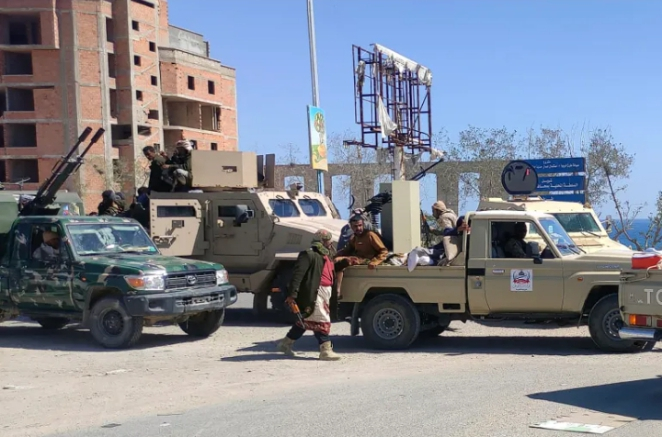
Mukalla’s control is critical for trade routes, energy infrastructure, and military logistics, giving whoever holds it outsized leverage in Yemen’s fractured political landscape.
STC fighters had seized Mukalla in December, alarming the Yemeni government and Saudi Arabia over the separatists’ expanding territorial ambitions.
Government sources said Saudi-backed forces entered the city after sustained clashes and air raids weakened STC positions across administrative and military facilities.
An STC military official told AFP that Saudi warplanes conducted “intense” strikes on camps west of Mukalla, forcing fighters to withdraw under heavy pressure.
“These raids were decisive and left us little room to regroup,” the official said, speaking on condition of anonymity because of security concerns.
Beyond Hadramout, the operation extended eastward into al-Mahra governorate, a sparsely populated but strategically sensitive region bordering Saudi Arabia and Oman.
Local officials said Homeland Shield forces took control of all nine districts of al-Mahra after STC units withdrew over several days of fighting.
Al-Mahra and Hadramout together make up nearly half of Yemen’s territory, amplifying the political and security impact of their recapture by government forces.
Since early December, tensions escalated after the STC moved to seize both provinces, challenging the authority of the Presidential Leadership Council directly.
The STC has long advocated for southern independence, arguing the south was marginalised following Yemen’s unification in 1990 under northern dominance.
Saudi Arabia initially sought to manage these tensions politically, but analysts say the latest operation reflects a decisive shift toward military enforcement.
Al Jazeera’s Yemen affairs editor Ahmed al-Shalafi said events marked a turning point in Riyadh’s handling of its former coalition partner.
“The military intervention came first, and the political track followed afterward,” al-Shalafi said, describing a reversal of earlier conflict management approaches.
Only after territorial gains did the Yemeni government invite STC leaders to talks in Saudi Arabia, underscoring Riyadh’s renewed assertiveness.
The fighting came at a heavy cost, with STC officials reporting at least eighty fighters killed, more than one hundred fifty wounded, and dozens captured.
“These losses reflect the intensity of the confrontations,” an STC spokesperson said, warning of further instability without a political settlement.
Despite the clashes, the STC welcomed Saudi mediation, calling dialogue a “genuine opportunity” to protect what it described as southern aspirations.
On the ground, signs of cautious normalisation emerged in some areas, particularly in Seiyun, a key city in Wadi Hadramout.
Residents told newsmen that shops reopened, public offices resumed work, and basic services slowly returned following days of uncertainty.
Hadramout Governor Salem Ahmed Said al-Khanbashi arrived in Seiyun shortly afterward, symbolising the restoration of state authority.
“This visit reassures citizens that the government is present and accountable,” a local official said, welcoming renewed administrative oversight.
However, tensions persist in Aden, the southern port city serving as the government’s temporary capital but dominated by STC influence.
The Yemeni government accused the STC of imposing unlawful restrictions on civilian movement into Aden, calling the measures unconstitutional.
“These practices violate the Riyadh Agreement and undermine national unity,” the government said in a strongly worded statement.
Officials pledged to take measures protecting civilians and guaranteeing freedom of movement, warning against further unilateral actions by separatist forces.
The Riyadh Agreement, brokered in 2019, was intended to regulate power-sharing between the government and STC but has repeatedly faltered.
Observers say the latest clashes highlight Yemen’s increasingly complex war, now shaped by overlapping conflicts and competing regional agendas.
Saudi Arabia prioritises border security and a unified Yemeni state under friendly leadership, viewing fragmentation as a long-term strategic threat.
The United Arab Emirates, meanwhile, has cultivated local allies controlling ports and coastal areas critical to maritime trade and regional influence.
These divergent priorities have strained relations between Riyadh and Abu Dhabi, despite their shared opposition to Yemen’s Houthi movement.
The Houthis continue to control much of northern Yemen, including the capital Sanaa, complicating any attempt at national reconciliation.
Read also: UK France joint strike ISIL Palmyra shakes Syria security landscape
Analysts warn that internal fighting among anti-Houthi factions risks weakening the broader front against the group.
“Every internal clash buys the Houthis more time and leverage,” a regional analyst said, speaking to newsmen.
For now, the government’s territorial gains represent a significant boost to Saudi-backed authority in the south.
Yet many Yemenis fear that without inclusive political dialogue, military victories will prove temporary and deepen long-term instability.
“The battlefield can change overnight,” a Yemeni political commentator said, “but peace requires agreements everyone accepts.”
As diplomacy resumes alongside military manoeuvres, Yemen’s future remains uncertain, caught between regional rivalries and unresolved internal divisions.


