

Russia carried out one of its largest strategic nuclear exercises in years, launching missiles from land, sea, and air, directly after the Putin-Trump summit delay announcement.
The Russian defence ministry confirmed President Vladimir Putin personally oversaw the drills, which tested the readiness and coordination of Russia’s full nuclear triad under live operational conditions.
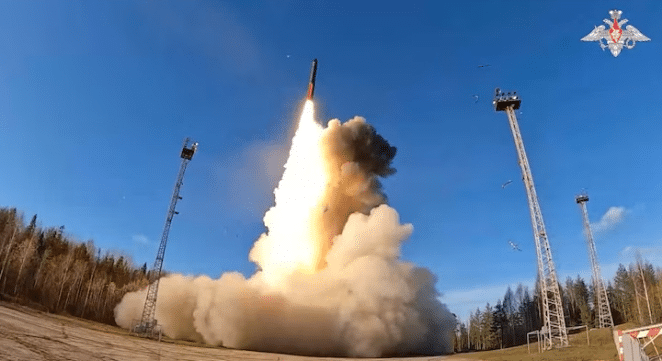
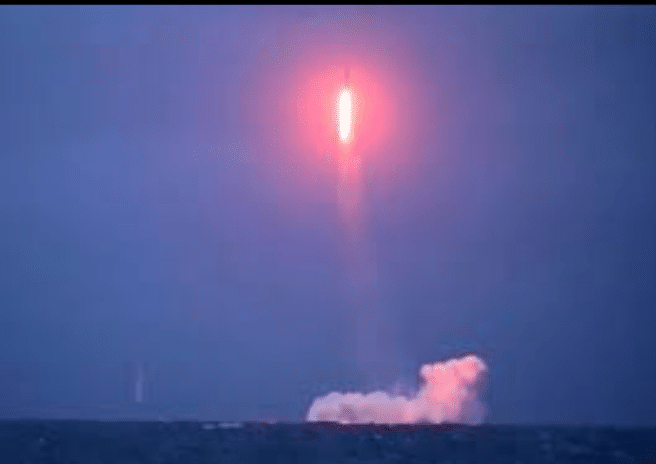
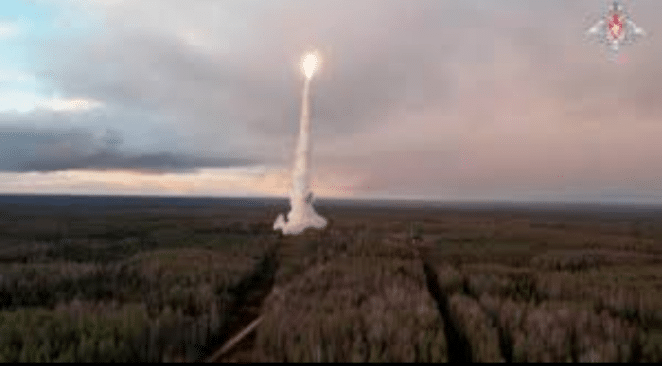
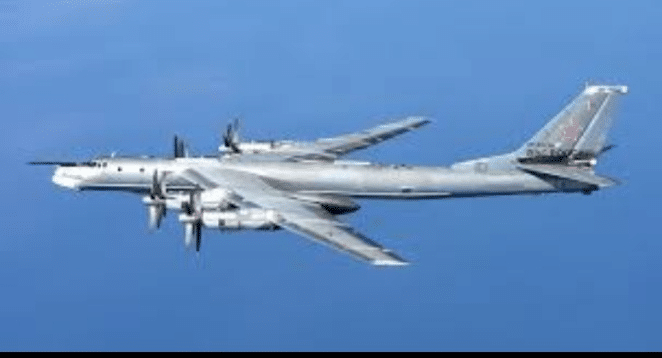
The exercise involved the Yars intercontinental ballistic missile, the Sineva submarine-launched ballistic missile, and long-range air-launched cruise missiles from Tu-95 strategic bombers, targeting simulated enemy positions.
Moscow described the operation as “routine,” but Western analysts interpreted it as a deliberate show of force timed to coincide with heightened diplomatic uncertainty.
The Putin-Trump summit delay created a perfect backdrop for Moscow to demonstrate global relevance and military strength, exploiting Washington’s hesitation to reassert its deterrence capability.
Footage broadcast by Russian state media showed Putin inside the National Defence Control Center, flanked by top generals, authorising missile launches and receiving live strike confirmations.
The Kremlin said the purpose was to test “strategic command reliability” and to ensure all nuclear forces remain combat-ready despite international sanctions and ongoing geopolitical tensions.
Analysts in NATO capitals said the manoeuvres mirrored pre-war coordination patterns seen before Russia’s 2022 invasion of Ukraine, sparking renewed alarm across Europe’s defence community.
Experts argue that the Putin-Trump summit delay emboldened Moscow to act more assertively, interpreting Western diplomatic disunity as an opportunity for strategic posturing.
European officials described the exercise as “escalatory theatre,” accusing the Kremlin of leveraging nuclear symbolism to pressure both Kyiv and Western governments into strategic concessions.
Western intelligence sources reported the drills featured more visible deployments than previous years, with increased activity near Bryansk, Belgorod, and the Barents Sea, indicating multi-domain coordination.
Satellite imagery confirmed the presence of mobile launchers and nuclear submarines conducting simultaneous readiness operations across three regions, displaying unprecedented synchronization in command control.
Russia’s defence ministry emphasised that “all objectives were achieved,” claiming successful launches validated the strength and precision of its deterrence architecture against potential Western aggression.
The Putin-Trump summit delay allowed Russia to frame the drill as a response to “Western uncertainty,” portraying itself as the stable power amid diplomatic hesitation.
Kremlin spokesperson Dmitry Peskov said the exercise proved Russia’s “ability to defend sovereignty,” rejecting Western claims that the manoeuvres were provocative or politically timed.
In contrast, NATO condemned the drills as irresponsible, warning they risk miscalculation at a moment when both sides are conducting overlapping nuclear readiness exercises.
Alliance sources noted the operation coincided with NATO’s “Steadfast Noon” nuclear deterrence drill, creating potential for confusion or misinterpretation between rival command centres.
The Putin-Trump summit delay therefore magnified global risk, increasing chances that symbolic actions could escalate into unintended confrontation amid weakened diplomatic communication channels.
European security analysts warned of “mirror escalation,” where mutual exercises by nuclear powers blur the distinction between readiness and aggression.
Brussels urged renewed dialogue on nuclear transparency and crisis communication mechanisms, saying deterrence without trust creates “a razor-thin margin between signalling and catastrophe.”
Ukrainian officials condemned Moscow’s display as intimidation, arguing the timing of the nuclear drills sought to distract from Russian setbacks along multiple frontlines.
Kyiv’s defence ministry stated that “nuclear theatrics will not hide battlefield failures,” emphasising Ukraine’s determination to continue resisting despite escalating psychological warfare.
The Putin-Trump summit delay reinforced Kyiv’s view that Russia uses global uncertainty to destabilise international unity while seeking leverage over Western financial and military support.
Ukraine’s allies echoed this assessment, describing the nuclear drill as a calculated propaganda exercise designed to remind Europe of Moscow’s strategic endurance.
Meanwhile, Ukrainian intelligence warned that Russia often masks operational troop rotations under the guise of such exercises, preparing for renewed offensives later in winter.
In Moscow, state media celebrated the event as proof of national strength, airing patriotic montages showing missile launches, submarine crews, and bomber formations in formation.
Commentators described the drills as “routine and defensive,” insisting the West exaggerated their significance to justify further NATO militarisation near Russian borders.
The Putin-Trump summit delay became a recurring theme in Russian broadcasts, framed as evidence that Washington feared direct dialogue with a confident and resurgent Moscow.
Putin himself made a televised statement after the exercise, declaring that Russia’s deterrence systems “guarantee peace through strength and readiness.”
Analysts viewed this rhetoric as part of Moscow’s broader effort to normalise nuclear signalling as a diplomatic tool within global power politics.
European leaders responded cautiously, avoiding direct escalation but reaffirming collective readiness under NATO’s Article 5 deterrence framework and increased strategic surveillance operations.
Germany, Poland, and France issued coordinated statements calling Russia’s drill “provocative but predictable,” urging unified resilience against continued Kremlin intimidation.
The Putin-Trump summit delay served to strengthen Europe’s perception that it must rely on itself, not Washington, for consistent deterrence and security leadership.
Brussels officials said the timing highlighted “a power vacuum in transatlantic policy,” prompting fresh debate about Europe’s independent nuclear doctrine.
Across the continent, defence stocks rose sharply, reflecting renewed investor confidence in Europe’s long-term rearmament trajectory amid sustained geopolitical confrontation.
Strategically, the drills demonstrate Russia’s intent to remind adversaries of its triad capability: ICBMs for distance, submarines for stealth, bombers for global reach.
Each component reflects decades of investment designed to ensure survivability, even under first-strike conditions — a cornerstone of Russia’s deterrence doctrine.
The Putin-Trump summit delay amplifies the significance of this timing, projecting Moscow’s confidence and autonomy in defining the tempo of global strategic signalling.
Western observers noted that Russia’s nuclear posture now blends military readiness with political theatre, reinforcing its image as a state unshaken by sanctions.
In Washington, officials privately admitted frustration, saying Trump’s diplomatic inconsistency undermines coordinated Western messaging and emboldens Russia’s aggressive self-presentation.
Ultimately, Russia’s October 2025 nuclear drills were not merely a technical test but a political performance, crafted to intimidate, reassure, and distract simultaneously.
By merging power projection with symbolism, Moscow asserted its centrality in global security discourse, ensuring every Western capital took notice.
The Putin-Trump summit delay turned an annual military routine into a high-stakes geopolitical event, magnifying every launch into a statement of defiance.
While no direct confrontation followed, the exercise underscored the fragility of international stability amid blurred lines between deterrence and provocation.
As winter approaches, analysts warn that nuclear rhetoric may rise again, shaping 2026’s strategic landscape under the shadow of the Putin-Trump summit delay.
About The Author


