A massive Russian assault has struck Ukraine’s Shebelinka gas processing plant, setting off blazing infernos and crippling vital energy infrastructure as President Zelenskyy seeks U.S. missile support.
The predawn attack in Kharkiv region left the Shebelinka gas facility engulfed in flames, sending thick plumes of smoke into the sky and triggering power outages across eight regions.
“This was one of the most devastating nights for Ukraine’s energy system,” President Volodymyr Zelenskyy said. “Russia’s goal is to freeze our people into submission.”
Officials reported that the Shebelinka gas plant—one of Ukraine’s largest—was hit by both drones and missiles just before dawn, with two major explosions rocking the complex.
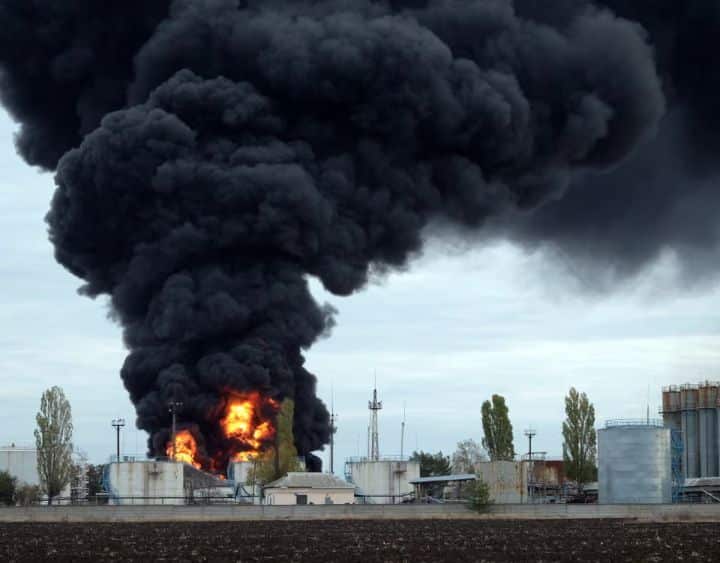
“It felt like the ground split open,” said plant engineer Mykola Kravchenko. “We saw fireballs rise higher than the towers. Everything burned within seconds.”
The Russia attacks on the Shebelinka gas plant mark one of the most severe strikes on Ukraine’s energy infrastructure since the full-scale invasion began in 2022.
Kharkiv’s emergency services battled the blaze for hours, as fires spread across multiple sections of the facility. Several workers sustained injuries but were quickly evacuated to safety.
Ukraine’s state energy company Naftogaz confirmed extensive damage. “Operations have been halted at Shebelinka,” CEO Sergii Koretskyi said. “This is a critical loss for our gas production network.”
Authorities imposed emergency electricity restrictions across Kyiv, Poltava, Sumy, and Vinnytsia as grid operators worked to reroute dwindling power supplies to hospitals and essential services.
“Russia launched over 300 drones and 37 missiles targeting energy facilities,” Zelenskyy said on X. “Every attack on our power grid is an attack on our survival.”
Residents of Kharkiv described terrifying scenes as the night sky erupted with explosions. “The city shook for hours,” said 63-year-old Olha Taran. “We thought it was the end.”
The Russia-Ukraine gas site bombardment has pushed millions closer to a deepening humanitarian crisis as Ukraine faces another bitter winter without stable energy supplies.
Since the start of the war, Russia has made Ukraine’s energy network a central target, striking power plants, oil depots, and gas infrastructure to break the country’s resistance.
Moscow’s defense ministry claimed its forces targeted “military-related sites” with precision strikes, calling them a “response” to Ukrainian attacks on Russian refineries. Kyiv dismissed the claim as propaganda.
Energy experts estimate that more than half of Ukraine’s gas output could be lost if repair efforts at the Shebelinka gas plant are delayed for several weeks.
“This was not a military target,” said energy analyst Kateryna Volynska. “It’s clear Russia wants to turn the cold into a weapon against civilians.”
The attack comes as Zelenskyy travels to Washington, where he is expected to meet Donald Trump to request long-range Tomahawk missiles to defend critical infrastructure.
“We need effective deterrence,” Zelenskyy said before boarding his flight. “Without stronger air defenses, we cannot protect our energy systems from constant destruction.”
Ukrainian officials held meetings with U.S. weapons manufacturers, including Raytheon—the maker of Tomahawk missiles—hoping to fast-track potential deliveries pending political approval.
A senior Ukrainian defense adviser noted, “Every day of delay means more power stations destroyed, more hospitals in the dark, more children freezing.”
Trump’s aides have signaled cautious openness to supplying the missiles, but Moscow warned that such a move would “rupture diplomatic relations” and “invite severe consequences.”
Analysts view the Shebelinka strike as part of Russia’s strategy to destabilize Ukraine ahead of winter, draining morale while testing Western commitment to Kyiv’s defense.
“This is not just energy warfare—it’s psychological warfare,” said political scientist Iryna Lytvyn. “Every blackout sends a message: resistance has a price.”
Kyiv’s mayor Vitali Klitschko urged citizens to brace for rolling blackouts. “We are strong people,” he said. “We will not let darkness break our unity.”
Meanwhile, Naftogaz engineers are working nonstop to restore power. “Our teams are risking their lives under shelling,” Koretskyi said. “But we will rebuild every pipe, every valve.”
The Shebelinka gas plant, located in eastern Ukraine, has long been a symbol of the nation’s industrial strength, processing millions of cubic meters of natural gas daily.
Its destruction represents a symbolic and strategic blow. “This is a wound to the heart of Ukraine’s energy independence,” said economist Pavlo Horodetskyi. “The impact will be enormous.”
Humanitarian organizations are warning of dire consequences. “We are seeing an unfolding catastrophe,” said the Red Cross mission chief in Kyiv. “Energy is life—and life is under attack.”
Hospitals across the Kharkiv region have switched to emergency generators. “Every operation now depends on diesel,” said surgeon Andriy Melnyk. “It’s like working in the 19th century.”
Russia’s ongoing attacks on Ukraine’s gas facilities have also caused environmental damage, with fires releasing toxic emissions that could poison local air and soil for months.
Environmental expert Oksana Yaremchuk described the Shebelinka gas plant fires as “a chemical nightmare,” warning that “pollutants from burned gas condensate are already spreading.”
The European Union condemned the strikes, calling them “a barbaric assault on civilian infrastructure.” NATO leaders pledged to enhance Ukraine’s air defenses and energy resilience.
“Targeting heating plants and gas stations is an act of cruelty,” said an EU spokesperson. “Russia seeks not victory, but suffering.”
Despite the destruction, Ukrainians remain defiant. In Kyiv, volunteers are distributing power banks, blankets, and hot meals. “We won’t freeze,” said volunteer Ihor Hlushko. “We’ll endure, like always.”
The Russia attacks on Shebelinka gas plant have also hardened public opinion against any peace deal that concedes territory or rewards aggression.
“Every strike makes peace harder,” said resident Svitlana Petrenko. “How do you negotiate with those who bomb your homes and hospitals?”
Zelenskyy emphasized unity during his U.S. trip. “Our partnership with America is stronger than missiles,” he said. “Together, we’ll defend freedom against tyranny.”
Still, questions linger about whether the U.S. will deliver the Tomahawks in time to make a difference before the next wave of strikes.
Military observers believe the missiles could shift the balance, giving Ukraine capacity to hit Russian launch sites and deter further air assaults on energy targets.

“Putin fears only one thing—power that can reach back,” said defense analyst Yuriy Butusov. “That’s why the Tomahawks matter.”
As winter approaches, Ukraine faces a grim test of endurance. The Shebelinka gas plant may burn, but its ruins tell a story of resilience against impossible odds.
“Let them bomb the pipes,” said engineer Kravchenko, standing near the wreckage. “We’ll rebuild again. They can’t destroy the fire inside us.”
For now, Ukraine waits in the dark—its fate tied to decisions made thousands of miles away in Washington.
About The Author