Cristiano Ronaldo red card against the Republic of Ireland overshadowed Portugal’s World Cup qualifying defeat, provoking intense discussions about sportsmanship and referee interpretations across European football circles.
In the heated match at Dublin’s Aviva Stadium, Ronaldo became embroiled in a clash with Dara O’Shea, which led to the incident that earned him a red card, shocking fans and pundits alike.
Portugal was trailing 2-0 after Troy Parrott’s first-half double, and Ronaldo’s confrontation with O’Shea appeared to escalate the tension, with the veteran forward using his elbow to jostle for position.
Referee Glenn Nyberg initially issued a yellow card, but after consulting the pitch-side video assistant review, the decision was upgraded to a red card, leaving Portugal shorthanded at a critical moment.
Ronaldo’s reaction was visibly frustrated, and rather than quietly leaving the pitch, he exchanged words with the Republic of Ireland manager and sarcastically acknowledged the crowd, amplifying the spectacle.
Afterwards, the Irish manager suggested he might have “got into Ronaldo’s head,” but emphasized that the on-field action was ultimately the player’s responsibility, not a psychological ploy by the opposition.
The Icelander explained that while he encouraged fair refereeing, he could not be blamed for the red card, stating the decision resulted from Ronaldo’s physical actions rather than any off-pitch tactics.
Portugal’s coach disagreed, defending Ronaldo as a committed captain who had been repeatedly fouled during the match, arguing the incident appeared worse on camera than it was in reality.
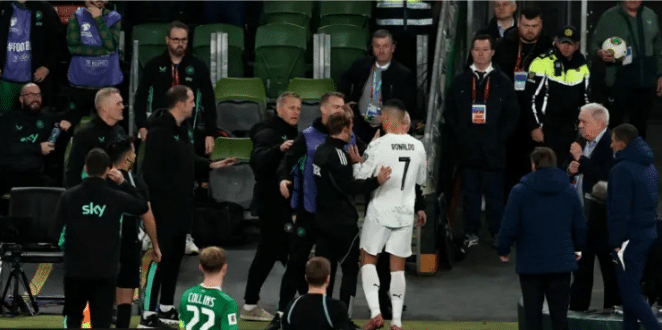
Martinez highlighted that Ronaldo had been held, pulled, and blocked for nearly an hour inside the penalty area, and when he attempted to create space, the contact was misinterpreted as violent conduct.
The red card leaves Ronaldo facing potential suspension for multiple matches, which could impact Portugal’s World Cup campaign, particularly if they qualify automatically for the North American tournament.
Under FIFA regulations, violent conduct carries a minimum three-match ban, meaning Ronaldo could miss group stage matches or crucial playoff fixtures, depending on Portugal’s qualifying route.
If the suspension is enforced during automatic qualification, Portugal may start their campaign without their most influential player, raising concerns about squad depth and tactical adjustments for upcoming opponents.
Even if Portugal enters the playoffs, Ronaldo would still serve part of the suspension during those games, potentially affecting team morale and diminishing the forward’s ability to contribute during key fixtures.
The incident has triggered widespread debate among football analysts, fans, and former players, questioning whether referees should interpret such challenges as aggressive or simply part of the natural physicality of the sport.
Ronaldo’s history as a disciplined, record-breaking professional adds complexity to the situation, as many argue his career reputation should influence the evaluation of isolated incidents like this red card.
Critics contend that age and accumulated physical exertion may make top players more prone to frustration in high-pressure qualifiers, while others insist standards of conduct should remain consistent regardless of status.
Portugal’s squad faces scrutiny for their inability to protect their captain from repeated fouls, with commentators noting that defensive cohesion and midfield support are crucial to mitigate unnecessary confrontations in the penalty area.
The match itself was a tactical battle, with Ireland’s defenders employing high-pressure marking, which contributed to Ronaldo’s visible agitation and the eventual clash resulting in the red card.
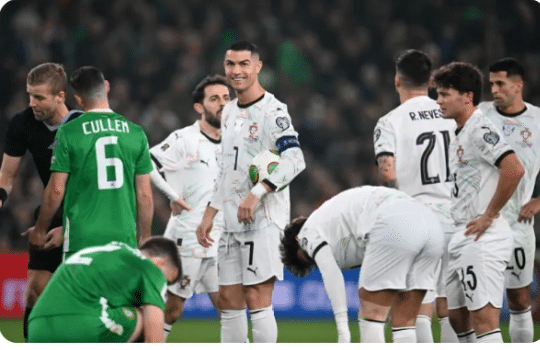
Fans of both teams have flooded social media with opinions, highlighting how the Ronaldo red card has become a symbol of modern football’s delicate balance between competitiveness and discipline.
The controversy also raises questions about video assistant referee (VAR) influence, as on-field decisions can be overruled by technology, sometimes creating greater confusion rather than clarity for players and coaches.
Some experts argue that VAR reviews tend to emphasize minor contact and exaggerate perceived aggression, which may unfairly penalize elite athletes known for high-intensity movements in confined spaces.
Ronaldo’s emotional response, including sarcastic applause and verbal exchanges with staff, underscores the psychological component of elite football, where tension, expectations, and personal legacy intersect on the pitch.
Portugal now faces the challenge of regrouping for their final qualifier against Armenia, adjusting strategies to compensate for the temporary absence of their captain due to the red card suspension.
Beyond tactical considerations, the red card highlights leadership dynamics, as Portugal must rely on senior players to guide younger squad members in high-stakes matches without Ronaldo’s direct presence.
Analysts predict that Portugal’s approach may become more conservative, emphasizing defensive solidity and counterattacks to mitigate the loss of offensive firepower created by the absence of their star forward.
Historical parallels in football demonstrate that teams can adapt to suspensions, but the psychological impact of losing a world-class player like Ronaldo may affect confidence and composure during decisive moments.
Coaches must weigh the risks of encouraging aggressive pressing in the penalty area against the potential for additional disciplinary issues that could exacerbate the fallout from the red card incident.
For Ronaldo, the red card may serve as a moment of reflection on emotional regulation, particularly when high-stakes matches intensify both external pressure from fans and internal expectations for performance.
Portugal’s journey to the World Cup remains uncertain, and how the squad responds to this setback could influence their tournament trajectory, as the red card introduces a narrative of resilience or vulnerability.
Fans, meanwhile, continue to debate the fairness of the decision, with opinions split between viewing Ronaldo as a victim of harsh refereeing or as a player momentarily succumbing to frustration under competitive stress.
The incident also adds to Ronaldo’s complex legacy, merging his extraordinary achievements with occasional controversies, reminding observers that even elite athletes are not immune to public scrutiny in critical matches.
As football continues to evolve, disciplinary rules, VAR interventions, and the psychological resilience of players like Ronaldo will remain central to discussions about fairness, consistency, and the spirit of competition.
Ultimately, the red card incident serves as a case study for managers, referees, and analysts, illustrating how singular moments can shape both immediate results and longer-term tournament planning.
Portugal’s coaching staff must now navigate the practical challenges of integrating replacements, maintaining tactical coherence, and preserving morale in the absence of a transformative figure like Ronaldo.
Moreover, the psychological impact on the squad could be profound, as players adjust to a different leadership dynamic and attempt to uphold team performance under the weight of external expectations.
The red card may also affect Ronaldo personally, influencing his preparation, mindset, and interaction with teammates during subsequent matches, potentially serving as a catalyst for disciplined focus or public frustration.
International football rarely presents such dramatic scenarios where a single player’s suspension alters strategic calculations, fan sentiment, and media narratives simultaneously, demonstrating the layered nature of elite competition.
This incident will likely be referenced in future analyses of Ronaldo’s career, illustrating how a single disciplinary moment can intersect with legacy, leadership perception, and the broader competitive environment.
In the context of Portugal’s campaign, the team faces a critical test of resilience, tactical intelligence, and emotional stability, where lessons from the red card could either motivate or destabilize their efforts.
Discussions about referee decisions, VAR interpretation, and elite player conduct will continue, with Ronaldo’s red card serving as a focal point for debates about fairness, discipline, and the psychology of high-pressure football.
The match against the Republic of Ireland has already become a defining memory for both nations, with the red card incident occupying a central narrative in sports commentary, fan conversation, and analytical reports.
As Portugal prepares for upcoming fixtures, the ripple effects of Ronaldo’s absence will be assessed through performance metrics, substitution strategies, and leadership adjustments implemented by coaching staff.
Fans, pundits, and players alike recognize the red card as more than a disciplinary action; it is a symbolic moment reflecting the intersection of talent, emotion, and high-stakes competition in international football.

Portugal’s response in the following matches will likely determine whether the red card becomes a minor setback or a pivotal turning point in their World Cup qualification journey, emphasizing resilience and tactical acumen.
Finally, Ronaldo’s red card highlights the enduring tension between individual brilliance and collective responsibility, illustrating how even the most celebrated athletes must navigate the delicate balance of conduct, emotion, and competitive excellence.
About The Author