


The Rivers impeachment crisis escalates as the State Assembly confirms service of impeachment notices on Governor Siminalayi Fubara and his deputy.
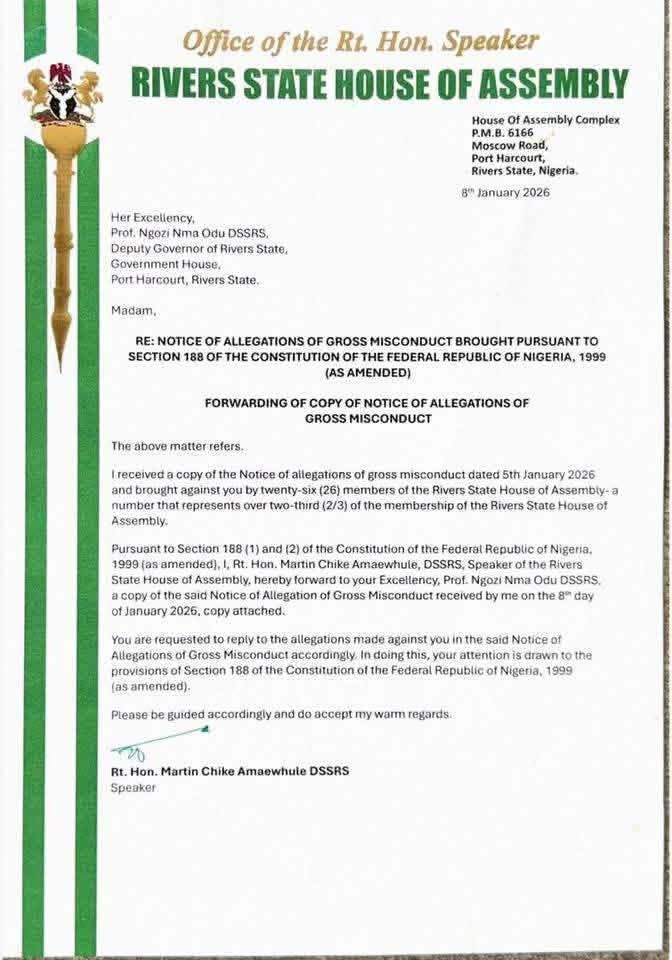
The political atmosphere in Rivers State has become increasingly tense following confirmation by the State House of Assembly that impeachment notices have been formally served on Governor Siminalayi Fubara and his deputy, Professor Ngozi Odu.

The confirmation came after the House of Assembly, during an emergency plenary session held on Thursday, initiated impeachment proceedings against the governor and his deputy.
The action was reportedly supported by 26 lawmakers, who accused the governor of a series of misconducts they claimed were capable of undermining democratic principles and effective governance in Rivers State.
According to details made public by the Assembly, the impeachment notice addressed to Governor Fubara was signed by at least 19 legislators, meeting the constitutional threshold required to activate the impeachment process.
The notice reportedly outlined eight separate allegations of gross misconduct against the governor and his administration, though the specific details of the allegations were not immediately disclosed to the public.
The Assembly confirmed the service of the notice through a statement posted on its official Facebook page
The post read, in part, that the impeachment notice had been “successfully served on the Governor of Rivers State, Siminalayi Fubara,” signalling that the process had moved beyond legislative debate into formal constitutional procedure.
This confirmation has further intensified the Rivers impeachment crisis, drawing widespread political and public attention.
More insight into the Assembly’s position was provided in a statement issued by Martins Wachukwu, Special Assistant on Media to the Speaker of the Rivers State House of Assembly.
The statement announced that the House had officially issued notices of allegations of gross misconduct against both Governor Fubara and his deputy, in strict compliance with Section 188 of the 1999 Constitution of the Federal Republic of Nigeria, as amended.
According to the statement, the Speaker of the House, Rt. Hon. Martin Chike Amaewhule, made the disclosure during the 59th legislative sitting of the Assembly.
He reportedly pledged to transmit the notices of allegations, which were endorsed by 26 lawmakers, to the governor and his deputy without delay, in line with constitutional provisions governing impeachment proceedings.
The statement further revealed that the notices contained eight grounds of alleged gross misconduct each against the governor and the deputy governor, accompanied by detailed particulars.
These allegations were formally read on the floor of the House to ensure transparency and legislative record.
The Majority Leader, Hon. Major Jack, presented the allegations against Governor Fubara, while the Deputy Majority Leader, Hon. Linda Somiari-Stewart, read those relating to the deputy governor.
Upon receiving the notices, Speaker Amaewhule reportedly assured lawmakers and the public that the Assembly would adhere strictly to due process throughout the impeachment proceedings.
He emphasized that the House would act within the limits of the Constitution, regardless of political pressure or public sentiment surrounding the Rivers impeachment crisis.
In a related development, the House of Assembly resolved to suspend consideration of the Medium-Term Expenditure Framework (MTEF) and the 2026 Appropriation Bill.
This resolution followed a motion moved by Rt. Hon. Dumle Maol and seconded by the Minority Leader, Hon. Sylvanus Nwankwo.
Lawmakers agreed that deliberations on key fiscal documents should be put on hold until investigations into the allegations against the governor and his deputy are thoroughly concluded.
The Assembly justified its decision by arguing that proceeding with major budgetary approvals amid unresolved allegations could undermine accountability and public confidence.
The suspension of fiscal deliberations has added an economic dimension to the Rivers crisis, raising concerns among policy analysts about potential disruptions to governance and development planning.
Lawmakers also used the opportunity to criticise Governor Fubara’s alleged refusal to comply with agreements reached during peace meetings reportedly brokered by President Bola Tinubu at various times.
The Assembly described the governor’s posture as recalcitrant, alleging that he failed to honour commitments aimed at restoring harmony between the executive and legislative arms of government in the state.
While commenting on the motion, Speaker Amaewhule reportedly made strong remarks about the governor’s conduct, questioning his reliability and accusing him of lacking respect for the office of the President of the Federal Republic of Nigeria.
The Speaker argued that recent events had exposed deep-seated governance issues.
As the process unfolds, political stakeholders within and outside Rivers State are closely monitoring developments.
Analysts note that the coming weeks will be critical in determining whether the impeachment process proceeds to its final stages or gives way to renewed dialogue and reconciliation.
For now, the impeachment crisis remains a defining issue in the state’s political landscape, with significant consequences for governance, stability, and democratic institutions.


About The Author


