

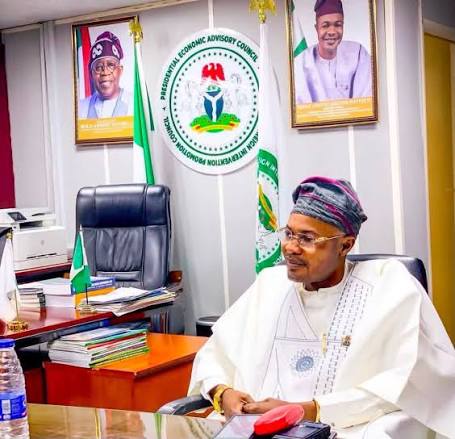
PFIPC DG Adeniyi Matthew says the council was created to attract foreign investment, questions its denial by the Presidency, and vows to submit evidence..
The Director-General of the Presidential Foreign Intervention Promotion Council (PFIPC), Adeniyi Adeyemi Matthew, has publicly defended the establishment of the controversial council, maintaining that its creation was driven by a desire to attract foreign investment into Nigeria and contribute to the country’s economic development rather than for personal enrichment.
Matthew made the remarks during a video conversation with social commentator Martins Vincent Otse, widely known as VeryDarkMan, where he responded to several allegations surrounding the council and addressed questions about the ongoing legal case against him.
The controversy surrounding the PFIPC has continued to generate public debate after questions were raised about the agency’s legal status, its appearance in the national budget, and the circumstances surrounding Matthew’s appointment as its Director-General.
Speaking during the interview, Matthew dismissed suggestions that he established the council for financial gain or political influence.
Instead, he described himself as someone motivated by patriotism and a genuine desire to contribute to national development.
According to him, the vision behind the council was to create a platform capable of attracting international investors and promoting Nigeria as one of Africa’s most attractive destinations for business opportunities.
He said the initiative was designed to complement the Federal Government’s efforts to improve the country’s investment climate and strengthen economic growth.
Matthew explained that he had been willing to make personal sacrifices because he believed the project would benefit Nigeria in the long run.
He also reacted to reports that approximately ₦400 million was spent in connection with securing office space for the agency.
While addressing the issue, he insisted that every step he took was motivated by his passion for national service and not by any expectation of personal reward.
According to him, his dream was to build an institution that would encourage foreign businesses, development partners, and international investors to consider Nigeria as a preferred destination for investment.
He noted that before the controversy erupted, preparations were already underway for what he described as a major global investment summit.
The planned event, he said, was expected to bring investors from different parts of the world to Nigeria and create opportunities for partnerships across several sectors of the economy.
Matthew further claimed that the council had already begun working with several ministries, departments, and agencies of government.
He said the collaboration also extended to anti-corruption institutions and other regulatory bodies as part of efforts to improve transparency and boost investor confidence.
A significant part of his comments focused on the Presidency’s position that the PFIPC does not officially exist.
Matthew questioned that claim, arguing that it raised important questions about how the council eventually appeared in Nigeria’s national budget.
He insisted that he neither prepared nor defended any budget proposal on behalf of the council before lawmakers.
According to him, he was already in detention during the period when the budget was reportedly considered by the National Assembly.
Matthew revealed that he spent 23 days in custody between October and November 2025, making it impossible for him to participate in any budget-related activities.
He questioned how an agency that is now being described as non-existent could have received a budget allocation without anyone appearing before the legislature to defend its financial proposal.
Matthew also recalled that he was invited for questioning by the then Inspector-General of Police, Kayode Egbetokun, over the circumstances surrounding his appointment.
He said investigators demanded explanations regarding how he became Director-General of the council and the process through which he received his appointment letter.
According to Matthew, he provided authorities with the identity and contact details of the individual who facilitated his appointment through the Office of the Chief of Staff to the President.
He alleged that shortly after providing the information, he was detained as investigations continued.
The embattled official further disclosed that after regaining his freedom on November 19, 2025, he was immediately arraigned before a court.
He added that by the time he was released from detention, the office originally assigned to the council had already been allocated to another government official.
As a result, he said he has not returned to the office since late October 2025.
Responding to questions concerning a petition reportedly filed against him by the President’s Chief of Staff, Femi Gbajabiamila, Matthew denied having any formal meeting with the senior government official regarding the council.
However, he acknowledged that he once spoke with Gbajabiamila over the telephone through a mutual associate, the late Dolapo Tanimola.
Matthew maintained that he possesses documents which, according to him, establish the legitimacy of the council and explain the process that led to its formation.
He pledged to hand over every document in his possession to security agencies, including the Nigeria Police Force and the Department of State Services (DSS), to support ongoing investigations into the matter.
He also made an emotional revelation concerning Tanimola, describing him as the individual who financed the payment connected with the establishment of the council.
According to Matthew, Tanimola has since died following a fire incident at a hotel in Utako, Abuja, a development he described as both painful and unfortunate.
The controversy surrounding the PFIPC remains unresolved, with investigations and legal proceedings expected to determine the authenticity of the council, the legality of its operations, and the circumstances under which it was included in the national budget.
Matthew, however, insists that he acted in good faith and remains prepared to cooperate fully with investigators in the hope that the facts surrounding the agency will eventually become public.
Related news
Gbajabiamila gives PFIPC DG 72 hours to retract allegations, threatens N10bn defamation suit

PFIPC controversy: Arewa Think Tank urges Tinubu to ignore allegations against Gbajabiamila

PFIPC scandal: Atiku gives Tinubu seven days to order probe
About The Author
