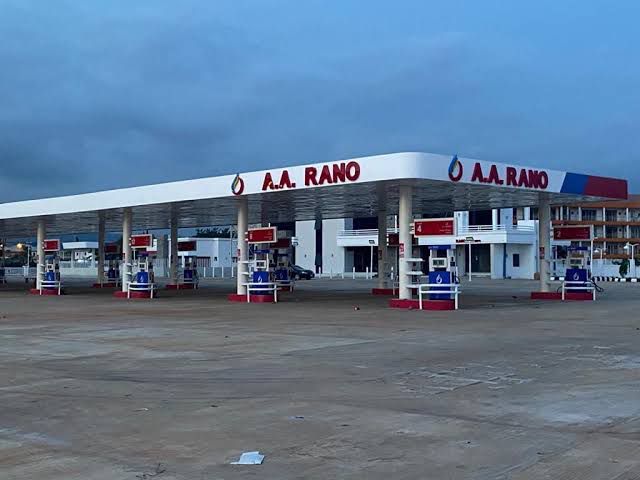
Petrol station workers across Nigeria have raised strong objections to plans by indigenous oil marketing firm, AA Rano, to introduce what it described as the country’s first fully automated and unmanned fuel stations, warning that the initiative could deepen unemployment and worsen the nation’s already fragile security situation.
The opposition is coming from members of the Concerned Petrol Station Workers, a group representing fuel attendants and ancillary staff in the downstream petroleum sector, who argue that the move prioritises efficiency over human livelihoods at a time when millions of Nigerians are struggling to survive.
AA Rano had recently announced that it would begin rolling out the automated stations in January 2026, stating that the new outlets would operate on a 24-hour self-service fuelling model powered by digital payment platforms, automated dispensing systems, and real-time surveillance technology.
According to the company, the initiative is aimed at improving service delivery, reducing operational costs, and aligning Nigeria’s retail fuel sector with global best practices.
However, labour groups insist that the plan raises serious social and economic concerns that must not be ignored.
Concerns Over Job Losses Linked to Unmanned Fuel Stations
Reacting to the announcement, the convener of the Concerned Petrol Station Workers and labour rights advocate, Comrade Ibrahim Zango, described the plan to introduce unmanned fuel stations as ill-timed and potentially destabilising.
In a statement issued in Kaduna, Zango warned that thousands of petrol station attendants—many of whom are young Nigerians with limited alternative employment opportunities—could lose their primary source of income if the initiative is implemented without a comprehensive transition framework.
“At a time when Nigeria is battling rising unemployment, high inflation, and increasing insecurity, deploying job-eliminating technology without safeguards is a dangerous gamble,” Zango said.
He noted that petrol station jobs remain one of the few readily available sources of employment for young people without advanced educational qualifications, adding that sudden displacement could push more Nigerians into poverty and social vulnerability.
According to him, AA Rano operates a vast network of fuel stations across multiple states, each employing several attendants per shift.
The cumulative effect of replacing human labour with automation, he argued, would be devastating for families that depend entirely on daily earnings from pump operations.
Long-Serving Workers Fear an Uncertain Future
Zango further stressed that many fuel attendants have spent decades working in the sector, gradually building experience and loyalty to their employers, only to now face the prospect of being rendered redundant by technology.
“For some of us, this is not just a job; it is a lifetime of work,” he said.
“To be sent out without a clear plan for retraining, redeployment, or compensation will only multiply the crisis Nigeria is facing.”
He acknowledged that technological advancement is inevitable and that automation is transforming industries globally.
However, he insisted that innovation must be implemented responsibly, especially in a developing economy like Nigeria where social safety nets remain weak.
Balancing Innovation and Social Responsibility
The workers’ group emphasised that automation in the downstream petroleum sector should be structured to create new roles, rather than simply eliminate existing ones.
They called for a model where technology complements human labour through retraining programmes, digital operations roles, maintenance jobs, and supervisory positions.
Zango also urged AA Rano’s management to reflect on its own corporate journey, noting that many successful business leaders began their careers at entry-level positions similar to those currently occupied by petrol attendants.
“They should remember where they started from,” he said.
“Workers should not be sacrificed in the name of progress.”
Call for Government and Regulatory Intervention
Beyond the company itself, the Concerned Petrol Station Workers appealed to the Federal Government and relevant regulatory agencies to urgently develop policies that address the labour implications of automation in Nigeria’s energy sector.
They argued that while unmanned fuel stations may improve efficiency, the absence of clear labour-protection policies could lead to widespread job losses, increased social unrest, and higher crime rates.
The group called for stakeholder consultations involving oil marketers, labour unions, regulators, and security agencies before the nationwide deployment of automated stations is approved.
According to the workers, countries that have successfully adopted automated fuel retail systems did so alongside strong labour protections, retraining initiatives, and phased implementation strategies—conditions they say are currently lacking in Nigeria.
A Growing Debate in Nigeria’s Energy Sector
The controversy surrounding AA Rano’s plan highlights a broader national debate over the impact of automation on employment in Nigeria.
As companies increasingly turn to technology to cut costs and boost efficiency, labour groups fear that human welfare is being sidelined.
Analysts note that while automation can enhance transparency and reduce operational risks such as theft and fraud, its introduction in labour-intensive sectors must be carefully managed to avoid unintended consequences.
For now, petrol station workers are calling for dialogue rather than confrontation, urging AA Rano to suspend the rollout of unmanned fuel stations until all stakeholders are adequately consulted.
As Nigeria continues to modernise its energy infrastructure, the challenge remains how to balance innovation with inclusivity—ensuring that progress does not come at the expense of livelihoods.
About The Author