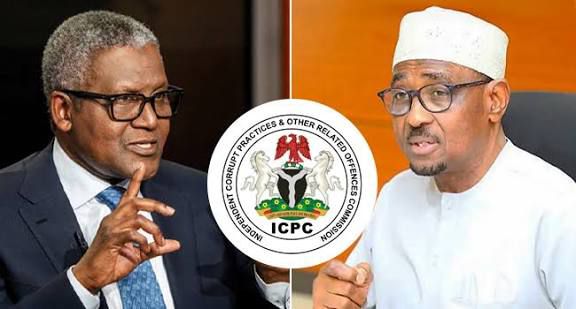
The Independent Corrupt Practices and Other Related Offences Commission (ICPC) has reaffirmed its commitment to fully investigate allegations of corruption involving the immediate past Chief Executive Officer of the Nigerian Midstream and Downstream Petroleum Regulatory Authority (NMDPRA), Engineer Farouk Ahmed, despite the withdrawal of the original petition by billionaire industrialist Aliko Dangote.
The anti-graft agency’s position underscores a growing institutional resolve to treat corruption allegations involving public office holders as matters of national interest, rather than private disputes that can be abandoned at the discretion of petitioners.
Aliko Dangote, Africa’s richest man and President of the Dangote Group, had earlier submitted a petition to the ICPC accusing Ahmed of financial impropriety and abuse of office.
However, in a surprising turn, the business mogul’s legal representatives formally notified the Commission on January 5, 2026, that the petition had been withdrawn in its entirety.
Despite this move, the ICPC has made it clear that the withdrawal does not invalidate or halt an investigation that has already commenced.
ICPC Probe of Dangote Petition Against Ex-NMDPRA Chief Continues
In a press statement issued on Wednesday, the ICPC confirmed receipt of the withdrawal letter from Dangote’s lawyers, O.J. Onoja, SAN & Associates, but stressed that the investigation remains active and ongoing.
According to the Commission, once allegations of corruption are formally submitted and preliminary findings establish sufficient grounds, such matters transcend individual interests and fall squarely within the Commission’s statutory responsibility.
“The ICPC wishes to state categorically that investigations in this matter have already commenced and will continue in line with Sections 3(14) and 27(3) of the ICPC Act,” the statement read.
The agency emphasized that alleged abuse of office, diversion of public funds, or unexplained wealth involving senior public officials cannot be discontinued merely because a petitioner chooses to step back, especially where public confidence in governance institutions is at stake.
Legal analysts say the ICPC’s stance reflects a broader shift in Nigeria’s anti-corruption framework, where whistleblowers initiate scrutiny, but institutions ultimately carry the burden of accountability.
Withdrawal Letter and ICPC’s Legal Position
Dangote’s legal team explained that the decision to withdraw the petition was informed by the involvement of another law enforcement agency, which they claimed had taken over the investigation of the allegations.
However, the ICPC rejected the implication that such a development diminishes its jurisdiction.
The Commission maintained that it is empowered by law to pursue investigations concurrently or independently where corruption allegations fall within its mandate.
Anti-corruption advocates note that allowing petitioners to halt investigations midstream could set a dangerous precedent, enabling powerful interests to manipulate accountability mechanisms.
Allegations That Triggered National Attention
The controversy gained national prominence after Dangote publicly accused Ahmed of corruption during a media briefing on challenges facing Nigeria’s downstream oil and gas sector in December 2025.
Central to the allegations was a claim that the former NMDPRA chief spent an estimated $5 million on the education of his four children in Switzerland—an amount Dangote argued was inconsistent with Ahmed’s known legitimate earnings as a public servant.
The claims sparked outrage across the country, with many Nigerians questioning how senior regulators could allegedly afford lavish lifestyles while millions struggle under inflation, fuel price hikes, and declining purchasing power.
Civil society groups and labour unions demanded transparency, while social media debates intensified calls for lifestyle audits of top government officials.
Resignation and Presidential Action
Following the public fallout and the submission of the petition, Engineer Farouk Ahmed resigned from his position as head of the NMDPRA.
President Bola Ahmed Tinubu subsequently appointed a replacement to lead the petroleum sector regulator.
While the resignation was widely viewed as an attempt to ease public tension, analysts argue that stepping down from office does not absolve a former official from scrutiny over actions taken while in public service.
In late December 2025, the ICPC invited Dangote to appear before a special investigative panel in Abuja to provide further clarification and supporting evidence regarding the allegations.
Broader Implications for Nigeria’s Petroleum Sector
The ICPC probe of Dangote petition against ex-NMDPRA chief comes at a sensitive time for Nigeria’s oil and gas industry, which is undergoing reforms aimed at transparency, deregulation, and investor confidence.
Experts say the outcome of the investigation could shape public perception of regulatory integrity in the sector and influence future investments, particularly as Nigeria seeks to reposition itself amid global energy transitions.
Transparency advocates insist that regulators must be held to the highest ethical standards, given their influence over licensing, pricing frameworks, and policy enforcement in a sector critical to national revenue.
ICPC Signals Zero Tolerance for Abuse of Office
By refusing to discontinue the investigation, the ICPC has sent a strong signal that corruption allegations involving senior public officials will be pursued to logical conclusions, regardless of political or economic influence.
The Commission reiterated that its actions are guided by public interest, accountability, and the rule of law, not the preferences of individuals or corporations.
As the investigation progresses, Nigerians are watching closely to see whether the probe will lead to prosecutions, exoneration, or broader institutional reforms within the petroleum regulatory space.
For many observers, the case represents a litmus test for Nigeria’s anti-corruption drive—one that could either reinforce trust in public institutions or deepen public skepticism if left unresolved.
About The Author