

Petroleum marketers sourcing Premium Motor Spirit (PMS) from the Dangote Refinery have been directed to pay an additional N100 per litre to lift petrol, triggering fresh volatility in Nigeria’s deregulated downstream oil market and pushing pump prices sharply higher in major cities.
The development follows the refinery’s decision to withdraw a temporary festive price support and realign its ex-depot price to what it described as a more sustainable level, barely weeks after marketers had processed payments and secured loading authorisations at the earlier rate.
Industry sources confirmed that marketers who had completed payments and documentation at N699 per litre are now required to top up to N799 per litre before their trucks can be loaded, after the refinery invalidated previously issued Authority to Collect (ATC) documents.
The sudden change has left dozens of fuel trucks stranded at the refinery’s gantry, heightening tension across the supply chain and exposing the growing sensitivity of pump prices to policy shifts at Nigeria’s largest refinery.
Pay extra N100 per litre for petrol from Dangote Refinery
Checks by correspondents revealed that loading operations were halted at midnight as the refinery moved to reconcile outstanding volumes, payments, and pricing differentials.
All active PMS deal recaps were subsequently nullified, forcing marketers to either pay the additional N100 per litre or accept revised, lower volumes based on the new pricing structure.
In a notice circulated to customers, the Dangote Refinery explained that the earlier ex-depot price was a deliberate but temporary intervention introduced during the festive season to cushion consumers amid elevated household spending.
“With the festive period concluded, PMS prices have been modestly realigned to sustainable levels,” the refinery said, confirming that its official gantry price now stands at N799 per litre.
The refinery further clarified that all unutilised loading approvals had been cancelled and that marketers would be required to reprogramme new ATCs to lift any outstanding balances.
Operational constraints behind pricing pressure
Industry analysts say the latest price adjustment reflects not just the withdrawal of festive support but also ongoing operational challenges at the 650,000-barrel-per-day facility.
According to industry reports, persistent technical issues affecting the refinery’s Residual Fluid Catalytic Cracking (RFCC) unit have constrained full-capacity operations, limiting the volume of PMS available for domestic distribution.
Sources indicate that these challenges may extend into the first half of 2026 if not fully resolved.
While the refinery has steadily ramped up output since commencing operations, capacity limitations have complicated its ability to meet rising demand while keeping prices stable, particularly in a deregulated market exposed to global crude prices, logistics costs, and financing pressures.
Analysts note that as Dangote Refinery increasingly displaces imported petrol, any pricing or operational adjustment at the facility now has immediate market-wide consequences, given its dominant role in domestic supply.
Pump prices surge across Abuja
The impact of the additional N100 per litre at the gantry was swiftly transmitted to the retail market, with petrol pump prices in Abuja climbing to as high as N910 per litre within hours of the refinery’s announcement.
Market surveys showed that Optima Energy outlets around the EFCC Junction and near Dunamis Church raised prices from N815 to N910 per litre, an increase of N95, representing nearly 12 per cent.
Similarly, an AP filling station at Airport Junction adjusted its pump price to about N899 per litre, up from N815, while several other outlets implemented increases ranging between N35 and N85 per litre, depending on existing stock levels and supply costs.
Conoil stations along Airport Road were observed selling at around N800 per litre, while Matrix outlets raised prices to N850 per litre. Shafa stations in some locations maintained prices around N815, reflecting earlier inventory acquired at lower costs.
The rapid price adjustments underscore how downstream deregulation has shortened the transmission lag between depot-level changes and pump prices, particularly in urban centres heavily dependent on Dangote-supplied fuel.
Refinery’s growing influence on downstream pricing
Dangote Petroleum Refinery, Africa’s largest single-train refinery, has emerged as a central price-setter in Nigeria’s downstream petroleum market.
By significantly reducing reliance on imported fuel, the facility has reshaped supply dynamics, but it has also amplified the market impact of pricing decisions taken at a single source.
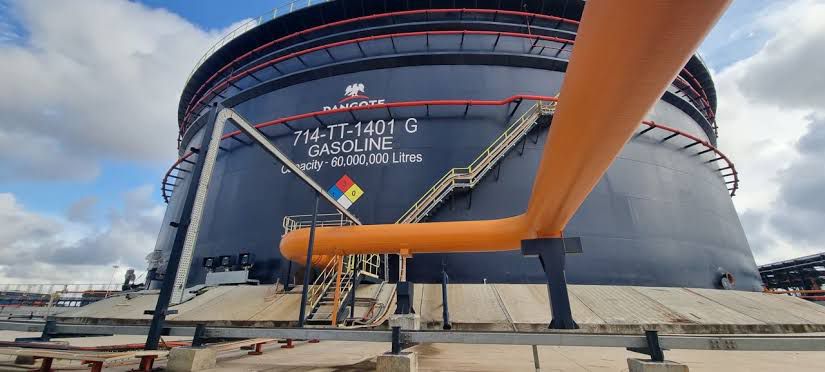
Energy economists argue that while local refining reduces exposure to foreign exchange volatility and shipping costs, it also concentrates pricing influence, especially when alternative domestic refineries remain largely inactive.
“The refinery has changed the structure of the market,” said an industry analyst. “But until there is sufficient competition from other domestic refiners, any adjustment at Dangote’s gantry will continue to ripple quickly through the entire retail network.”
Marketers face tighter margins
For petroleum marketers, the additional N100 per litre represents a significant cost shock, particularly for those who had already priced deliveries and entered supply agreements based on the earlier N699 per litre rate.
Many marketers now face compressed margins or outright losses on outstanding contracts, especially where retail prices cannot be immediately adjusted due to competitive pressures or regulatory scrutiny.
Some operators warned that repeated mid-stream price changes could weaken confidence and complicate planning in the downstream sector.
“Uncertainty makes it difficult to hedge or plan inventory,” a depot operator said. “If prices change after payments have been made, the risks are pushed entirely onto marketers.”
Implications for consumers and inflation
The latest increase comes amid broader concerns about the cost of living, as fuel prices directly influence transportation costs, food prices, and general inflation.
Economists warn that sustained increases in PMS prices could further strain household budgets and complicate monetary policy efforts to tame inflation.
While the Dangote Refinery maintains that its pricing reflects market realities rather than arbitrary adjustments, consumer groups have called for greater transparency and predictability in depot pricing to help stabilise the retail market.
As Nigeria navigates a fully deregulated fuel regime, stakeholders agree that pricing stability will depend not only on refining capacity but also on operational efficiency, competition, and clear communication across the supply chain.
About The Author


