


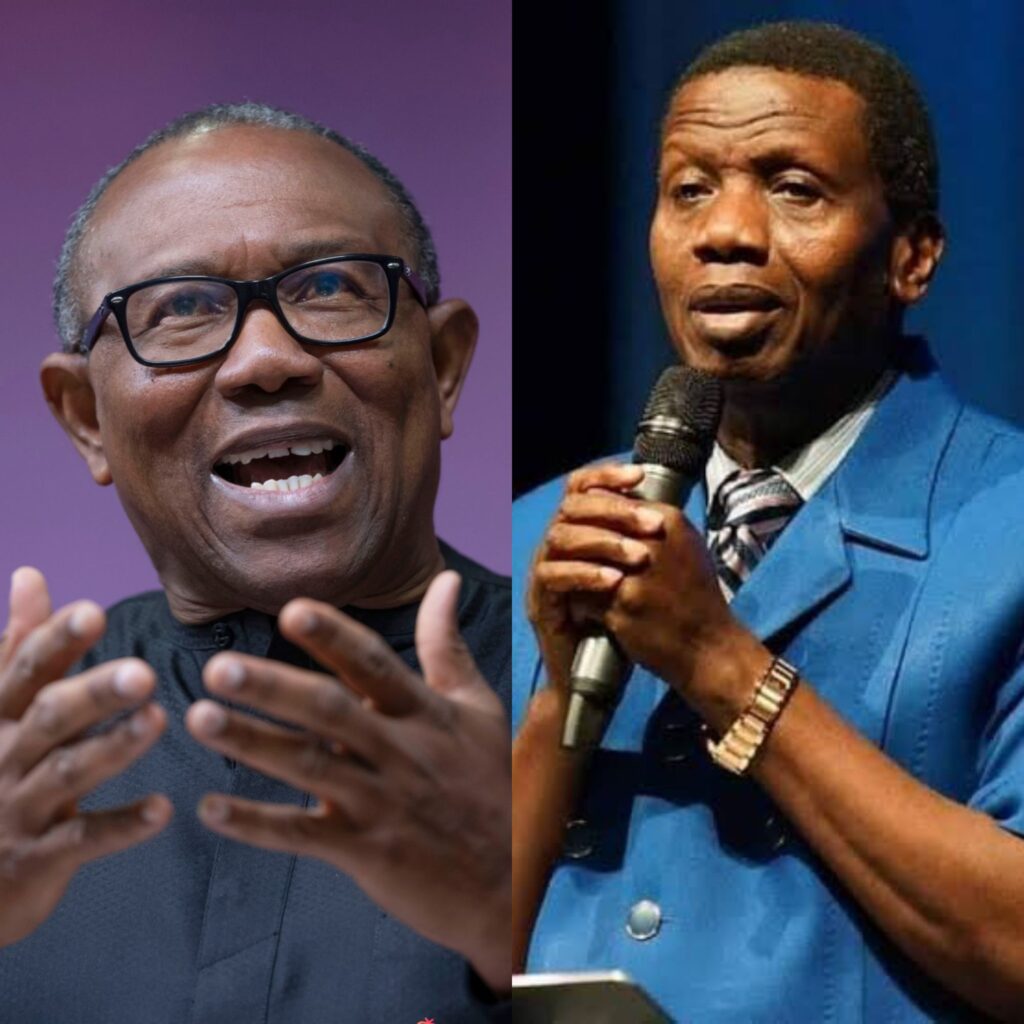
Peter Obi has defended Pastor Adeboye against criticism over insecurity, urging Nigerian youths to lead reforms, reject division, and promote unity.
The National Democratic Congress Presidential (NDC) candidate, Peter Obi has called on Nigerian youths to take greater responsibility for the future of the country by leading efforts toward positive change, national unity, and democratic accountability.
Peter Obi made the appeal while reacting to the recent criticism directed at the General Overseer of the Redeemed Christian Church of God (RCCG), Pastor Enoch Adeboye, over the growing concerns about insecurity in Nigeria.
According to Obi, young Nigerians should avoid turning respected religious leaders into political actors whenever national challenges arise.
The debate began after some social media users questioned why Pastor Adeboye had not publicly led protests or strongly criticized the Federal Government over the country’s security situation.
Some individuals circulated a photograph online, claiming it showed the cleric participating in a protest against a previous administration. The image quickly gained attention and fueled calls for him to take a similar stance today.
However, the RCCG clarified that the photograph was not connected to any political protest.
Church officials explained that the image was taken during a peaceful prayer walk organized under a previous administration and should not be interpreted as evidence of political activism.
Reacting to the controversy, Peter Obi described Pastor Adeboye as one of Nigeria’s most respected religious leaders whose messages over the decades have consistently focused on peace, love, reconciliation, and national unity.
He noted that the cleric has maintained a reputation for humility and restraint despite facing criticism on various occasions.
According to Peter Obi, expecting an 84-year-old religious leader to spearhead political campaigns or public protests places an unfair burden on someone who has dedicated his life to spiritual leadership.
He argued that the responsibility for demanding better governance and accountability should primarily rest with citizens, especially the younger generation.
The former Anambra State governor emphasized that Nigerian youths possess the energy, creativity, and influence required to drive meaningful reforms across the country.
Rather than waiting for religious figures or elders to lead every national conversation, he encouraged young people to become active participants in shaping Nigeria’s future.
Peter Obi also warned against the growing trend of ethnic and religious polarization in public discourse. He stated that attempts to divide Nigerians along tribal or religious lines only weaken the collective effort needed to address pressing national issues such as insecurity, unemployment, and economic hardship.
He further encouraged citizens to verify information before sharing it online. In an era where misinformation spreads rapidly across social media platforms, Obi stressed the importance of critical thinking and fact-checking.
He said that false narratives often create unnecessary tension and distract attention from genuine solutions.
He wrote:
Dear Young Nigerians,
One lesson from the 2023 elections, particularly in Lagos, should never be forgotten.
In the period following the presidential election and leading up to the governorship election, we witnessed a troubling shift in public discourse. Conversations that should have focused on competence, governance, development, and the future of our nation were gradually diverted towards tribal sentiments, ethnic divisions, and unnecessary suspicion among citizens.
Many sincere and well-meaning Nigerians participated in these conversations without realising that they were being drawn into narratives carefully designed by others.
Throughout history, whenever politicians find it difficult to compete on ideas, performance, character, or vision, some resort to exploiting the fault lines of ethnicity, religion, and identity. Their calculation is simple: a divided people are easier to manipulate than a united people.
Today, I see similar efforts emerging again, sometimes in more subtle and sophisticated ways. Narratives are planted, amplified, and circulated, often by individuals who genuinely believe they are defending a worthy cause, without recognizing the broader agenda behind such campaigns.
Let me state clearly that Pastor Enoch Adeboye remains one of the foremost fathers of faith in our nation. For decades, he has consistently preached the virtues of peace, prayer, love, reconciliation, and national unity. Even when faced with provocation, his response has always reflected humility, restraint, wisdom, and grace.
At 84 years of age, it would be unfair for young and able-bodied Nigerians to transfer to him responsibilities that properly belong to them. The task of building a better Nigeria rests primarily on the shoulders of the younger generation. It is their duty to lead the conversations, champion the reforms, and drive the positive change our nation urgently requires.
We must be careful not to become instruments in the hands of those who secretly nurture division while publicly preaching unity. In most cases, their target is not the individual being attacked; instead, it is the person who is attacking. Their real objective is to weaken the bonds that hold us together as one people and one nation.
I therefore urge all young Nigerians: do not allow anyone to recruit you into hatred. Do not allow anyone to weaponise your ethnicity, your faith, or your admiration for respected leaders.
Question every narrative. Verify every claim. Follow the facts. Resist manipulation.
The Nigeria of our dreams can only be built by citizens who refuse to be divided, who choose unity over hatred, and who place our collective future above narrow interests.
A New Nigeria is POssible. -PO
RELATED NEWS:
About The Author

Good a blog toper
Great post,Thanks for sharing