

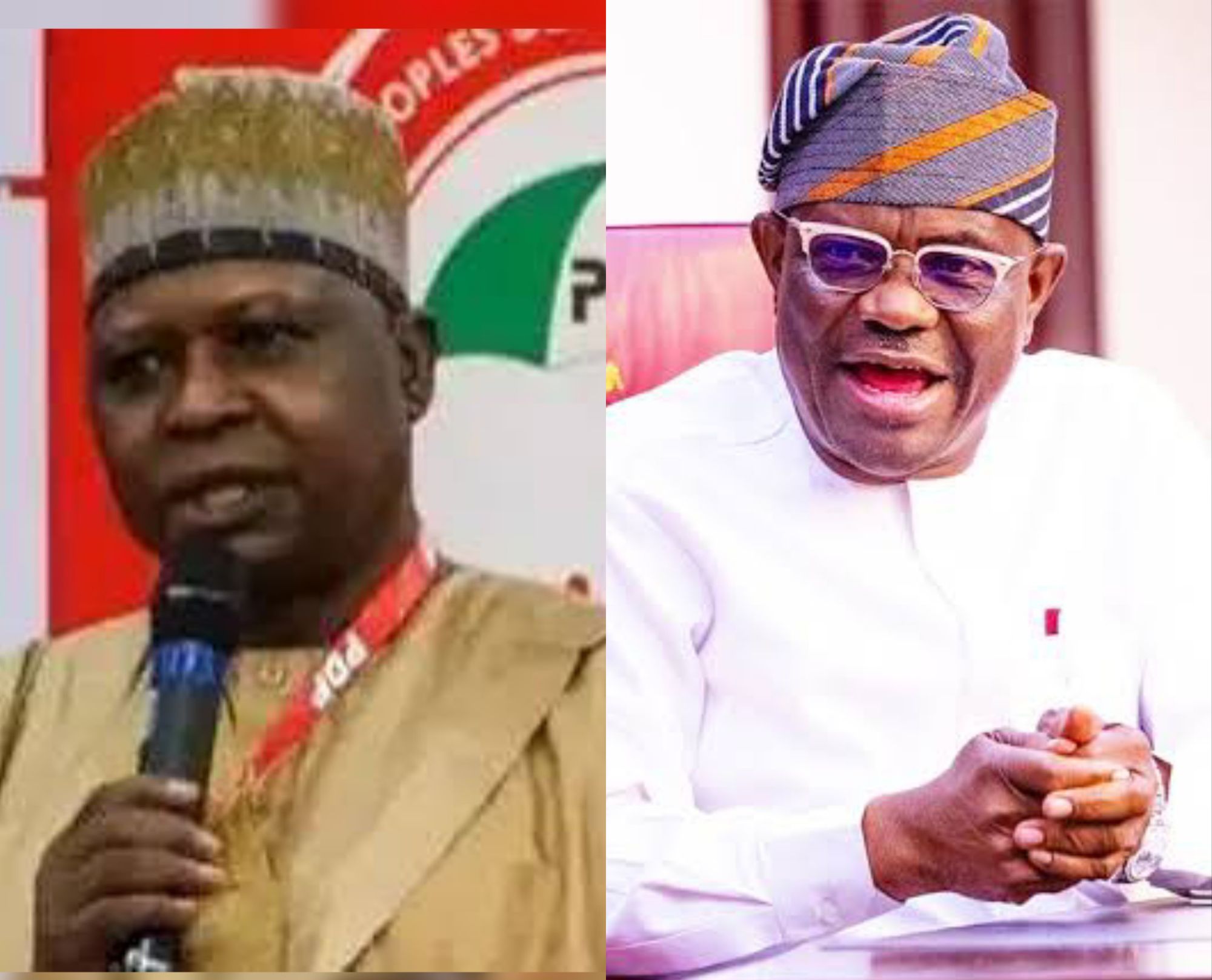
The internal turmoil rocking the Peoples Democratic Party (PDP) has intensified, as reconciliation efforts between rival factions collapse, pushing the party closer to a decisive legal confrontation.
What initially began as a leadership disagreement has now evolved into a full-scale struggle for control, with both camps adopting contrasting strategies to assert dominance.
At the centre of the dispute is the unresolved question of leadership within the party’s National Working Committee (NWC).
The faction aligned with former Minister Tanimu Turaki has accused the opposing camp, loyal to the Minister of the Federal Capital Territory, Nyesom Wike, of attempting to monopolise key leadership positions.
This perceived imbalance has been cited as a major obstacle to achieving meaningful reconciliation.
Legal Battle Takes Centre Stage
Following months of stalled negotiations, the Turaki-led group has opted to seek judicial intervention, directing the party to approach the Supreme Court for final arbitration.
This move underscores growing frustration within the faction, which believes that political dialogue alone may no longer be sufficient to resolve the crisis.

At a crucial meeting of its National Executive Committee (NEC) in Abuja, the faction reviewed earlier resolutions taken by party organs and unanimously endorsed the decision to escalate the dispute legally.
The meeting also ratified actions taken by the National Working Committee and the Board of Trustees, including the pursuit of reconciliation and the initiation of legal proceedings.
According to party officials, an appeal has already been filed at the Supreme Court, alongside applications for accelerated hearing.
These steps are aimed at securing a timely resolution to the leadership impasse, which continues to cast a shadow over the PDP.
Fragile Reconciliation Efforts
Despite the shift toward litigation, the Turaki faction maintains that reconciliation has not been completely abandoned.
Party spokespersons have described the process as gradual, noting that while progress has been slow, it has not entirely stalled.
There are indications that tensions between the factions have somewhat eased in recent weeks.
Hostile public exchanges have reduced, and communication channels between key actors have reopened. Observers say this “cooling-off period” suggests that both sides may still be open to compromise under the right conditions.
However, deep-seated mistrust remains a significant barrier. The PDP leadership crisis is rooted not only in disagreements over positions but also in broader concerns about fairness, inclusion, and the future direction of the party.
Convention Plans Under Threat
Meanwhile, the planned National Convention being organised by the Wike-aligned faction faces uncertainty due to fresh legal challenges.
The convention, scheduled for late March, is intended to formalise leadership appointments and solidify the faction’s control of party structures.
However, the Turaki group has filed a motion at the Court of Appeal seeking to halt the event.
The application argues that proceeding with the convention while legal proceedings are ongoing could undermine the judicial process and create complications for the court.
Legal representatives for the faction have emphasised the importance of maintaining the status quo until the substantive issues are resolved.
They contend that allowing the convention to go ahead could prejudice the outcome of the case and further deepen divisions within the PDP.
In addition to the Court of Appeal motion, a separate appeal has been lodged at the Supreme Court, reinforcing the faction’s determination to challenge the convention through legal means.
Electoral Body Drawn Into Dispute
The unfolding crisis has also drawn in the Independent National Electoral Commission (INEC), adding another layer of complexity to the situation.
The Turaki faction has formally written to the commission, urging it not to monitor the proposed convention.
The group argues that INEC’s involvement could be interpreted as endorsing a process that is subject to ongoing litigation.
ALSO READ: Court orders arrest of PDP chairman Turaki
Since the commission is reportedly a party to the case, its participation could raise questions about impartiality and due process.
To reinforce its position, the faction has filed a motion seeking to restrain INEC from attending or supervising the convention. This legal step highlights the high stakes involved and the potential implications for the PDP’s institutional credibility.
Wike Camp Remains Defiant
In contrast, the Wike-aligned faction has shown no intention of backing down. The minister has publicly reaffirmed that the convention will proceed as planned, describing it as a critical step toward stabilising the party.
According to him, preparations for the event are already in advanced stages, with logistical arrangements and stakeholder engagements ongoing.
He has also indicated that discussions with influential party figures are aimed at ensuring a smooth and successful convention.
The faction believes that delaying the convention would only prolong uncertainty and weaken the PDP’s ability to function effectively as a political organisation.
Moves to Consolidate Leadership
As part of its strategy, the Wike camp has moved to legitimise its leadership structure by endorsing members of its current National Caretaker Committee as substantive NWC officials. These appointments are expected to be ratified during the convention.
The faction has also reaffirmed its commitment to the party’s zoning arrangement, which allocates key positions based on regional considerations.
Under this framework, the National Chairman is expected to emerge from the northern region, while the National Secretary position is reserved for the south.
Several individuals have been identified as likely candidates for these roles, reflecting the faction’s determination to establish a clear leadership hierarchy within the PDP.
Deepening Uncertainty
The ongoing crisis has left the PDP at a critical crossroads. With both factions pursuing parallel paths—legal action on one hand and political consolidation on the other—the prospect of a unified resolution appears increasingly uncertain.
Political analysts warn that prolonged infighting could weaken the party’s internal cohesion and diminish its effectiveness as an opposition force.
The PDP, once a dominant political entity, now faces the challenge of rebuilding trust among its members while navigating a complex web of legal and political disputes.
The Road Ahead
Ultimately, the resolution of the PDP crisis may depend on a combination of judicial rulings and political compromise.
While the courts may provide clarity on legal questions, a lasting solution will likely require genuine dialogue and concessions from both sides.
For now, the party remains divided, with its future hanging in the balance. Whether the PDP can overcome its internal challenges and emerge stronger will depend on the willingness of its leaders to prioritise unity over rivalry.
About The Author
