


Oyo and Lagos declare August 20 a work-free day as residents prepare for the 2026 Isese Day celebration of Yoruba spirituality and cultural heritage.
The Oyo and Lagos State Governments have separately declared Thursday, August 20, 2026, a work-free day to allow residents to participate in activities lined up for this year’s Isese Day celebration, an annual event dedicated to Yoruba traditional religion, spirituality and cultural heritage.
The declarations are expected to give traditional worshippers, cultural groups, community leaders and other residents across the two states sufficient time to take part in ceremonies and programmes marking the occasion.
Oyo Government approves public holiday
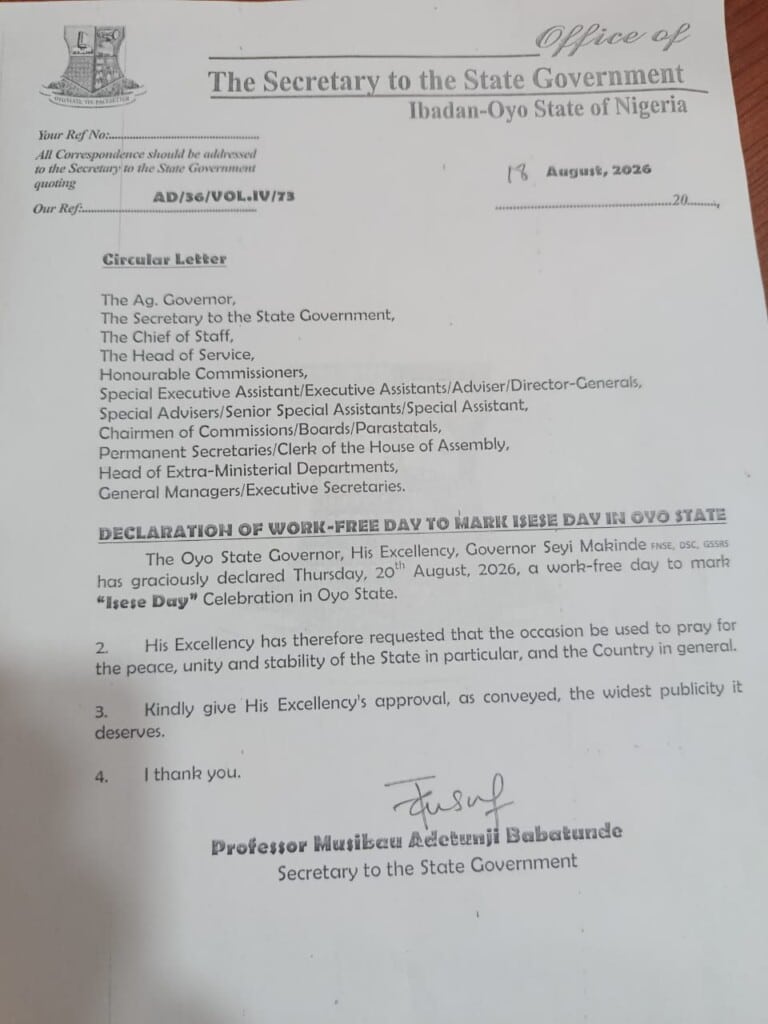
In Oyo State, the decision was communicated through a circular dated August 18, 2026, and signed by the Secretary to the State Government, Professor Musibau Adekunle Babatunde.
The circular stated that Governor Seyi Makinde had approved Thursday as a work-free day to enable residents to observe the annual Ìṣẹ̀ṣe Day.
The state government also encouraged residents to use the occasion to pray for peace, unity and stability in Oyo State and Nigeria.
Government agencies and relevant authorities were directed to give the announcement adequate publicity to ensure that residents were properly informed about the holiday.
The declaration places Oyo among the states that continue to recognise the importance of indigenous cultural practices and traditional institutions as part of the country’s wider cultural heritage.
The Day provides an opportunity for practitioners and cultural enthusiasts to participate in traditional rites, prayers, festivals and other activities associated with Yoruba spirituality.
Lagos joins Oyo in declaring holiday
Lagos State has also announced a work-free day for the same date, with the government saying the decision would enable residents and visitors to participate fully in the 2026 Isese Day programme.
The announcement was made on Wednesday by the Special Adviser to Governor Babajide Sanwo-Olu on Tourism, Arts and Culture, Idris Aregbe.
Aregbe said the decision was intended to provide adequate time for people to attend the various activities planned for the celebration.
He disclosed that more than three million traditional worshippers are expected to participate in the event, highlighting the scale of the annual gathering.
The Lagos government views the celebration as an important platform for promoting indigenous culture and recognising the historical significance of Yoruba traditions.
Aregbe argued that Isese should not be treated simply as another day off work, but as an expression of a cultural identity that has survived through generations.
“Isese is not a relic. It is a living expression of our traditions and a celebration of Yoruba spirituality as an important part of Nigeria’s cultural and religious landscape,” he said.
Yoruba heritage extends beyond Nigeria
The Lagos government official also drew attention to the international spread of Yoruba culture, noting that millions of people of Yoruba descent live outside Nigeria.
According to him, Yoruba traditions have remained visible in countries such as Cuba, Brazil and several Caribbean communities, where descendants of people taken from West Africa during the transatlantic slave trade have preserved elements of their ancestral heritage.
He maintained that the celebration in Lagos therefore has significance beyond the state or Nigeria, describing the city as an important meeting point for Yoruba cultural expression.
“When the drums sound in Lagos on Thursday, they answer drums in Havana, in Salvador, in Port of Spain. Fifty-five million people and counting. Lagos is not observing a local holiday. Lagos is standing at the centre of a global heritage,” Aregbe said.
His comments reflect the argument that the preservation of Yoruba traditions remains relevant not only to people living in southwestern Nigeria but also to communities across the world with historical links to the Yoruba people.
Ìṣẹ̀ṣe celebration in Lagos
The 2026 Ìṣẹ̀ṣe Day is expected to mark the culmination of a week-long programme of traditional and cultural activities in Lagos.
The state has observed the occasion as a work-free day since 2023 following a request by the Lagos State Council of Obas and Chiefs.
Governor Sanwo-Olu has maintained the practice every year, with the administration linking its support for the celebration to its commitment to indigenous values, cultural development and religious inclusiveness under the THEMES+ Agenda.
Aregbe commended the governor for continuing to support the annual celebration and for recognising the role of traditional institutions in preserving Yoruba heritage.
He also paid tribute to traditional rulers and other custodians who continue to transmit indigenous knowledge and practices to younger generations.
“We thank His Excellency, Mr. Babajide Olusola Sanwo-Olu. It takes real conviction for a leader to stand publicly with heritage, and he has done so without hesitation and without apology,” he said.
The special adviser specifically acknowledged the contributions of the Oba of Lagos, Oba Rilwan Akiolu I, traditional chiefs, Babaláwo, Ìyánífá, Olóòrìṣà and other custodians of Yoruba traditions.
“Governments come and go. Custodians carry the culture,” Aregbe stated.
Call for peaceful celebration
As residents prepare for the celebration, the Lagos government has urged participants to observe the occasion peacefully and respectfully.
Aregbe said the gathering should serve as an avenue for people to express pride in their heritage while encouraging unity and mutual respect.
He described the expected participation of millions of people as an expression of cultural identity rather than a disruption.
“Three million voices rising in honour of tradition is not noise. It is history, faith and cultural pride in harmony,” he said.
He further emphasised that the celebration should not be interpreted as an event exclusively for traditional worshippers, arguing that cultural heritage can be appreciated by people regardless of their religious beliefs.
“Whether you worship in a mosque, a church or a grove, Ìṣẹ̀ṣe Day belongs to you, because heritage has no denomination. Lagos remains the city where every heritage finds its place,” he added.
The separate declarations by Oyo and Lagos mean that residents of the two states will have Thursday free from official work to participate in the celebration and associated cultural activities.
Beyond the immediate festivities, the recognition of Ìṣẹ̀ṣe Day by state governments reflects continuing efforts to preserve indigenous traditions at a time when cultural practices are increasingly being promoted as important components of identity, history and tourism.

For Oyo and Lagos, the 2026 celebration is expected to bring together traditional institutions, worshippers, cultural practitioners and members of the public in activities centred on Yoruba spirituality, heritage and communal identity.
The two governments have consequently encouraged residents to make responsible use of the holiday while respecting the beliefs of others and ensuring that the celebrations remain peaceful.
About The Author
