Political leaders from across the American political spectrum have united in tribute following the death of Jesse Jackson, the influential civil rights activist, minister, and former presidential candidate, who died at the age of 84.
Jackson was widely described as a titan of the civil rights movement and one of the most significant moral voices in modern US history.
Jackson rose to prominence during the later stages of the civil rights era, working closely with Martin Luther King Jr. and later forging an independent path that blended faith, activism, and electoral politics.
Over decades, he became a bridge between street-level protest and institutional power, insisting that civil rights required not only moral appeals but political representation.
Former US president Joe Biden said Jackson would be remembered as “a man of God and of the people,” praising his determination and courage in confronting America’s deepest injustices.
Biden said Jackson remained steadfast in his belief that the nation’s founding promise of equality must be continuously defended rather than assumed.
Biden reflected on Jackson’s ability to guide the country through periods of turmoil with optimism and moral clarity.
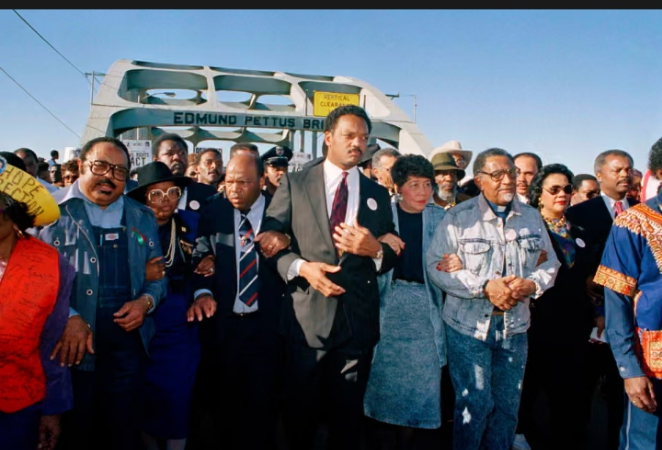
He said Jackson influenced generations of Americans and elected officials by refusing to allow the nation to abandon its conscience, even when progress appeared stalled or reversed.
Another former president, Bill Clinton, said he and Hillary Clinton were deeply saddened by the loss of a man they had known for more than five decades.
Clinton credited Jackson with championing human dignity and expanding opportunities for people long excluded from political and economic power.
Clinton highlighted Jackson’s historic presidential campaigns in 1984 and 1988, noting that while Jackson did not secure the Democratic nomination, he permanently reshaped the party’s coalition.
By elevating the concerns of Black, Latino, Asian American, and working-class white voters, Jackson helped redefine what national politics could look like.
Civil rights activist Al Sharpton, who worked closely with Jackson after King’s assassination in 1968, described him as a “transformative leader” who changed laws as well as lives.
Sharpton said Jackson kept the dream of equality alive during periods when progress was threatened by political backlash.
Sharpton credited Jackson with mentoring young people from marginalized backgrounds and teaching them that dignity could not be erased by poverty or discrimination.
He described Jackson’s ministry as both spiritual and political, rooted in the belief that justice required constant action rather than symbolic gestures.
Senior Democratic leaders also emphasized Jackson’s enduring influence. US vice-president Kamala Harris said Jackson made millions of Americans feel that their voices mattered. She recalled her early days as a law student, when she proudly displayed a “Jesse Jackson for President” sticker on her car.
Harris described how strangers from all walks of life responded with gestures of support, saying those small moments captured Jackson’s life work: lifting the dignity of working people, building coalitions, and strengthening American democracy. She called him a mentor and a selfless leader whose influence shaped her own path in public service.
Other Democrats echoed these sentiments. Transportation secretary Pete Buttigieg described Jackson as a titan in the struggle for racial justice, while Georgia senator Raphael Warnock said the nation had lost one of its great moral voices.
Warnock praised Jackson’s distinctive rhetoric and moral urgency, saying he reminded Americans that justice was never inevitable. He said Jackson advanced King’s dream by insisting that freedom demanded vigilance, commitment, and sacrifice.
Voting rights advocate Stacey Abrams said Jackson understood both the promise of America and the responsibility of shaping its destiny.
She credited him with widening the nation’s moral imagination and deepening its commitment to justice for all.
From the King family, Bernice King paid tribute to a life she said pushed hope into weary places.
She highlighted Jackson’s work with the Rainbow PUSH Coalition, which sought to unite people across race, class, and faith in pursuit of economic and social justice.
King described Jackson as a gifted negotiator and courageous bridge-builder who brought calm into tense situations and opened doors where none previously existed. She noted the long relationship between her family and Jackson, rooted in shared values of justice and love.
Tributes also came from outside the Democratic Party. US president Donald Trump described Jackson as “a good man” and a friend, referencing past interactions and support for initiatives Jackson championed, including funding for historically Black colleges and universities.
Trump’s remarks, however, also reflected his characteristic political tone, blending praise with personal grievances and claims of past accomplishments. Even so, his acknowledgment underscored Jackson’s ability to command respect across ideological divides.
The breadth of tributes reflected the scale of Jackson’s influence. Few figures in American history have moved so fluidly between protest movements, electoral politics, religious leadership, and international diplomacy.
Jackson insisted that democracy must include those most often excluded from it, and he spent his life pushing institutions to reflect that belief.
Read also: Starmer condemns Reform UK as measles outbreak exposes vaccine misinformation fault lines
Jackson’s legacy lies not only in the offices he sought or the movements he led, but in the coalitions he built.
He argued that progress depended on unity across racial, economic, and religious lines, and he challenged America to measure itself not by rhetoric but by outcomes.
As the nation reflects on his passing, Jesse Jackson is being remembered not merely as a witness to history, but as one of its architects.
His death marks the loss of a generation of civil rights leaders whose work reshaped the United States, even as the struggle for equality they championed continues.