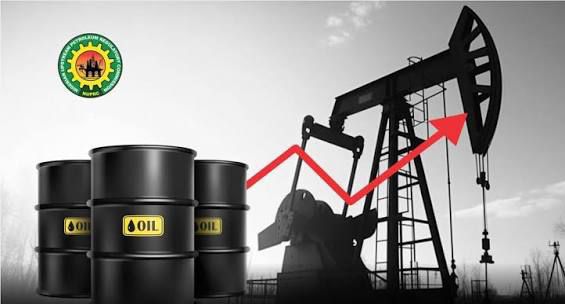
Global oil markets recorded a notable rebound on Tuesday as crude prices climbed toward the $65 mark, supported by supply disruptions in Central Asia and renewed optimism around global economic growth, even as geopolitical risks and trade tensions continued to cloud the outlook.
Brent crude futures gained nearly $1 to settle close to $65 per barrel, while the United States benchmark, West Texas Intermediate (WTI), advanced by more than $1 to trade above $60 per barrel.
The upward movement marked a reversal from recent weakness and reflected the market’s sensitivity to supply-side shocks and shifting demand expectations.
Supply outages tighten short-term market balance
One of the key drivers behind the rally was the temporary suspension of crude output at major oilfields in Kazakhstan, a significant producer within the Caspian region.
Tengizchevroil, the consortium-led operator of the Tengiz and Korolev oilfields, announced that production had been halted following a fault in power distribution systems supplying the facilities.
Industry sources indicated that the outage could last between seven and ten days, disrupting crude flows through the Caspian Pipeline Consortium (CPC), a critical export route delivering oil to international markets via the Black Sea.
The Tengiz field is among the world’s largest oil-producing assets, and any interruption, even if short-lived, is closely watched by traders.
Energy analysts noted that while the disruption is likely temporary, it has immediate implications for supply availability, particularly at a time when global inventories are already under pressure from earlier production cuts and maintenance-related shutdowns.
According to market observers, the suspension underscores how operational risks in major producing regions can quickly alter sentiment, even in a market grappling with longer-term demand uncertainties.
China’s economic resilience boosts demand outlook
Beyond supply issues, stronger-than-expected economic data from China, the world’s largest oil importer, also helped underpin prices.
Official figures showed that China’s economy expanded by around five per cent in 2025, outperforming earlier projections and reinforcing confidence in the country’s post-pandemic recovery.
Refinery throughput in China rose by more than four per cent year-on-year, reflecting sustained domestic fuel consumption and export demand for refined products.
Crude oil production within the country also recorded modest growth, suggesting a balanced approach to managing imports and domestic output.
Market analysts said the data eased concerns about a sharp slowdown in Asian demand, which has been a recurring source of volatility for oil markets over the past year.
The resilience of Chinese industrial activity and transport fuel consumption provided a positive signal for near-term oil demand, particularly for diesel and jet fuel.
IMF upgrade adds to bullish sentiment
Further support came from the International Monetary Fund’s upward revision of its global growth outlook for 2026.
The IMF cited easing inflationary pressures in advanced economies and improving financial conditions as factors that could support moderate expansion across major regions.
A firmer global growth trajectory typically translates into higher energy consumption, reinforcing expectations of stable or rising oil demand.
Analysts pointed out that even marginal upgrades to growth forecasts can have an outsized impact on commodity markets, especially when supply remains constrained.
In addition, stronger diesel prices in key markets added momentum to crude benchmarks, reflecting tightness in middle distillate supplies and seasonal demand factors.
Weaker dollar supports oil prices
Currency movements also played a role in lifting crude prices. The U.S. dollar weakened against a basket of major currencies, making dollar-denominated commodities such as oil cheaper for holders of other currencies.
Historically, a softer dollar tends to support oil demand by lowering effective purchase costs for importing countries.
Traders said the dollar’s decline amplified the impact of supply disruptions and positive economic data, helping push prices higher despite lingering macroeconomic risks.
Oil Prices Rise to $65 as Trade Tensions Cap Gains

Despite the bullish factors, analysts cautioned that the rally could face headwinds from escalating geopolitical tensions and renewed trade threats.
U.S. President Donald Trump’s recent comments on imposing additional tariffs on European countries have reintroduced uncertainty into global markets.
Trump indicated that new levies could be applied to imports from several European Union members and allied states if disagreements persist over Arctic and Greenland-related issues.
The prospect of higher tariffs has raised concerns about a potential slowdown in global trade, which could dampen economic growth and energy demand.
Energy market specialists warned that prolonged trade disputes often weigh on oil prices by reducing industrial output, freight movement, and consumer confidence.
As a result, while oil prices rise to $65 on short-term fundamentals, sustained gains may prove difficult if trade tensions intensify.
European leaders have pushed back against the proposed measures, describing them as counterproductive and harmful to global economic stability.
The European Commission has signalled that it is exploring policy responses while working on broader security and economic initiatives in the Arctic region.
Looking ahead, oil markets are expected to remain highly sensitive to developments on multiple fronts, including supply disruptions, macroeconomic data, and geopolitical signals.
While temporary outages and improving demand indicators can drive short-term rallies, structural concerns such as slowing global trade and policy uncertainty continue to limit upside potential.
Analysts suggest that prices could retreat if Kazakhstan’s production resumes sooner than expected or if trade rhetoric escalates into concrete policy action.
Conversely, any extension of supply outages or stronger-than-anticipated demand growth could keep prices elevated in the near term.
For now, the latest rebound highlights the fragile balance shaping global energy markets, where oil prices rise to $65 on optimism and disruption, even as deeper uncertainties linger beneath the surface.
About The Author