Former President Olusegun Obasanjo rejects El-Rufai as successor in 2007, saying the former FCT Minister lacked the maturity to lead Nigeria at the time.
Former President Olusegun Obasanjo has revealed that he once refused to endorse Nasir El-Rufai as his successor when his tenure ended in 2007.
Speaking candidly at an event in Abeokuta, Ogun State, Obasanjo explained why Obasanjo rejects El-Rufai as successor, insisting the former minister was brilliant but “not mature enough” to handle the complexities of leading Nigeria at the time.
The statement has since reignited national conversations about leadership readiness, mentorship, and the standards expected of those aspiring to occupy the highest office in the land.
The revelation came during the Ajibosin Platform Annual Symposium, where Obasanjo shared the stage with former Minister of Aviation Osita Chidoka, who served under his administration. During his keynote speech, Chidoka recounted how El-Rufai introduced him to Obasanjo at the age of 34 — a meeting that paved the way for his appointment as Corps Marshal of the Federal Road Safety Corps (FRSC).
Interrupting Chidoka mid-speech, Obasanjo told the audience, “He didn’t mention that he once pushed for his friend, El-Rufai, to succeed me when I was leaving government.”
Amid laughter, Obasanjo turned to Chidoka and asked in Pidgin, “No be so?” to which Chidoka nodded in agreement. Obasanjo then revealed why Obasanjo rejects El-Rufai as successor, explaining, “I did not yield to the pressure because I felt El-Rufai needed to mature. Leadership is not about intellect alone—it requires patience and character.”
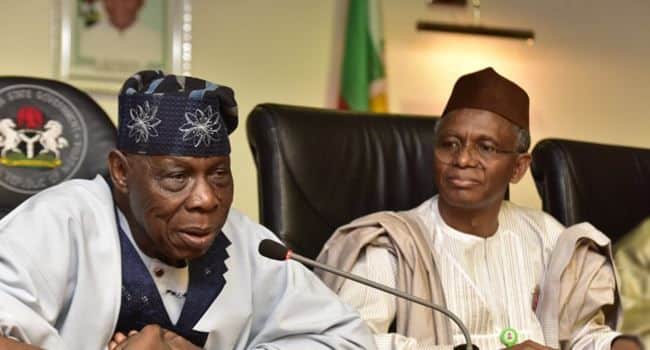
Obasanjo explained that several individuals close to him admired El-Rufai’s energy and administrative discipline during his time as Minister of the Federal Capital Territory (FCT) and Director-General of the Bureau of Public Enterprises (BPE). However, he believed leading a diverse and complex nation like Nigeria required more than technical skills.
“I told them he’s talented, but not yet ready,” Obasanjo recalled. “El-Rufai needed time to grow politically and emotionally. Years later, even those who once recommended him came back and admitted I was right.”
By recounting this episode, the former president emphasized that political leadership is not an experiment but a serious responsibility requiring growth, exposure, and humility.
Between 1999 and 2007, El-Rufai earned a reputation as one of the most dynamic members of Obasanjo’s cabinet. His efforts to reform Abuja’s urban landscape and push for privatization marked him as a strong reformer.
Yet, Obasanjo’s decision not to back him as successor highlighted his broader philosophy on governance. According to him, Obasanjo rejects El-Rufai as successor because leadership requires “temperament, maturity, and a sense of balance.”
He noted, “Leadership is not about energy or ideas alone. It is about character, exposure, and the discipline to manage power wisely. Without that, even the best intentions can collapse under pressure.”
In his remarks, Obasanjo lamented that Nigeria’s political space lacks formal leadership grooming. “It’s only in politics that I found there is no training for leadership,” he said. “Even among armed robbers, there’s apprenticeship. But in politics, there’s none — and that’s not good enough.”
He called for mentorship and capacity-building programs for aspiring leaders, saying that leadership in a democracy should be rooted in experience, exposure, and empathy, not just ambition or popularity.
The audience responded with applause as Obasanjo encouraged the younger generation to focus on preparation and service, rather than rushing into positions of authority without adequate grounding.
Delivering his keynote address, Osita Chidoka emphasized that Nigeria’s governance failures stem not from a lack of bright minds but from weak institutions and poor accountability mechanisms.
“Leadership finds its true measure not in charisma or speeches but in the systems it leaves behind,” Chidoka stated. “Moral conviction must translate into everyday governance—rules, routines, and institutions that make competence predictable and corruption difficult.”
He urged Nigerians to judge leaders by measurable outcomes, not campaign promises. “We must make leadership accountable to results,” he said. “Build dashboards that track every promise, every budget, every outcome. Strengthen the institutions that monitor government performance and expose complacency.”
Chidoka’s argument complemented Obasanjo’s perspective, as both leaders stressed that sustainable governance comes only when individuals and systems grow together.
The story of how Obasanjo rejects El-Rufai as successor serves as a powerful reminder that leadership readiness involves timing, growth, and moral strength. Obasanjo’s decision reflected not personal bias, but his conviction that the right leader must emerge at the right time — equipped with wisdom, experience, and humility.
Both Obasanjo and Chidoka agreed that Nigeria’s political culture must evolve from personality-driven politics to institution-based governance. They emphasized that leadership should be measured by service delivery and nation-building, not by charisma or tribal affiliations.
Obasanjo concluded with a timeless message: “We must produce leaders who understand service, not power. Leaders who build systems, not empires. Leadership without preparation is like a ship without a compass—it may move, but it will never reach its destination.”
The Abeokuta symposium offered a blend of reflection, history, and wisdom. By revealing why Obasanjo rejects El-Rufai as successor, the former president reignited discussions about the importance of maturity, mentorship, and institutional strength in Nigeria’s leadership journey.
As the nation continues to face challenges of governance and accountability, Obasanjo’s remarks remind future leaders that greatness is not in ambition but in preparation, integrity, and service.
More news at ireport247news
About The Author