The Israeli opposition power struggle intensified on Tuesday as opposition lawmakers moved swiftly to weaken Benjamin Netanyahu‘s influence over parliament, immediately after the country’s newly elected Knesset was sworn in.
Although the parties opposed to Netanyahu have yet to agree on a governing coalition, they are already using their combined parliamentary strength to challenge his allies and push through legislation that could reshape Israel’s political system.
Their first major move was to demand a vote to replace Knesset Speaker Amir Ohana, a Netanyahu loyalist who controls the legislature’s agenda. Installing an opposition-backed speaker would give the six opposition parties greater influence over parliamentary business, even if negotiations to form a government collapse.
The proposed changes include establishing a state commission of inquiry into the Hamas-led attacks of 7 October 2023 and introducing limits on how long an individual can serve as prime minister.
The term-limit proposal could prevent Netanyahu from returning to power, having led Israel for 19 of the past 30 years.
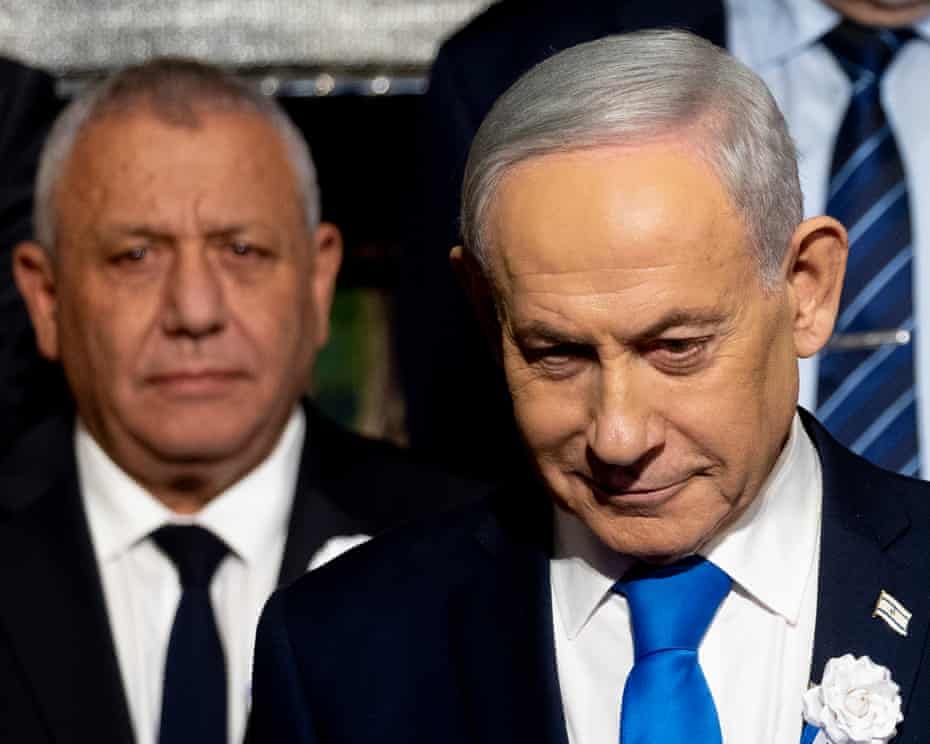
Eisenkot gets first opportunity to form government
The parliamentary confrontation is unfolding alongside a difficult attempt to assemble a new government. Former Israeli military chief Gadi Eisenkot has received the presidential mandate to negotiate a coalition and try to replace Netanyahu.
He has six weeks to secure sufficient support and bring together parties with different political positions and election commitments.
If Eisenkot fails, another candidate, most likely Netanyahu, will receive an opportunity to form a government. Should that attempt also fail, Israel could be forced into another election.
The opposition leader has acknowledged the difficulty of the negotiations, describing the route to power as “extraordinarily complex”.
However, he has argued that removing Netanyahu from office represents a national emergency, suggesting that some parties may have to reconsider campaign promises to reach an agreement.
The possibility of prolonged negotiations leaves Netanyahu in office as caretaker prime minister, potentially extending his hold on executive power even after his coalition lost its parliamentary majority.
Nevertheless, the opposition believes it can weaken his position by taking control of key parliamentary institutions and advancing legislation before a new government is formed.
Netanyahu attacks Palestinian-led opposition parties
Netanyahu used his address at Tuesday’s swearing-in ceremony to criticise two Palestinian-led opposition parties whose support was crucial to the defeat of his coalition.
He described their lawmakers as “terror supporters”, prompting an angry response from opposition figures who accused the prime minister of using a formal state occasion to deepen political divisions.
Eisenkot condemned the speech as a “delusional, divisive, hate-filled and shameful” exploitation of the ceremony, arguing that Netanyahu’s conduct demonstrated his unfitness to remain prime minister.
The protest also prompted two lawmakers to leave the chamber. Yair Golan, leader of the centre-left Democrats, and Yoav Segalovich, a Jewish-Israeli former police chief who contested the election on the Islamist Ra’am party’s slate, walked out during Netanyahu’s address.
The confrontation reflects the growing tension surrounding the role of Palestinian citizens in Israeli politics.
Palestinian citizens make up approximately 20% of Israel’s population, and their political parties have become significant players in the parliamentary arithmetic following the election.
Netanyahu had made criticism of these voters and their parties a central feature of his campaign. Since polling day, he has also promoted allegations of electoral fraud in Palestinian communities, seeking to cast doubt on the results.
However, election officials have said there was no evidence of irregularities capable of affecting the outcome or undermining the integrity of the election.
Opposition prepares legislation to reverse Netanyahu’s reforms
Eisenkot’s Yashar party wasted little time translating its parliamentary position into legislative action.
Immediately after the new Knesset was sworn in, the party submitted several proposed bills with backing from other opposition groups.
Beyond the proposed prime ministerial term limits and an independent investigation into the 7 October attacks, the package includes measures intended to reverse Netanyahu’s controversial judicial overhaul.
The reforms pursued by Netanyahu’s government weakened the authority of Israel’s judiciary and the attorney general, generating widespread political opposition and protests.
The proposed legislation would seek to restore powers that critics believe were undermined by the government’s changes.
The opposition is also targeting influential parliamentary committees, having nominated candidates to take control of key defence and finance committees.
These positions would give its lawmakers greater oversight of important areas of government policy, including national security and public spending.
The battle over the speakership, however, will not be settled immediately. Ohana has scheduled the vote to choose his replacement for next Tuesday, the latest date permitted.
Until then, Netanyahu’s allies retain control of the speaker’s office, although the opposition has already demonstrated its intention to use its numerical advantage to challenge the existing parliamentary leadership.
Herzog warns lawmakers against another election
President Isaac Herzog used the opening ceremony of the new Knesset to appeal for cooperation, warning political leaders against allowing their disagreements to trigger another election.
With coalition negotiations expected to be difficult, Herzog urged lawmakers to seek compromises rather than allow political rivalry to prevent the formation of a stable government.
“Reach out a hand for compromise, even between rivals … Look upon one another with generosity. There is much work to be done here, and it requires the ability and experience found in every part of this House,” he said.
His intervention reflects concerns that another prolonged political deadlock could leave Israel without a functioning elected government.
A fresh election would also give Netanyahu additional time in his caretaker position, while the fragmented opposition would face another test of its ability to maintain a united front.
The Israeli opposition power struggle therefore extends beyond the question of who will become prime minister. Control of the Knesset, the future of judicial reforms and the proposed investigation into the 7 October attacks are all central to the emerging confrontation.
Netanyahu’s political future remains uncertain
The opposition’s immediate strategy is to make use of its parliamentary numbers while Eisenkot works to secure a coalition agreement.
Even without forming a government, the six parties hope to demonstrate that they can govern parliamentary proceedings, advance legislation and restrict the influence Netanyahu has exercised over Israeli politics.
However, their ability to sustain that cooperation remains uncertain because of conflicting political commitments and differences among the parties.
Read also: Indonesian recruitment surge: Ukraine captures first Indonesian prisoner of war fighting for Russia
Eisenkot’s six-week mandate will be a crucial test of whether those disagreements can be overcome in pursuit of a common objective.
If he succeeds, Netanyahu could lose power after nearly two decades of leadership across several periods in office. If negotiations fail, the prime minister may receive another opportunity to assemble a government.
For now, the opposition’s parliamentary offensive has opened a new phase of political confrontation, with the struggle for control of Israel’s legislature taking place even before the next government has been decided.
About The Author