

Moscow witnessed the murky death of militia leader Stanislav Orlov, signaling the Kremlin’s determination to control rogue paramilitary groups, even those once celebrated as war heroes.
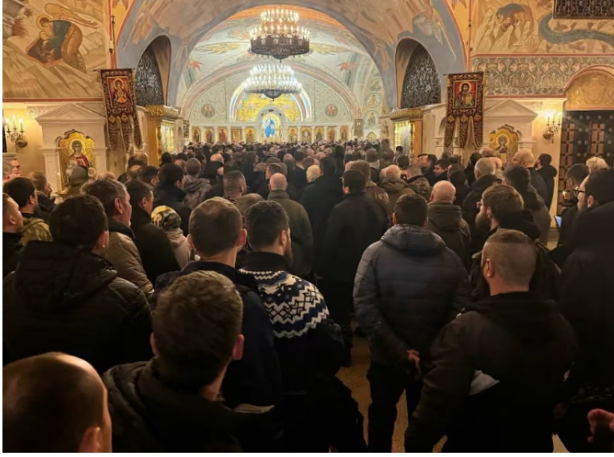
Beneath the frescoed ceilings of Moscow’s Cathedral of Christ the Saviour, hundreds of mourners gathered, blending religious ritual with political symbolism, as prayers for Orlov’s soul echoed through the hall.
Orlov, better known as “Spaniard,” founded the far-right Española unit, a paramilitary formation of football hooligans and neo-Nazi volunteers who fought alongside Russian forces in Ukraine.
Russian pro-war Telegram channels depicted the funeral as a battlefield commander’s tribute, while the lack of an official cause of death raised suspicion about state involvement in his demise.

Rumors about Orlov’s death began circulating online on 9 December, with reports suggesting he had been ambushed and shot at his home in Russian-annexed Crimea by Russian security agents.
CCTV footage published by anti-war outlet Astra allegedly shows armed servicemen arriving outside Orlov’s residence, gunshots sounding, and an ambulance delayed six hours, highlighting procedural irregularities surrounding his death.
Experts argue that Orlov’s killing reflects the Kremlin’s broader crackdown on independent ultranationalist figures and paramilitary formations after the Wagner mutiny challenged Putin’s authority in 2023.
During the early years of the Ukraine war, radical formations like Española were tolerated, providing rapid mobilization and projecting ideological zeal that complemented Kremlin propaganda efforts across Russian society.
Española engaged in some of Ukraine’s deadliest battles, including Mariupol and Bakhmut, while cultivating influence at home through football culture, social campaigns, and recruitment of ex-athletes and public figures.
Former Russian football international Andrei Solomatin joined the unit, lending credibility and a veneer of normalcy to the organization while maintaining visibility at sporting events nationwide.
After Yevgeny Prigozhin’s Wagner rebellion in June 2023, which briefly threatened Moscow, the Kremlin moved decisively to curb paramilitary autonomy and eliminate potential challenges to centralized authority.
Prigozhin died in a plane crash two months later, widely viewed as a Kremlin-ordered reprisal, sending a clear message to independent military actors regarding the limits of tolerated power.
Independent paramilitary groups were dismantled or incorporated into the regular Russian military, while outspoken ultranationalists like Igor Girkin faced arrest and imprisonment, demonstrating the consequences of defiance.
Española formally disbanded in October 2025, folding its units into Russia’s military structure, leaving Orlov’s death as the final and symbolic enforcement of Kremlin authority over non-state armed actors.
Political analyst Andrei Kolesnikov described Orlov’s killing as a “demonstrative elimination,” warning others that independent action outside state oversight would not be tolerated under the current regime.
Few influential pro-war bloggers publicly addressed Orlov’s death, suggesting that self-censorship has become a key mechanism to avoid state scrutiny and potential reprisals against outspoken supporters.
Española issued a careful statement on Telegram, urging followers to await official investigations, reflecting the group’s acknowledgment of the overwhelming influence and reach of Kremlin security services.
Allowing Orlov’s burial in Moscow’s Cathedral of Christ the Saviour highlights a paradox in Russia: radical zeal is celebrated ceremonially, yet stepping beyond state boundaries can be fatal.
Kolesnikov noted that the Kremlin applied the same logic to Prigozhin, memorializing his role in the war but disallowing any challenge to centralized political or military authority.
Orlov’s death serves as a warning: loyalty and obedience are paramount, while independent paramilitary influence is tolerated only when subordinate to the state, not as a power in itself.
Observers note that Orlov’s killing mirrors past patterns, demonstrating consistency in Kremlin strategy to manage semi-autonomous militarized figures through controlled displays of force.
The ongoing military and political climate in Russia makes control of groups like Española essential to prevent uprisings or armed dissent as peace talks or war developments unfold.
Even in death, Orlov exemplifies the tension between glorification and elimination, reflecting Russia’s approach to heroic figures who step beyond narrow boundaries of state-sanctioned influence.
Moscow’s ceremonial tribute reinforced the Kremlin’s dual message: valorize paramilitary contributions while asserting ultimate state authority over all armed entities.
Analysts say this strategy could discourage other armed groups from asserting autonomy, reinforcing Moscow’s narrative of disciplined patriotism and centralized control of ultranationalist factions.
Orlov’s death highlights the paradox of wartime Russia, where celebrated radicals are both sanctified in sacred spaces and eliminated if perceived as a threat to political stability.
The murky circumstances and state-linked nature of his killing send a clear signal: independent power is dangerous in Russia, regardless of prior military achievements or public support.
Experts agree that the Kremlin’s approach balances the memory of battlefield contributions with the ruthless enforcement of political obedience, ensuring the continued dominance of centralized authority.
Orlov’s life and death underscore the perils faced by ultranationalist commanders navigating Russia’s complex war environment, caught between ideological zeal and Kremlin oversight.
The incident illustrates how Moscow maintains control over paramilitary networks, leveraging both public displays of respect and covert eliminations to prevent dissent from spreading within armed formations.
Ultimately, the murky death of Stanislav Orlov serves as a cautionary tale to all non-state actors: state power is absolute, and defiance carries lethal consequences even for celebrated figures.
Read also: Balmoral emails from ‘A’ deepens scrutiny as Epstein files expose troubling exchanges
About The Author


