Aggrieved homeowners and business operators affected by the Lagos-Calabar Highway project have raised alarm over what they describe as forceful and unlawful attempts to evict them from legally acquired properties without due process, adequate notice, or compensation.
Operating under the umbrella of Project Affected Persons (PAPs), residents along the proposed coastal corridor say they are being compelled to vacate structures allegedly falling within a rigid 150-metre setback from the high-water mark, with threats of demolition looming over homes, businesses, schools, and places of worship that have existed for decades.
The affected residents argue that the directive being enforced lacks a solid legal foundation and represents a dangerous precedent that undermines constitutional property rights.
Lagos-Calabar Highway homeowners decry forceful vacation
In a strongly worded position paper titled “Our Homes, Our Rights: Rejecting Retroactive Eviction Under the Guise of UNCLOS,” the group accused authorities of misapplying international law to justify actions that, in their view, contravene Nigeria’s Constitution and land administration statutes.
According to the PAPs, the eviction directive—attributed to the Office of the Surveyor-General of the Federation—is being justified through reference to the United Nations Convention on the Law of the Sea (UNCLOS). However, the group insists that such reliance is legally flawed and misleading.
They explained that UNCLOS, which Nigeria ratified in 1982, is primarily concerned with maritime boundaries, navigation rights, offshore resource control, and the protection of the marine environment.
The convention, they stressed, does not mandate a 150-metre coastal setback, authorize the demolition of existing structures, or permit the retroactive eviction of lawful occupants.
“Nowhere in the over 300 articles of UNCLOS is there any provision that empowers the demolition of legally developed properties or overrides constitutional protections for property ownership,” the group stated.
Residents cite decades of lawful occupation
The homeowners said many of the affected properties were acquired legally over 20 to 30 years ago, developed with approvals from state planning authorities, and occupied without objection from any government agency until the announcement of the Lagos–Calabar Coastal Highway project.
They argue that the sudden enforcement of a uniform setback rule—without scientific, environmental, or site-specific assessments—amounts to arbitrary action that disregards the social and economic realities of coastal communities.
The PAPs further noted that international environmental obligations must be implemented through domestic laws and procedures, not through executive directives that bypass constitutional safeguards.
Legal experts warn of constitutional violations
Legal counsel to the group, Sola Enitan, described the situation surrounding the Lagos–Calabar Coastal Highway as a textbook case of coercive acquisition carried out in violation of Nigerian law.
According to him, Section 43 of the 1999 Constitution guarantees every Nigerian the right to acquire and own immovable property, while Section 44 expressly prohibits compulsory acquisition except under strict legal conditions.
“Any compulsory acquisition must clearly state the public purpose, provide prompt and adequate compensation, and guarantee access to judicial redress. None of these requirements appears to have been satisfied in this case,” Enitan said.
He further cited the Land Use Act, which has constitutional backing, noting that it does not give the government unfettered powers over land.
Under Section 28 of the Act, revocation of rights of occupancy is only permissible for overriding public interest and must follow laid-down procedures.
These include publication of revocation in the Official Gazette, service of notice on affected persons, proper valuation of assets, and payment of compensation before possession is taken.
“Any acquisition that bypasses these steps is unconstitutional, null, and void,” Enitan warned.
Concerns over lack of transparency
Beyond legal issues, the affected residents expressed concern over what they described as a lack of transparency in the execution of the Lagos–Calabar Coastal Highway project.
They alleged that no detailed cartographic maps or clear boundary delineations have been publicly presented to show precisely which properties fall within the acquisition zone.
Many residents, they claim, have not received formal written notices, while others reportedly learned of the demolitions only when markings appeared on their buildings.
The PAPs also allege that no comprehensive valuation of affected properties—covering buildings, businesses, economic trees, and improvements—has been conducted in a transparent and professional manner.
Instead, they claim the process has been characterised by intimidation, demolitions under armed supervision, and a growing climate of fear among residents.
The group is now demanding an immediate suspension of all demolitions and evictions linked to the Lagos–Calabar Coastal Highway pending full compliance with constitutional and statutory requirements.
Their demands include the disclosure of all acquisition instruments, gazette notices, environmental and valuation reports, and the establishment of a transparent engagement process that allows affected persons to contest valuations and seek redress where necessary.
They also called on the Federal Government to adopt a more humane and consultative approach that balances infrastructure development with the protection of citizens’ rights.
A major project with far-reaching impact
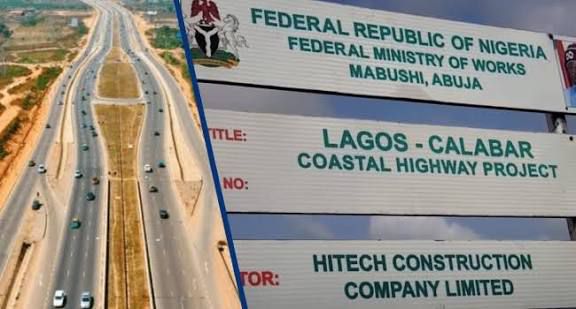
The Lagos–Calabar Coastal Highway is one of the Federal Government’s flagship infrastructure projects, envisioned as a roughly 700-kilometre road stretching from Lagos to Cross River State.
The highway is expected to pass through several coastal and southern states, including Ogun, Ondo, Edo, Delta, Bayelsa, Rivers, Akwa Ibom, and Cross River.
While the project is widely seen as critical to improving connectivity, boosting trade, and unlocking coastal economic potential, analysts warn that its success will depend heavily on how social, legal, and environmental concerns are addressed.
As tensions rise, observers say the unfolding dispute highlights a broader national challenge: how Nigeria can pursue ambitious infrastructure development without undermining the constitutional rights and livelihoods of its citizens.
About The Author