

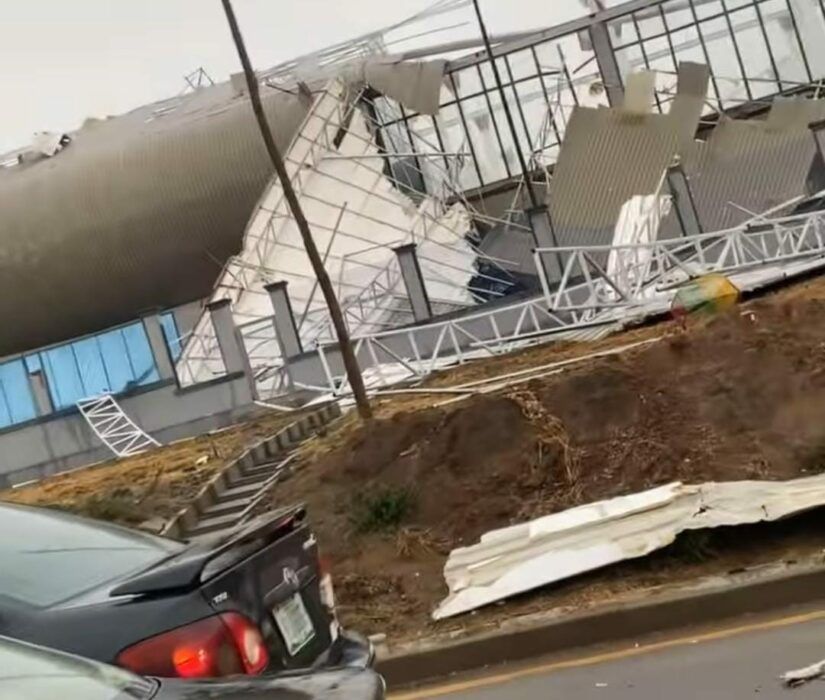
The sudden storm that swept through parts of Abuja on Tuesday afternoon left a trail of destruction, with the Kugbo Bus and Taxi Terminal bearing the brunt of the impact.
The incident, now widely described as Kugbo Terminal rainstorm damage, has raised fresh concerns about the durability of newly built public infrastructure and the preparedness of facilities awaiting commissioning.
The heavy downpour began in the mid-afternoon, accompanied by strong winds that intensified within minutes.
As the storm gathered momentum, large sections of the terminal’s roofing were ripped off and hurled onto the nearby Abuja-Keffi Expressway.
The falling debris created an immediate hazard for motorists, forcing vehicles to slow down and causing a significant traffic buildup on both sides of the road.
Commuters and road users found themselves stranded as officials struggled to clear the obstruction.
Eyewitnesses described scenes of confusion, with some passersby attempting to salvage pieces of roofing materials and other valuables scattered across the highway.
While such actions further complicated recovery efforts, authorities quickly moved in to restore order.
Officials later confirmed that despite the scale of the destruction, no injuries or vehicle damage were recorded.
This was considered a stroke of luck, given the busy nature of the expressway and the timing of the incident.
Nonetheless, the Kugbo Terminal rainstorm damage has sparked debate about safety standards and whether adequate stress testing was conducted before the project’s completion.
Reacting to the situation, the Minister of the Federal Capital Territory, Nyesom Wike, directed the immediate deployment of security operatives to the affected area.
The goal was to secure the site, prevent looting, and ensure that traffic flow returned to normal as quickly as possible.
He also assured residents that repairs would commence without delay.
The Kugbo terminal is one of three major transport hubs developed as part of a broader plan to modernize Abuja’s public transportation network.
Alongside facilities in Mabushi and the Central Business District, the project is designed to improve commuter safety, reduce congestion, and provide a more organized transit system.
Construction of these terminals began in July 2024 and was completed the following year.
The Kugbo and Mabushi terminals were specifically designed to handle high passenger volumes, with each capable of processing over 10,000 commuters daily.
In addition, the facilities were structured to accommodate up to 120 buses and taxis every day, supporting both intercity and intra-city travel.
Despite their completion, operations have yet to begin. Authorities had previously explained that the delay was due to administrative processes tied to their management structure.
The terminals are to be run under a Public-Private Partnership arrangement, requiring approval from the Federal Executive Council before full operations can commence.
The Kugbo Terminal rainstorm damage now introduces an additional layer of uncertainty to that timeline.
While officials insist that repairs will be carried out promptly, the incident could lead to further inspections and possible adjustments to the facility’s structural design.
Urban development experts have noted that extreme weather events are becoming increasingly common, making it essential for infrastructure projects to incorporate climate-resilient features.
In this context, the damage at Kugbo serves as a reminder that beyond aesthetics and capacity, durability must remain a top priority in public construction.
The economic implications of the delay are also worth noting. Each of the three terminals was expected to create at least 100 direct jobs, in addition to numerous indirect employment opportunities.
With operations yet to commence and repairs now required, those benefits may take longer to materialize.
For residents of Abuja, particularly those who rely on public transport, the situation is both frustrating and concerning.
The terminals were expected to bring order to what is often a chaotic transport system, offering designated loading points, improved security, and better traffic management.
As recovery efforts continue, attention will likely focus on accountability and future prevention.
The Kugbo Terminal rainstorm damage has highlighted vulnerabilities that may need to be addressed not just at Kugbo, but across similar projects in the city.
In the coming weeks, the pace and quality of repair work will be closely monitored.
Authorities will also be expected to reassure the public that once operational, the terminals will meet the highest standards of safety and resilience.
Ultimately, while the storm may have caused temporary setbacks, it also presents an opportunity to strengthen Abuja’s infrastructure against future challenges.

About The Author
