Kim Jong Un missile production push now defines North Korea’s latest military posture, underscoring Pyongyang’s determination to expand its war deterrent amid shifting regional alliances and intensifying global scrutiny.
North Korean state media reported that Kim personally ordered a sharp increase in missile and artillery shell production during inspections of key munitions factories across the country.
Accompanied by senior ruling party officials, Kim toured assembly halls, pausing to examine machinery and discuss output targets with managers responsible for weapons manufacturing.
“The missile and shell sector is of paramount importance,” Kim was quoted saying, describing industrial capacity as the backbone of national defence and strategic deterrence.
He urged workers to embrace innovation, speed, and discipline, warning that complacency could weaken the country’s ability to respond to external military threats.
According to KCNA, Kim demanded factories prepare for a “busy year ahead,” signalling sustained production rather than a short-term surge.
Analysts say the Kim Jong Un missile production push reflects Pyongyang’s belief that industrial resilience equals strategic survival under long-standing international sanctions.
Weapons manufacturing has long occupied a central place in North Korea’s ideology, presented domestically as proof of self-reliance and resistance against foreign pressure.
Kim reportedly instructed officials to construct additional munitions plants, expanding capacity and decentralising production to minimise vulnerability during conflict.
Such expansion, experts argue, suggests North Korea is planning for prolonged confrontation rather than symbolic shows of strength.
The renewed focus on factories coincides with an uptick in missile tests, including systems designed to improve accuracy and survivability against missile defences.
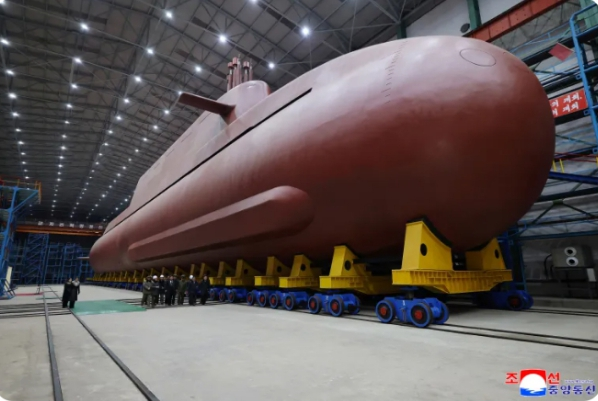
Only days earlier, Kim was shown inspecting a shipyard where an 8,700-ton nuclear-powered submarine is reportedly under construction.
Images released by state media showed Kim walking beside a massive hull inside an assembly hall, flanked by naval engineers and high-ranking officials.
“This vessel will reinforce our maritime deterrent,” Kim reportedly said, linking naval ambitions directly to missile production priorities.
South Korean analysts studying released images suggested the submarine’s design indicates nuclear propulsion, marking a significant technological leap for Pyongyang.
If operational, the submarine could eventually deploy missile systems, providing North Korea with a sea-based second-strike capability.
Kim also used the inspection to criticise South Korea’s plans to develop nuclear-powered submarines, calling them destabilising and provocative.
He warned that Seoul’s ambitions, supported by Washington, would “worsen regional instability” and threaten North Korea’s national security.
At a recent summit, South Korean President Lee Jae Myung urged US support for acquiring nuclear-powered submarines, a move Kim views as deeply hostile.
US President Donald Trump later said Washington was open to sharing certain technologies, further alarming Pyongyang’s leadership.
Against this backdrop, Kim Jong Un missile production push appears aimed at counterbalancing perceived encirclement by US-aligned military capabilities.
Kim also reportedly oversaw test launches of new high-altitude, long-range anti-air missiles over the Sea of Japan.
“These systems enhance our defen
sive shield,” Kim was quoted saying, praising scientists for advancing modernisation goals.
State media said broader modernisation and production plans would be unveiled at the next Workers’ Party congress, expected early next year.
Analysts believe these announcements will formalise expanded weapons manufacturing targets and outline future missile development priorities.
Kim’s emphasis on production efficiency suggests lessons learned from recent conflicts, particularly the importance of sustained ammunition supply.
Observers note parallels with Russia’s wartime industrial mobilisation following its invasion of Ukraine nearly four years ago.
Relations between Pyongyang and Moscow have deepened significantly since the war began, anchored by a mutual defence pact.
North Korea has supplied Russia with artillery shells, missiles, rockets, and even troops, according to Western and South Korean intelligence assessments.
In return, Moscow is believed to have provided financial support, food aid, energy supplies, and advanced military technology.
Washington has also accused Russia of sharing satellite and space technology, enhancing North Korea’s surveillance and targeting capabilities.
Ahn Chan-il, a researcher originally from North Korea, said Pyongyang likely seeks submarine and fighter jet technologies from Russia.
“Missile production is only one part of a much larger military exchange,” Ahn said, highlighting the strategic depth of the partnership.
For Kim, the industrial push also serves domestic political purposes, reinforcing his image as guardian of national security.
Factory visits are carefully choreographed propaganda events, portraying Kim as hands-on and deeply involved in military preparedness.
Workers are often shown applauding enthusiastically, reinforcing loyalty and linking economic hardship to patriotic sacrifice.
Despite chronic food shortages, resources continue flowing into weapons production, reflecting regime priorities.
Humanitarian groups warn that expanding military industries may worsen civilian suffering, though such concerns are absent from state narratives.
Instead, official messaging frames economic strain as necessary for defending sovereignty against hostile forces.
The Kim Jong Un missile production push thus blends ideology, strategy, and symbolism into a single national project.
Regionally, neighbours remain uneasy, with Japan and South Korea closely monitoring developments.
Both countries have expanded missile defence cooperation with the United States in response to North Korean advances.
China, meanwhile, has urged restraint, balancing concern over instability with opposition to increased US military presence.

As 2025 draws to a close, North Korea’s actions suggest no easing of tensions.
Instead, Pyongyang appears committed to entrenching its deterrent through relentless industrial expansion.
Whether this strategy enhances security or fuels further escalation remains deeply contested.
What is clear is that Kim views factories, missiles, and submarines as inseparable tools of state power.
Read also: British anti-disinformation campaigner fights U.S. deportation threat in Court
The missile production drive signals not just military ambition, but a long-term vision of confrontation and resilience.
In Kim’s calculus, deterrence begins on the factory floor and ends with strategic leverage on the global stage.
About The Author