

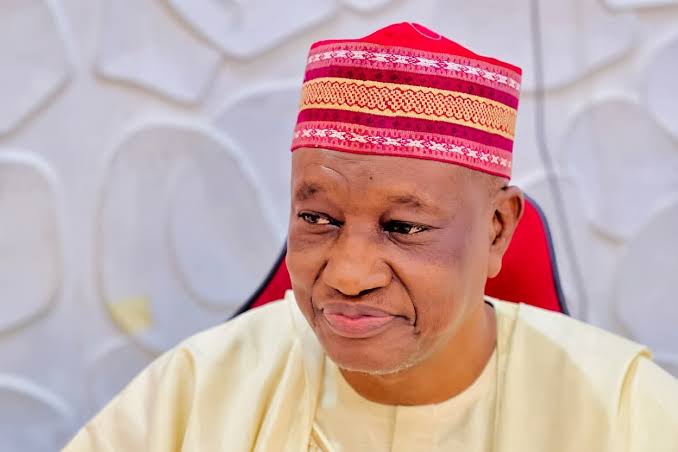
The political atmosphere in Kano State has taken a new turn as the State House of Assembly formally terminated impeachment proceedings against the immediate past Deputy Governor, Comrade Aminu Abdulsalam Gwarzo, following his voluntary resignation from office.
The decision, which brought weeks of political debate and legislative tension to a close, was reached during a plenary session presided over by the Speaker, Hon. Jibril Isma’il Falgore.
Lawmakers agreed that the impeachment process had become unnecessary after the deputy governor stepped down from his position.
The motion for withdrawal was presented by the Majority Leader of the Assembly, Lawan Hussaini, who explained that continuing the process would serve no practical or constitutional purpose.
According to him, once the official in question had vacated office, the Assembly’s primary mandate in the matter had already been fulfilled.
He noted that under the House Rules, specifically Order 3, Rule 6A, legislative proceedings of such nature can be discontinued when the subject of investigation is no longer in office.
Legislative decision and rationale
Addressing journalists shortly after the sitting, Hussaini clarified that the lawmakers acted strictly within their constitutional and procedural boundaries.
He stressed that the impeachment process was never intended to be punitive beyond removal from office.
He stated that since the former deputy governor had already resigned, there was no longer a constitutional basis to proceed with the case.
The Majority Leader further explained that the Assembly is not an investigative agency such as the EFCC or ICPC, but rather a legislative body with defined responsibilities. Once those responsibilities are fulfilled, continuation of proceedings becomes unnecessary.
This position was unanimously supported by members of the House, effectively bringing the matter to a formal close.
Background of the impeachment process
The impeachment proceedings had initially been triggered by allegations of gross misconduct, abuse of office, and breach of public trust against Gwarzo.
The motion was first introduced on March 5, 2026, marking the beginning of a politically sensitive process within the state legislature.
The allegations were linked to his time in office and raised concerns among lawmakers regarding administrative conduct and accountability.
The Assembly subsequently invoked Section 188 of the 1999 Constitution of the Federal Republic of Nigeria (as amended), which outlines the legal framework for the removal of elected officials.
At the time, the House argued that the accusations required legislative scrutiny to uphold public trust and institutional integrity.
However, developments changed when Gwarzo voluntarily stepped down from office amid mounting political pressure and ongoing legislative scrutiny.
Resignation changes legislative direction
Following his resignation, lawmakers reassessed the situation and concluded that pursuing impeachment would be redundant.
The House then shifted focus from disciplinary action to procedural closure.
According to officials, the resignation effectively resolved the constitutional question at the heart of the impeachment effort, since the objective of such proceedings is primarily to remove a sitting officeholder from power.
With this development, the Assembly moved to formally withdraw all charges and discontinue the process entirely.
Kano lawmakers close chapter on allegations
During the plenary session, members reflected on the importance of adhering strictly to constitutional provisions while handling sensitive political matters.
The Speaker, Hon. Jibril Isma’il Falgore, oversaw the proceedings that ultimately led to the unanimous decision.
Lawmakers emphasized that the decision was not influenced by external pressure but was instead based on legal interpretation and procedural necessity.
With the withdrawal, the Assembly declared the matter closed, signaling an end to months of political attention surrounding the former deputy governor.
The Majority Leader reiterated that the House had acted within its legal mandate throughout the process, ensuring due process was followed at every stage.
Link to earlier public service role
Before becoming Deputy Governor, Gwarzo served as Commissioner for Local Government Affairs between 2023 and 2024.
It was during this period that some of the allegations forming the basis of the impeachment attempt were said to have originated.
These claims included administrative irregularities and concerns over governance practices, which later resurfaced during his tenure as deputy governor.
However, with his resignation and the Assembly’s withdrawal of proceedings, no further legislative action is expected on the matter.
About The Author
