Iran–Trump latest strikes intensified sharply on Monday as Israel and Lebanon’s Hezbollah exchanged heavy missile and drone attacks, while the United States confirmed battlefield casualties and Britain responded to a suspected drone strike on one of its overseas military bases.
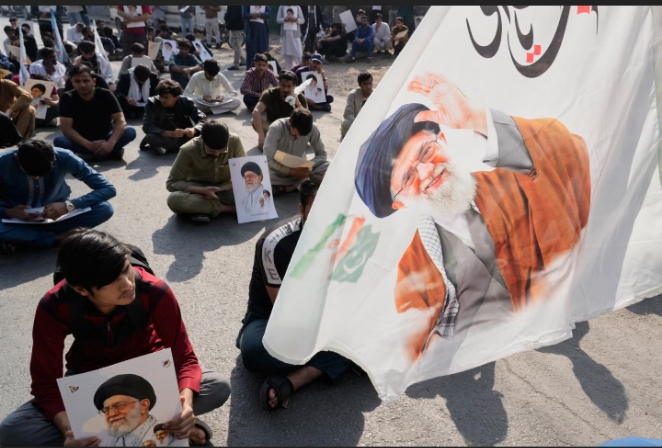
The Iran–Trump latest strikes unfolded across multiple fronts, with Israel launching extensive air operations against Hezbollah-controlled areas in southern Lebanon after the Iran-backed group fired rockets and drones toward Israeli territory in retaliation for the killing of Iranian supreme leader Ayatollah Ali Khamenei.

Israeli military officials said the attacks targeted what they described as Hezbollah command posts, infrastructure, and senior operatives, stressing that preparations for a wider regional escalation had been underway for weeks.
“We were prepared for this scenario and responded with force,” an Israeli spokesperson said, adding that evacuation orders had been issued to dozens of Lebanese villages near the border.
The violence coincided with mounting fallout from the broader confrontation between Iran and the United States under President Donald Trump, who suggested the conflict could continue for weeks.
“Operations are ahead of schedule,” Trump said, while cautioning that the standoff remained fluid and unpredictable.
The US military confirmed its first fatalities since the Iran campaign began, announcing that three American service members were killed and five others seriously injured during recent operations.
US Central Command said the troops were “killed in action,” without disclosing specific locations, citing operational security concerns.
Britain was drawn further into the crisis after the Ministry of Defence confirmed it was responding to a suspected Iranian drone strike on RAF Akrotiri.
“Our armed forces are responding to a suspected drone strike at the base,” a spokesperson said, noting that force protection levels across the region had been raised to their highest state.
Cyprus, a key logistical hub for Western military operations, has taken on increased strategic importance as fighting spreads. UK officials stressed that their actions were defensive, but acknowledged that the risk of further escalation remained significant as regional actors were pulled into the conflict.
In Israel, air defence systems were activated repeatedly as Iran launched a fresh wave of missiles, with explosions reported in Jerusalem and Tel Aviv. Israeli authorities said most incoming projectiles were intercepted, though debris caused damage in several areas.
Iranian officials claimed at least 201 people had been killed by US-Israeli strikes inside Iran, including dozens in a reported attack on a girls’ primary school. Those claims could not be independently verified, but humanitarian organisations warned that civilian casualties were mounting as the conflict widened.
Israel’s military said its Northern Command had significantly reinforced troop deployments along the Lebanese border, enabling what it described as “rapid and robust counterattacks.”
“Hezbollah chose the Iranian regime over the State of Lebanon,” a senior Israeli commander said, warning that the intensity of strikes would increase.
The United States also signalled a major show of force by deploying the USS Gerald R. Ford, the world’s largest aircraft carrier, to the eastern Mediterranean. US Central Command said the carrier was launching aircraft as part of ongoing operations, calling the move a deterrent against further escalation.
Meanwhile, the conflict disrupted civilian life and global travel across the region. Qatar Airways said passengers would have to wait at least another 24 hours for updates, as Qatari airspace remained closed following missile activity near Doha. Tens of thousands of travellers were left stranded as airlines struggled to reroute flights.
In Kuwait, smoke was seen rising near the US embassy compound, according to witnesses, though American officials said the cause was still under investigation. No injuries were immediately reported, but security was tightened around diplomatic facilities.
Regional governments responded cautiously. Australia ruled out participation in US military operations against Iran, with Foreign Minister Penny Wong saying Canberra was not central to the conflict.
“We didn’t participate in these strikes and wouldn’t anticipate participating in the future,” she said, while acknowledging the challenges of evacuating citizens amid widespread airspace closures.

As the Iran–Trump latest strikes continue, analysts warn that the convergence of US, Israeli, Iranian, and Hezbollah actions risks pulling additional countries into a prolonged regional war.
Diplomatic efforts have so far failed to halt the violence, with missile exchanges, drone strikes, and military deployments accelerating rather than slowing.
Despite repeated calls for restraint, both sides appear committed to escalating pressure. For civilians across Israel, Lebanon, Iran, and the Gulf, the immediate concern remains survival and uncertainty, as the Middle East faces one of its most volatile moments in decades.
Read also: BREAKING: US sunk 9 Iranian naval warships and destroyed headquarters, Trump says