Iran says no prospect of talks as the West builds pressure over nuclear issue, citing repeated maximalist demands.
Iranian Foreign Minister Abbas Araghchi said Sunday that US and allied pressure has left no room for meaningful negotiation, framing Western demands as unfair and unrealistic.
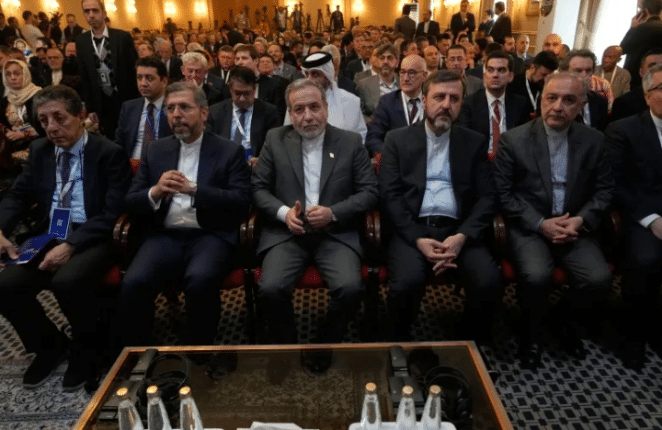
“The current approach of the US government demonstrates no readiness for equitable negotiation to safeguard mutual interests,” Araghchi declared at the Tehran Dialogue Forum attended by regional diplomats.
Iranian officials are also communicating with neighboring countries trying to mediate tensions, with a letter from Araghchi delivered to Qatar’s Prime Minister Sheikh Mohammed bin Abdulrahman.
Communication channels remain open with the International Atomic Energy Agency (IAEA), according to Tehran, even as inspections are limited due to damage to high-enriched uranium facilities.
“There is no enrichment ongoing since our nuclear enrichment sites were attacked,” Araghchi said, affirming Iran’s right to peaceful nuclear energy, including uranium enrichment under international law.
The IAEA’s latest report revealed difficulties verifying Iran’s stockpile of 60 percent-enriched uranium following damage from US and Israeli strikes targeting Fordo, Natanz, and Isfahan sites.
While Bushehr Nuclear Power Plant and Tehran Research Reactor remain accessible, Iran maintains that security and safety conditions prevent inspections at other key facilities with buried high-enriched uranium.
Over the weekend, Iranian officials indicated France, Germany, and the UK may be mobilizing a new resolution to the IAEA board focusing on Iran’s nuclear program.
Araghchi and other officials warned previous censure resolutions prompted escalations in enrichment, citing Israel’s June attacks shortly after the IAEA passed a European-backed resolution on compliance.
Iran’s deputy for international and legal affairs, Kazem Gharibabadi, emphasized that another resolution would have little practical effect, while signaling that Iran may reconsider its approach if imposed.
He explained that US-backed European efforts to reinstate UN sanctions against Iran ignored objections from China and Russia, undermining diplomatic engagement and constructive dialogue with Tehran.
Iran’s nuclear chief Mohammad Eslami accused the West and IAEA of political bias, claiming the agency enforces double standards and acts contrary to the principles of international law.
“The attacks on Iran’s nuclear facilities were unprecedented,” Eslami said, criticizing the IAEA for failing to condemn the strikes while violating international safeguards under its supervision.
Iranian Defense Minister Amir Hatami stressed that military forces are continuously improving capabilities after the 12-day conflict with Israel, reflecting a focus on national security and deterrence.
Tensions remain heightened after the IRGC confirmed it seized a Cyprus-registered tanker passing through the Strait of Hormuz, highlighting ongoing regional vulnerabilities and maritime security concerns.
Araghchi reiterated that Iran remains open to dialogue but will not compromise its sovereign rights over nuclear energy, stressing that peaceful enrichment is non-negotiable despite Western pressures.
Experts suggest that escalating pressure and potential sanctions could increase regional instability, with Iran likely to continue its nuclear program while seeking strategic alliances to counter Western influence.
European powers, including France, Germany, and the UK, are attempting to apply pressure diplomatically through IAEA resolutions, but Iran maintains these efforts are politically motivated rather than genuine negotiations.
The 2015 nuclear deal, now defunct, previously limited Iran’s enrichment capabilities, but Tehran argues that restrictions are no longer binding, asserting its sovereign right to resume peaceful nuclear activities.
IAEA inspections remain a contentious point, with Iran granting limited access while maintaining that security risks prevent full verification, complicating international monitoring and compliance assessments.
Iran’s stance is strengthened by support from China and Russia, which oppose renewed sanctions and call for balanced engagement rather than punitive measures that escalate tensions in the Middle East.
Analysts warn that if Western nations pursue maximalist demands without compromise, Iran may accelerate nuclear programs and regional defense initiatives, potentially destabilizing the already fragile geopolitical environment.
Araghchi’s communication with Qatar highlights ongoing diplomatic channels, emphasizing that regional mediation remains vital to preventing escalation while Western pressures continue to mount on Tehran.
The IAEA’s demand for “long overdue” inspections underscores the challenge of verifying Iran’s nuclear stockpiles, particularly following the June attacks that damaged key enrichment facilities and disrupted monitoring protocols.
Iranian authorities maintain that their nuclear program is intended for peaceful purposes, rejecting Western claims of militarization and insisting that self-sufficiency in energy production is both legal and necessary.
Defense Minister Hatami confirmed that Iran’s armed forces remain vigilant, improving capabilities after conflicts with Israel, and reiterating that sovereignty and security will not be compromised under external pressures.
Iran continues to assert its rights over peaceful nuclear energy while the West builds pressure through diplomatic, economic, and political means, making immediate talks unlikely as Iran says no prospect of talks.
About The Author