Iran president apologises to neighbours after massive explosions rocked Tehran’s Mehrabad airport overnight, with the country’s leadership attempting to calm regional fears while Israeli airstrikes continue across Iran.
The statement came from Iranian President Masoud Pezeshkian, who delivered a televised message apologising to nearby countries and insisting that Tehran does not intend to expand the conflict beyond its borders.
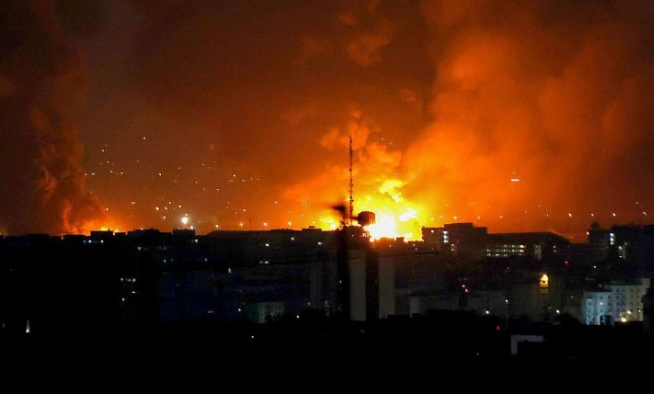
The apology followed reports that one of Tehran’s busiest aviation hubs, Mehrabad International Airport, was struck during a wave of Israeli attacks that triggered large fires and thick smoke across the skyline.
Witnesses described a dramatic scene with burning aircraft and explosions visible across the capital, with one resident saying it was “the second terrible night in a row” for people living near the airport.
Footage circulating online appeared to show flames rising from the airport’s runway area while emergency crews struggled to contain the fires amid continuing military strikes.
Iranian officials said the airport attack was part of a broader campaign targeting military and defence-linked infrastructure inside the country.
The Israeli military confirmed that more than 80 fighter jets participated in the operation, striking multiple sites linked to the Islamic Revolutionary Guard Corps.
Among the facilities reportedly targeted was the Imam Hossein University in Tehran, which Israel claims is used for training IRGC officers.
Military officials also said missile storage depots and underground ballistic missile facilities were struck during the operation.
The overnight bombardment came as Iran launched retaliatory missile and drone attacks toward Israel, prompting air raid sirens in Jerusalem and Tel Aviv.
Israel’s air defence systems intercepted most of the incoming projectiles, according to military statements released early Saturday morning.
Despite the retaliation, Israeli leaders signalled that further operations could continue as part of their campaign against Iranian military infrastructure.
Meanwhile, the conflict has begun affecting aviation and security across the wider Middle East region.
Authorities in the United Arab Emirates temporarily suspended operations at Dubai International Airport after missile threats triggered air defence responses nearby.
Airline giant Emirates initially halted flights to and from the airport, warning passengers not to travel to the facility until further notice.
Operations later resumed on a limited basis after the security situation stabilised, with the airline saying it would continue monitoring developments closely.
The wider aviation disruption has caused several aircraft to circle in holding patterns around Dubai as regional airspace restrictions continue to evolve.
Further south, authorities in Saudi Arabia reported intercepting drones targeting the Shaybah Oil Field, one of the kingdom’s largest oil production sites.
Saudi officials said six drones were destroyed before reaching the facility and that a ballistic missile aimed at Prince Sultan Air Base was also intercepted.
The growing regional tensions come as the United States intensifies its involvement in the conflict.
According to US military officials, more than 3,000 targets inside Iran have been struck since the start of the operation.
The campaign, known as Operation Epic Fury, aims to dismantle Iran’s military command structure and reduce its ability to launch attacks across the region.
US President Donald Trump has taken an especially hard line in recent days, declaring that there will be “no deal” with Iran unless it accepts what he called “unconditional surrender.”
Trump has also suggested that Iran should select a new leader acceptable to Washington after the conflict ends, a statement that has drawn criticism from analysts and foreign governments.
Many observers believe such demands are unlikely to be accepted by Iran’s political establishment, which has historically rejected foreign influence in its leadership decisions.
Iran’s current power structure remains under intense pressure following the assassination of several senior commanders and clerics during the early days of the conflict.
Despite internal divisions between reformists and hardliners, analysts say the Iranian political elite remains united in preserving the Islamic Republic system.
Some reports suggest the country’s Assembly of Experts may consider appointing a temporary leadership council rather than a single supreme authority during the crisis.
However, Israeli officials have warned that any new leadership figures associated with Iran’s military operations could become targets in future strikes.
Inside Tehran, residents described an atmosphere of fear and exhaustion following repeated nights of bombardment.

One woman living near the airport said the explosions woke her at around 2am and that windows in nearby buildings shattered from the shockwaves.
Another resident said the smell of smoke lingered across parts of the city hours after the strikes ended.
Internet outages across Iran have made it difficult for journalists and families abroad to communicate with people inside the country.
Several residents reported briefly reconnecting online before losing access again as infrastructure struggles to cope with the conflict.
At the same time, thousands of people have begun fleeing conflict zones across the region.
In neighbouring Lebanon, heavy Israeli strikes on areas linked to Hezbollah have forced many civilians to leave their homes.
Schools in Beirut have been converted into temporary shelters as the humanitarian situation worsens.
Further east, Qatar has partially reopened its airspace to allow evacuation flights from Hamad International Airport.
Officials said priority would be given to elderly travellers, families, and people requiring urgent medical assistance.
The first flight to depart since the war began left Doha bound for London, signalling the gradual reopening of regional travel corridors.
Despite these efforts, the security environment remains highly unstable across the Middle East.
Military analysts warn that the escalating cycle of strikes and counterstrikes risks dragging additional countries into the conflict.
Energy markets are also watching the situation closely, particularly after attacks targeted oil infrastructure and shipping routes near the Strait of Hormuz.
Any disruption to the region’s oil supply could have major consequences for global fuel prices and economic stability.
For now, Iran’s leadership appears focused on preventing the war from spreading to neighbouring countries.
In his televised message, Pezeshkian emphasised that Iran would only strike other states if attacked first.
He also warned regional governments against supporting Israel or the United States militarily.
Read also:Tehran night of terror: Residents describe Panic as airstrikes shake Iranian capital
“Those considering exploiting this moment to attack Iran must not become puppets of imperialism,” he said.
The president added that cooperation among neighbouring countries was essential to restore stability and prevent further escalation.
Whether such appeals will ease regional tensions remains uncertain as airstrikes and missile exchanges continue.
With major military powers already involved and the conflict spreading across multiple countries, many observers fear the crisis could still deepen in the coming days.
About The Author