INEC Chairman Joash Amupitan vows to defend electoral integrity, transparency, and fairness in Nigeria’s elections, assuring citizens of credible and accountable polls.
Newly appointed Chairman of the Independent National Electoral Commission (INEC), Professor Joash Amupitan, officially assumed duty on Thursday in Abuja with a firm promise to safeguard electoral integrity across Nigeria.
He declared that under his leadership, the Commission would remain independent, transparent, and fully committed to conducting credible elections that truly reflect the will of the Nigerian people.
Professor Amupitan arrived at the Commission’s headquarters in Maitama, Abuja, at 2:27 p.m., in a white Coaster bus accompanied by National Commissioners and aides.
His assumption of office followed his swearing-in earlier that day by President Bola Ahmed Tinubu, after his confirmation by the Senate and endorsement by the National Council of State.
Dressed in a white babariga and matching Yoruba cap, the new INEC Chairman was warmly welcomed into the Commission’s Conference Hall around 2:57 p.m. He was introduced to Directors and senior management staff amid cheers and applause.
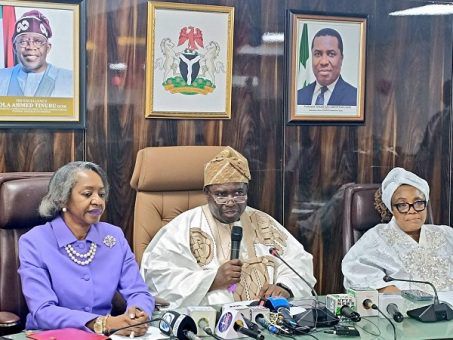
Amupitan’s assumption of duty was graced by a distinguished delegation from the University of Jos, where he had served as Deputy Vice-Chancellor.
Among those who accompanied him were his wife, also a professor; the Vice-Chancellor; the Registrar; the Deputy Vice-Chancellor; the Bursar; and the University Librarian.
His impressive academic profile, leadership record, and ethical reputation have been described as fitting for a man entrusted with the task of defending Nigeria’s democratic process and promoting electoral integrity.
In his inaugural address to staff, Professor Amupitan declared that the electoral integrity of Nigeria’s democracy is non-negotiable. He stressed that INEC’s primary duty is to conduct free and fair polls that genuinely mirror the choices of Nigerian voters.
“Our constitutional responsibility is clear,” he said.
“INEC must deliver credible elections that represent the will of the people. The eyes of Nigerians are on us, and we cannot compromise the electoral integrity of this nation.”
He added that transparency, discipline, and unity would be the guiding principles of his administration.
Every INEC official, he emphasized, must embody honesty and accountability in the discharge of their duties.
Professor Amupitan underscored the importance of teamwork in achieving INEC’s constitutional mandate.
According to him, while individual performance indicators are important, the real strength of the Commission lies in collective responsibility.
“We must work together as one team,” he stated.
“Each staff member brings unique skills and experience to the table. By collaborating effectively, we can improve our processes and reinforce public trust in INEC.”
He further assured staff that their welfare, training, and professional development would remain top priorities during his tenure, as motivated workers are vital to sustaining electoral integrity.
“INEC is not just an agency—it is the guardian of Nigerian democracy,” he noted.
“To protect that democracy, we must operate with discipline and excellence at all times.”
The INEC Chairman identified the forthcoming Anambra State governorship election as an immediate test of the Commission’s credibility.
He described the poll as an opportunity to reaffirm INEC’s dedication to free and fair polls.
“The Anambra election is not just another exercise,” he said.
“It is a defining moment for us to demonstrate our commitment to electoral integrity and fairness. The eyes of the entire nation are upon us, and we must rise to the occasion.”
He urged all staff members to be vigilant, professional, and patriotic, warning that any act of compromise could undermine years of democratic progress.
Acknowledging that public trust in the Commission must be rebuilt, Amupitan pledged to strengthen transparency and embrace technological innovation in electoral processes.
He said future elections would leverage advanced systems for voter registration, result transmission, and monitoring to ensure credibility.
“Technology will continue to play a central role in achieving transparency,” he stated.
“But technology alone cannot guarantee electoral integrity—it must be supported by ethical conduct and professionalism from all staff.”
He also extended an open hand to civil society organizations, political parties, and the media, urging them to collaborate with INEC in safeguarding democracy.
“Democracy thrives when everyone plays their part,” he said. “Electoral integrity is a collective responsibility.”
Observers have described Amupitan’s appointment as the dawn of a new era for INEC—one characterized by ethical leadership, accountability, and a commitment to national service.
His experience as a university administrator and academic is expected to bring analytical discipline and data-driven management to the Commission’s operations.
Under his leadership, stakeholders hope to see improved logistics, stronger institutional capacity, and better election management practices.
Amupitan’s early statements suggest a focus on restoring credibility, strengthening staff morale, and ensuring that every vote counts.
In his closing remarks, the INEC Chairman reassured Nigerians that he will lead by example and maintain a high moral standard.
“We owe it to our nation to protect its democratic values. The electoral integrity of Nigeria must never be compromised,” he declared.
More news at ireport247news
About The Author