

When the Indonesian president’s US ties questioned amid public anger over Iran war debate erupted, it highlighted a growing political storm surrounding President Prabowo Subianto’s foreign policy decisions.
The controversy intensified after the United States and Israel launched coordinated attacks against Iran, prompting Indonesia’s government to call for restraint and diplomatic dialogue.
Indonesia’s Ministry of Foreign Affairs posted that the country urges all parties to “exercise restraint and prioritize dialogue,” presenting Jakarta as a potential mediator in the escalating crisis.
Officials also suggested that President Prabowo Subianto could personally travel to Tehran if both sides agreed to mediation efforts.
Yet the diplomatic gesture quickly ignited domestic debate, with critics warning the move could deepen public suspicion about Indonesia’s relationship with Washington.
Some analysts argued the proposal appeared disconnected from the geopolitical reality unfolding across the Middle East.
Former deputy foreign minister Dino Patti Djalal publicly questioned the initiative, describing the mediation proposal as “highly unrealistic.”
He added that announcing such an offer publicly without prior consultation raised concerns about Indonesia’s diplomatic strategy.
Other experts warned the proposal could reinforce perceptions that Jakarta is moving closer to the United States under Prabowo’s leadership.
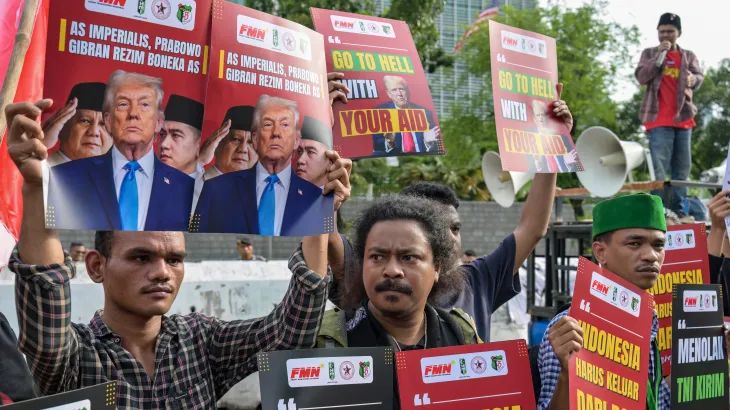
Political analyst Ian Wilson said Indonesians might interpret the initiative as “further alignment with Trump and therefore Netanyahu.”
Wilson argued that the mediation proposal was unlikely to succeed given the breakdown of negotiations between Iran and the United States.
According to him, diplomatic channels between Tehran and Washington have already collapsed following recent military escalations.
The domestic criticism comes at a time when Indonesia’s foreign policy direction is already under intense scrutiny.
Prabowo previously pledged to deploy 8,000 Indonesian troops to Gaza as part of an International Stabilization Force.
The deployment was proposed under the umbrella of a controversial initiative called the “Board of Peace,” supported by US President Donald Trump.
Critics within Indonesia say participation in the plan undermines the country’s longstanding support for Palestinian independence.
Indonesia has historically refused to establish formal diplomatic relations with Israel due to its stance on the Palestinian issue.
Many Indonesians therefore view participation in the Board of Peace initiative as contradictory to the nation’s traditional foreign policy principles.
Wilson described the initiative as part of a “dystopian plan” that could divide Gaza into administrative zones.
He argued that Indonesia’s participation risks legitimising a geopolitical arrangement designed outside United Nations frameworks.
For decades Indonesia has adhered to a diplomatic doctrine known as “bebas-aktif,” meaning “independent and active.”
This principle emphasizes neutrality while actively contributing to international peace efforts.
The policy dates back to the Cold War era when Indonesia helped establish the Non-Aligned Movement.
Under this doctrine, Jakarta avoided formally aligning itself with major global power blocs.
Instead the country sought to act as a bridge between competing geopolitical interests.
Analysts say the current controversy raises questions about whether that strategy is being abandoned.
Humanitarian activist Sarbini Abdul Murad criticized Indonesia’s official response to the Iran conflict as “regrettably naive.”
He noted that government statements focused on mediation rather than condemning the killing of Iran’s Supreme Leader Ayatollah Ali Khamenei.
Murad pointed out that Malaysia’s prime minister had publicly condemned the assassination, while Indonesia remained relatively cautious.
According to Murad, the lack of a stronger reaction signaled uncertainty about Indonesia’s diplomatic stance.
Foreign Minister Sugiono later stated that President Prabowo had conveyed condolences to Iran’s president following Khamenei’s death.
However, critics argued the gesture came too late to ease public dissatisfaction.
Indonesia now finds itself navigating a complex regional reaction to the widening Middle East conflict.
Although the country is home to the world’s largest Muslim population, its relationship with Iran has historically been complicated.
About 87 percent of Indonesia’s 270 million citizens are Muslim, the majority of whom follow Sunni Islam.
Iran, by contrast, is predominantly Shia, representing a different branch of Islamic theology.
In the past, sectarian tensions contributed to anti-Shia sentiment among some Sunni groups in Indonesia.
Yet analysts say geopolitical factors now shape Indonesian attitudes toward Iran more strongly than religious differences.
Many Indonesians sympathize with Iran largely due to widespread criticism of Israeli and American policies in the region.
Political researcher Made Supriatma noted that “anti-Israel and anti-American sentiment has long been high” among segments of Indonesian society.
Despite this sympathy, Iran has not inspired the same scale of public mobilization seen during the Gaza conflict.
When Israel’s war in Gaza began, thousands of Indonesians attended demonstrations across major cities.
Protests regarding the Iran war have largely been confined to discussions on social media platforms.
Still, the online conversation reflects deep public frustration with US actions in the Middle East.
Some Indonesians believe the conflict was initiated by Washington and Tel Aviv rather than Tehran.
A Jakarta resident named Ramadhan said he supported Iran’s right to defend itself.
“For me, it is not about religion but about humanity,” he explained when discussing the war.
He cited reports of air strikes on civilian infrastructure as a key reason for his position.
In particular, the bombing of a girls’ school in the southern Iranian city of Minab provoked widespread anger.
Reports said the strike killed 165 students and staff members.
Images and videos from the attack circulated widely online, fueling outrage among Indonesian social media users.
While these sentiments grow domestically, diplomatic progress toward mediation appears unlikely.
Iran’s ambassador to Indonesia welcomed the idea of mediation but emphasized that no concrete steps had been taken.
Ambassador Mohammad Boroujerdi suggested that negotiations with the United States would likely be ineffective.
He stated that Washington does not consistently honor agreements reached during diplomatic talks.
As a result, Tehran remains skeptical about reopening negotiations with American officials.
Meanwhile President Prabowo has begun consulting Indonesia’s political elite about the crisis.
He recently held a meeting attended by former presidents, vice presidents and senior political leaders.
The discussion reportedly lasted more than three hours and focused on geopolitical and economic consequences of the Iran war.
Former foreign minister Hassan Wirajuda later said the government was prepared to “evaluate” Indonesia’s involvement in the Board of Peace initiative.
The statement suggested that Prabowo may reconsider aspects of his foreign policy strategy.
Read also: David Lammy says Trump has no right to choose Iran’s next leader
However analysts believe the president now faces a difficult balancing act.
On one hand he aims to expand Indonesia’s global diplomatic influence.
On the other hand domestic pressure demands a clear stance against US and Israeli military actions.
Supriatma said Prabowo appears “cornered” by his own foreign policy choices.
He argued the president has struggled to explain why Indonesia should participate in Trump’s Board of Peace.
According to Supriatma, the government also lacks a coherent position regarding relations with Washington and Israel.
Public opinion inside Indonesia may ultimately determine how long the current strategy can survive.
Images of civilian casualties from the Middle East continue circulating widely across Indonesian media platforms.
As those images spread, public anger toward the United States could intensify further.
For now, the debate over the Indonesian president’s US ties questioned amid public anger over Iran war reflects a deeper struggle over Indonesia’s role on the global stage.
Whether Jakarta maintains its historic non-aligned approach or moves closer to Western alliances may shape the country’s diplomacy for years to come.
About The Author


