In a rare gesture of cooperation and fragile hope, the Red Cross accompanies Hamas into Gaza’s devastated zones to help locate and recover the bodies of missing Israeli hostages.
The move marks a cautious but significant turn in humanitarian coordination after months of fierce conflict, testing the delicate balance of the ongoing Gaza ceasefire brokered under U.S. pressure.
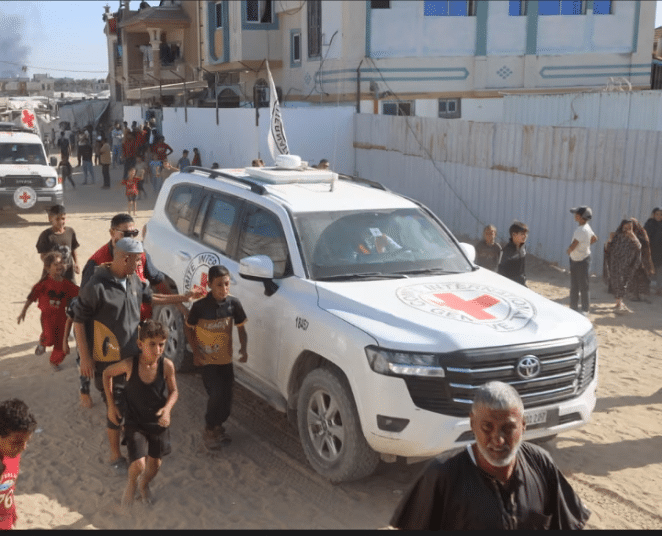
For the first time since the October truce began, international monitors have confirmed that the Red Cross accompanies Hamas beyond the Israeli-designated security perimeter, acting as a neutral intermediary in the painstaking mission.
“This is about dignity in death,” said Sarah Davies, an International Committee of the Red Cross spokesperson. “We’re simply ensuring both sides uphold humanitarian law amid unimaginable loss.”
Under the U.S.-mediated ceasefire agreement signed on October 10, Hamas committed to return the remains of all Israeli hostages, while Israel pledged to release Palestinian bodies in exchange.
The Red Cross accompanies Hamas during these searches not as a political actor but as a humanitarian presence, monitoring the safe retrieval of bodies from areas riddled with debris and unexploded munitions.
Israeli media confirmed the coordination on Monday night, noting that the Israel Defense Forces, Egyptian recovery crews, and the Red Cross jointly facilitated the retrieval operation near Rafah.
A senior IDF officer described it as “a grim but necessary duty,” adding, “Families deserve closure; even one return means one less mother waiting in the dark.”
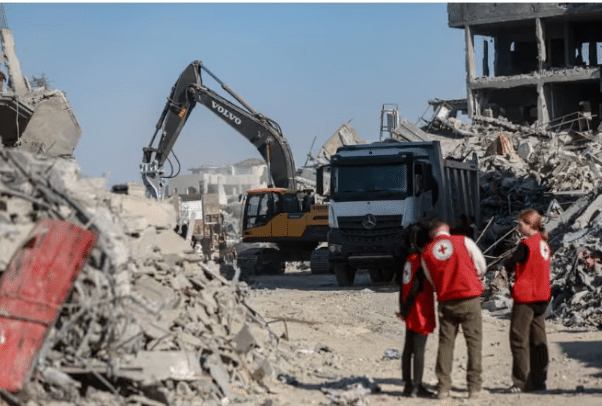
So far, Hamas has returned 15 sets of remains, but officials believe at least 12 more Israeli hostages lie buried beneath Gaza’s ruins, trapped under what aid workers estimate as sixty million tonnes of rubble.
The task remains daunting. “Each excavation brings the stench of war back,” said a Red Cross field worker, who spoke under anonymity for safety. “Still, we go where compassion demands.”
According to Hamas’s military wing, the al-Qassam Brigades, the group faces difficulty locating all the bodies, claiming several of their units responsible for captives were killed during bombardments.
International observers have welcomed the mission as a potential confidence-building measure that could prolong the fragile Gaza ceasefire, which many fear could collapse with a single misstep.
“This is precisely the kind of action that can prevent further escalation,” said Hadi al-Masri, a Palestinian analyst in Ramallah. “When the Red Cross accompanies Hamas, it’s a statement of accountability.”
Yet not everyone shares that optimism. Critics in Israel argue that Hamas’s cooperation is strategic, designed to buy time amid pressure from Washington following the latest Trump ultimatum.
On Saturday, former U.S. President Donald Trump warned Hamas to “return the bodies of the deceased hostages quickly” or face international consequences that could “reshape the peace framework entirely.”
The Trump ultimatum sent ripples through diplomatic circles, pushing both Hamas and Israel into a rare moment of synchronization over a single humanitarian mission.
As the deadline neared, footage surfaced showing Hamas’s so-called “Shadow Unit” escorting a Red Cross vehicle into the al-Tuffah neighborhood, where excavators dug under supervision of Egyptian teams.
Eyewitnesses described a scene heavy with tension yet faintly hopeful: “We saw the Red Cross accompanies Hamas, but it didn’t look like politics. It looked like people trying to end a nightmare,” said a Gaza resident.
The International Committee of the Red Cross clarified it did not take part in the negotiations nor physically recover the remains, but its presence provided crucial guarantees of safety.
“The parties to the conflict determine the modalities,” Davies reiterated. “We simply ensure no violations occur during such sensitive humanitarian efforts.”
For many families of the missing, that reassurance matters. “My son has been gone for months,” said an Israeli mother in Tel Aviv. “If the Red Cross accompanies Hamas, maybe I’ll finally have something to bury.”
Human rights advocates have praised the move as an example of what multilateral diplomacy can still achieve even amid deep enmity. “This cooperation reflects the moral strength of humanitarian neutrality,” said Dr. Nadia Al-Shami, a Geneva-based legal scholar.
Still, the process remains politically volatile. Israeli officials insist Hamas could locate the remaining bodies if it “truly wanted to,” while Hamas counters that Israeli bombardment has erased entire neighborhoods.
“Hamas knows where the hostages are,” said Israeli spokesman Shosh Bedrosian. “They just won’t admit it until it serves their narrative.”
In Gaza City, however, Hamas officials maintain a different stance. “Some bodies are simply unreachable,” said Khalil al-Hayya, a senior negotiator. “We lost contact with entire units buried under the same ruins.”
The Gaza ceasefire, although holding, trembles under growing distrust. Trump’s reemergence as a vocal mediator has polarized reactions across the Middle East, with Egypt and Turkey watching cautiously.
Analysts suggest the Trump ultimatum was partly meant to pressure Hamas into progress on another sticking point — Hamas disarmament, a precondition for any lasting peace under Israeli terms.
“Trump plays the dealmaker,” said Yossi Melamed, an Israeli journalist. “He ties humanitarian action with political surrender — the return of bodies today, the surrender of weapons tomorrow.”
Washington officials confirmed receiving “assurances” from Hamas about its willingness to disarm, though the timeline remains uncertain. “Some commitments exist on paper, but not yet in practice,” said one U.S. diplomat.
Hamas leadership remains cautious, linking Hamas disarmament to broader political guarantees. “If the occupation ends, these weapons will be handed to the state,” al-Hayya told Al Jazeera.
That conditional tone underscores Hamas’s survival instinct amid shifting power dynamics in Gaza, where Israel and Egypt jointly oversee reconstruction and security under international supervision.
Meanwhile, the Red Cross’s involvement has drawn global respect for upholding neutrality in an atmosphere poisoned by suspicion. “Where the Red Cross accompanies Hamas, the world glimpses decency amid despair,” noted Amnesty’s Middle East director.
Such decency is rare. Over 10,000 Palestinians remain missing under the rubble, according to Gaza’s health ministry, with thousands more displaced and infrastructure nearly annihilated.
Each recovery mission intertwines tragedy and diplomacy. “We find bones beside broken toys, and suddenly the ceasefire feels both sacred and temporary,” said a Red Cross logistics officer stationed near Rafah.
The Gaza ceasefire itself has become a political tightrope — one that could determine the future of Gaza’s governance once Hamas formally relinquishes control.
Turkey has offered to contribute troops to a stabilization force, but Israel’s foreign minister Gideon Saar firmly rejected Ankara’s involvement, citing President Erdoğan’s “hostile stance toward Israel.”
“It is not reasonable to let their forces into Gaza,” Saar told reporters, deepening the regional rift even as the humanitarian coordination continues.
Despite the political wrangling, the Red Cross accompanies Hamas as proof that moral imperatives can still cross military lines. Its presence signifies that compassion, not confrontation, defines true victory.
“The world must not underestimate what a handshake means here,” said UN envoy Laura di Bartoli. “A convoy passing safely through ruins is a small miracle.”
Indeed, for many in Gaza and Israel alike, this cooperation — however limited — restores faint faith in the idea that coexistence can grow even from ruin.
Families from both sides have gathered at crossings, awaiting news with cautious optimism. “If this is what peace looks like, I’ll take it,” whispered an elderly Palestinian man near Khan Younis.
As night descends over Gaza’s battered skyline, the Red Cross teams prepare for yet another mission, headlights piercing dust clouds where silence once screamed.
In those brief moments when the Red Cross accompanies Hamas, humanity stands taller than politics — a quiet testament that even in the bleakest conflicts, mercy can still find a way home.
About The Author