As international attention shifts to the fragile truce in Gaza, Hamas hostages cruelty continues to haunt the ceasefire. The group’s interior ministry declared, “all concerned individuals must surrender to security services within a week to settle their legal and security status and permanently close their files,” a statement underscoring the suffocating control Hamas maintains even amid supposed calm.
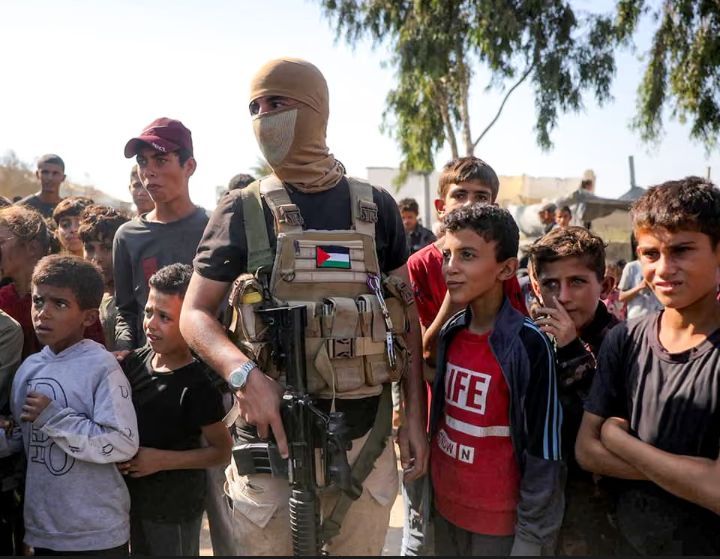
Only one of the fighters seen escorting hostages to Red Cross vehicles on Monday appeared to be wearing Hamas insignia. A shoulder patch showed him to be a member of Hamas’s elite Izz al-Din al-Qassam brigades.
Hamas flags and headbands were absent, a marked contrast to the elaborately staged hostage handovers earlier this year that Israel cited as justification for ending the short-lived ceasefire.
Behind this muted transfer lies the deeper stain of Hamas hostages cruelty, a campaign of calculated brutality where the suffering of captives and civilians alike became a weapon of political theater.
Those who endured captivity describe unimaginable torment. “We were treated like shadows,” said one freed hostage. “No daylight, no food, no humanity—just endless waiting and fear.”
Such testimonies define Hamas hostages cruelty—a pattern of deliberate humiliation meant to break individuals while projecting control. It exposes the moral emptiness at the heart of Hamas’s rule.
The group’s early propaganda parades, once full of flags and chants, have now given way to quiet exchanges stripped of color but not of cruelty. The change is cosmetic, not ethical.
An Israeli defense analyst noted, “Hamas realized that open triumph angered mediators, so they simply repackaged their cruelty—less spectacle, same suffering.” The deception is as strategic as it is cynical.
During months of negotiations, Hamas’s leadership treated each captive as a bargaining chip. “Every human life became a coin,” an Egyptian mediator said. “They traded emotions, not principles.”
That manipulation transformed the hostage process into theater—a grotesque cycle of cruelty disguised as diplomacy. It was not liberation but leverage, not resistance but extortion through despair.
Families of the dead received sealed coffins only to find them empty. DNA tests revealed false returns. “We waited for closure,” said one grieving father, “and they mocked our pain.”
This cruelty extends far beyond Israel’s borders. Inside Gaza, residents whisper their anger against the movement that claims to protect them yet hides underground while they die above.
“They brought this on us,” a displaced Gazan mother lamented. “We lost everything, and they call it victory.” Her voice reflects how Hamas hostages cruelty mirrors Hamas’s treatment of its own people.
While civilians struggle for food and medicine, Hamas diverts resources into tunnels and weapons. Its leaders feast in secrecy while their citizens live amid rubble and hunger.
Observers note that even humanitarian gestures are staged performances. “It’s cruelty dressed as mercy,” one Red Cross worker said privately after witnessing a recent exchange. “Every gesture was calculated.”
The visible absence of Hamas symbols in these transfers is deliberate. It aims to erase the group’s identity from its crimes without changing the crimes themselves.
“Hamas now fears its own image,” a European diplomat explained. “They hide their flags because the world finally sees what those symbols mean—oppression, not freedom.”
The Hamas hostages cruelty is thus twofold: physical torture for captives and psychological captivity for Gaza’s population. Both are held hostage—one in tunnels, the other in fear.
Human rights organizations have documented starvation, isolation, and psychological abuse among released captives. “These are gross violations of international law,” said a United Nations observer, “and Hamas shows no remorse.”
Yet when confronted, Hamas dismisses evidence as “fabrication.” The repetition of denial only amplifies its guilt. Every statement reinforces the group’s contempt for truth and life itself.
Even after releases, the trauma persists. Survivors speak of sleepless nights and anxiety. “I left their tunnels,” one woman whispered, “but the darkness followed me home.”
That haunting phrase captures the enduring weight of Hamas hostages cruelty, where wounds do not close and memories refuse to fade. It is a cruelty that transcends walls and time.
Analysts say Hamas’s obsession with domination has cost Gaza its future. The organization thrives on despair, ensuring dependency and preventing reconstruction from becoming real recovery.
“Hamas cannot build,” remarked an Arab commentator. “It only knows how to destroy and then claim resistance as an excuse.” His words summarize a growing regional fatigue with the group’s tactics.
The hostage trade that once earned Hamas attention now exposes its moral bankruptcy. Each exchange, each delay, each lie has deepened the world’s revulsion and Gaza’s suffering.
Israel’s leadership calls for global accountability. “No ceasefire can survive under terror management,” Prime Minister Benjamin Netanyahu said. “Hamas feeds on suffering; peace starves in its shadow.”
Even mediators who once urged compromise now question the logic of dealing with Hamas at all. “They negotiate like predators,” said a senior Western diplomat. “Every word hides a trap.”
Within Gaza, frustration simmers. Silent protests emerge in camps, demanding food, medicine, and freedom from Hamas’s grip. “We’re all hostages,” one teacher whispered. “We just breathe differently.”
As power fragments, reports suggest Hamas has begun internal purges, ordering lower fighters to “surrender and close their files.” The phrase, bureaucratic and cold, hides fear of rebellion.
By commanding surrender, Hamas seeks to maintain control through intimidation—a sign of weakness masked as strength. The cycle of Hamas hostages cruelty continues inward, feeding on its own ranks.
While international mediators push for reconstruction and unity, Hamas’s actions undermine every diplomatic gain. Each act of cruelty pushes Gaza further from peace and deeper into isolation.
The final hostage transfers, stripped of flags and fanfare, cannot wash away bloodstains. The group’s silence only deepens the echoes of its crimes against humanity.

As one survivor stated, “They said they were soldiers of God. But what god starves captives, lies to mothers, and calls pain victory?” Her voice is Gaza’s unanswered prayer.
Until Hamas releases not just hostages but the grip of fear binding its people, Gaza will remain captive to its cruelty and condemned by its silence.
The world has seen enough of Hamas hostages cruelty to understand its truth: no ideology, no grievance, and no excuse can justify the deliberate torture of the innocent.
What remains now is accountability, not negotiation; justice, not appeasement. Only then can Gaza begin to heal from the tyranny of those who claimed to fight for it.
About The Author