Train Collision in Southern Spain– Spain has been plunged into mourning after a devastating high-speed rail collision in the southern province of Córdoba left at least 21 people dead and more than 75 injured, marking one of the country’s deadliest rail disasters in recent years.
The tragedy unfolded near the town of Adamuz on Sunday evening when two passenger trains travelling on the same corridor derailed and collided, triggering a complex overnight rescue operation amid twisted metal, overturned carriages and shattered infrastructure.
The accident occurred shortly after one of the trains, operated by private rail company Iryo, departed Málaga en route to Madrid.
Approximately ten minutes into the journey, the train derailed on what authorities later described as a straight section of track.
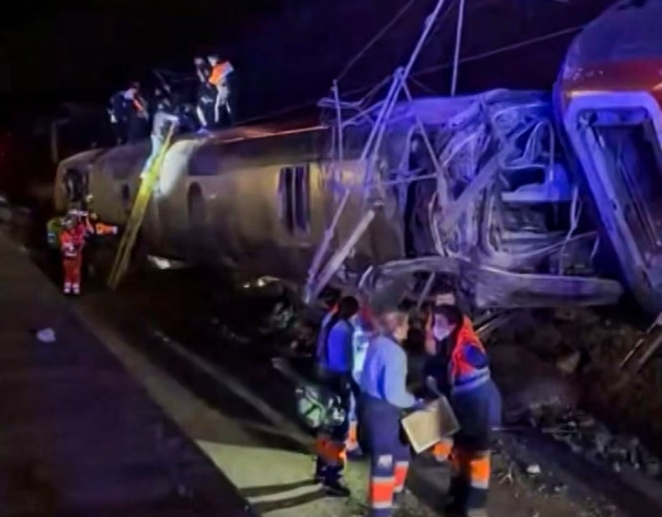
The derailment caused the train to veer into the opposite line, where it struck an oncoming passenger service travelling from Madrid to Huelva.
The force of the collision sent multiple carriages off the rails, with at least one train plunging down an embankment, complicating rescue efforts and prolonging access to trapped passengers.
Emergency services were dispatched within minutes, with firefighters, paramedics, police units and civil protection teams converging on the rural crash site as daylight faded.
The scale of the disaster quickly became apparent as responders worked through the night, navigating unstable wreckage and narrow access points to reach survivors.
Medical teams established triage zones close to the tracks, while helicopters and ambulances transported the injured to hospitals across Andalucía and beyond.
Officials confirmed that at least 75 people required hospital treatment, including 15 in critical condition. Authorities cautioned that the death toll could rise further as search teams continued to inspect damaged carriages and remove debris.
Many of the fatalities and severe injuries were concentrated in the first two carriages of the Madrid–Huelva train, which bore the brunt of the impact when the derailed train crossed into its path.
Survivors described moments of terror as the trains jolted violently before coming to a sudden halt. Passengers reported hearing loud bangs, feeling intense shaking and being thrown from their seats as lights went out inside the carriages.
Luggage tumbled from overhead racks, windows shattered, and smoke filled several compartments. In the darkness, some passengers used emergency hammers to break windows and escape, while others assisted the injured or attempted to comfort fellow travellers until help arrived.
One passenger recalled that the impact felt like an earthquake, while another described watching a carriage ahead completely overturn. Several accounts spoke of confusion and fear as people tried to understand what had happened, unsure whether further danger was imminent.
Rail staff onboard the trains were seen instructing passengers to remain seated where possible, conserve phone battery power and use torches sparingly while awaiting evacuation orders.
Fire officials confirmed that evacuating passengers from the first train was completed within hours, but reaching those inside the second train proved significantly more challenging.
Severely damaged carriages, crushed metal frames and awkward angles made access extremely difficult. Rescuers were forced to work slowly, cutting through wreckage and stabilising sections of the train to prevent further collapse.
At times, the operation required the removal of bodies in order to reach potential survivors, underscoring the grim reality faced by emergency teams.
Local residents from Adamuz, a small town of about 5,000 people, quickly mobilised to support victims. Community centres were converted into temporary reception shelters where stranded passengers received food, blankets and warm drinks as temperatures dropped to near 6°C overnight.
Volunteers worked alongside local authorities to provide comfort and practical assistance to those who had escaped injury but were unable to continue their journeys.
Spain’s prime minister described the incident as a night of profound national sorrow and cleared his schedule to focus on the unfolding crisis.
Senior government officials travelled to the scene and to hospitals treating the injured, while messages of condolence and solidarity poured in from across the country.
The king and queen were also briefed on developments and expressed deep concern for the victims and their families.
The transport minister said the cause of the derailment was not immediately known and stressed that it was highly unusual for such an incident to occur on a straight section of modern track.
Preliminary information indicated that the affected stretch of railway had undergone renewal work only months earlier, raising urgent questions about infrastructure integrity, signalling systems and operational safety.
Investigators from the national rail authority and independent safety bodies were deployed to examine data recorders, track conditions and train mechanics as part of a full inquiry.
Reports suggested that the Madrid–Huelva train was travelling at approximately 200 kilometres per hour at the moment of impact, though officials said further analysis was required to confirm exact speeds for both trains.
Spain’s rail operator suspended all services between Madrid and Andalucía indefinitely as a precautionary measure, leaving thousands of passengers stranded and prompting widespread disruption across the national rail network.
The disaster has reignited debate over rail safety standards in Spain, a country known for having one of Europe’s most extensive high-speed rail systems. While the network has long been regarded as modern and reliable, the collision has highlighted vulnerabilities that experts say must be urgently addressed.

Transport analysts have called for a transparent investigation and swift implementation of any safety recommendations that emerge, warning that public confidence in rail travel depends on accountability and reform.
Medical professionals treating the injured reported a wide range of trauma cases, including fractures, internal injuries and head wounds.
Hospitals across the region activated emergency protocols to accommodate the influx of patients, while neighbouring regions offered additional capacity if required. Psychological support teams were also deployed to assist survivors and families coping with shock and grief.
As daylight broke on Monday, the full scale of the destruction became clearer. Aerial images showed carriages lying on their sides, tracks twisted out of alignment and debris scattered across the surrounding countryside.
Heavy machinery was brought in to begin the painstaking process of clearing the site, though officials cautioned that restoring rail services would take time given the severity of the damage.
Authorities confirmed that approximately 400 passengers were travelling on the two trains combined at the time of the collision.
Efforts to identify the deceased and notify next of kin were ongoing, with officials urging patience and sensitivity as families awaited news.

Flags were lowered in several regions, and moments of silence were observed as Spain collectively mourned those lost in the tragedy.
While investigations continue, the focus remains on supporting victims, ensuring accountability and preventing similar disasters in the future.
The collision near Adamuz stands as a sobering reminder of the risks inherent in mass transportation and the devastating consequences when safety systems fail.
For now, Spain grieves, rescue workers persevere, and a nation searches for answers in the aftermath of an unthinkable rail tragedy.
About The Author