#FreeNnamdiKanuNow protest in Abuja sees police teargas, arrests, and roadblocks as activists demand the release of detained IPOB leader Nnamdi Kanu.
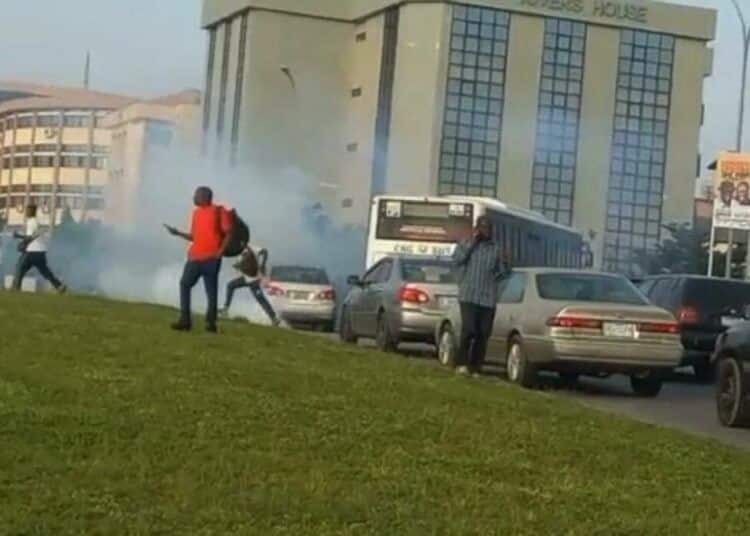
The #FreeNnamdiKanuNow protest escalated tensions in Abuja on Monday as security operatives of the Nigeria Police Force (NPF) deployed teargas at commuters in the Central Business District.
The protest, organized by human rights activist and Sahara Reporters publisher Omoyele Sowore, aims to demand the immediate release of Nnamdi Kanu, the detained leader of the banned Indigenous People of Biafra (IPOB).
Eyewitnesses described chaotic scenes as commuters waiting for public transport were caught in the teargas assault.
Many ran in panic, while others tried to navigate blocked roads. Several major streets in the city center were reportedly sealed off, causing heavy traffic congestion and confusion across multiple districts.
In a social media post on X (formerly Twitter), Sowore alleged that security operatives had arrested several individuals, including members of Kanu’s family and his legal representatives.
He wrote: “The @PoliceNG team deployed to brutalize #FreeNnamdiKanuNow protesters arrested Nnamdi Kanu’s brother, his lawyer, @AloyEjimakor, and innocent bystanders. They were beaten and taken to the FCT command. The police must release them immediately!”
The Federal Capital Territory Police Command had not issued an official statement regarding the teargassing or the alleged arrests at the time of filing this report.
Analysts note that the lack of official communication has added to public anxiety, with many residents fearing escalation of violence if tensions persist.
The police had previously warned against protests in Abuja, citing a Federal High Court order that restricts public demonstrations in certain areas.
Nevertheless, activists argue that citizens have a constitutional right to peacefully assemble, particularly when highlighting politically sensitive issues like Kanu’s detention.
Observers say Monday’s incident highlights the growing friction between Nigerian civil society and law enforcement agencies.
Over the past several years, public protests have frequently been met with suppression, triggering debates about the balance between public order and civil liberties.
The #FreeNnamdiKanuNow protest has become emblematic of these tensions, reflecting broader concerns about governance, human rights, and political accountability in Nigeria.
Supporters of Nnamdi Kanu argue that his prolonged detention is politically motivated and requires dialogue rather than purely judicial action.
They insist that the government’s approach to the situation undermines public confidence in the justice system and violates fundamental human rights.
Conversely, critics assert that Kanu’s activities constitute a threat to national security and that his detention is a legal matter that must follow due process.
Despite the teargas and arrests, activists continued their peaceful demonstrations across Abuja, holding placards and chanting slogans calling for Kanu’s release.
Videos and posts documenting the police intervention quickly circulated on social media, drawing both national and international attention.
Many Nigerians expressed outrage at what they described as an excessive use of force, while others criticized the protest itself for creating potential public disorder.
Human rights organizations and legal experts have called for dialogue and negotiation to resolve the crisis.
They argue that the #FreeNnamdiKanuNow protest underscores the need for political solutions that respect citizens’ rights while maintaining law and order.
Activists stress that sustained peaceful advocacy is critical to raising awareness about civil liberties and the rule of law in Nigeria.
The events of Monday morning also serve as a reflection of broader political challenges in the country, particularly the government’s handling of separatist movements and politically sensitive detentions.
Nnamdi Kanu remains a polarizing figure: while some see him as a symbol of oppressed communities and human rights advocacy, others view him as a destabilizing force whose activities must be curtailed for national unity.
As the situation continues to unfold, residents of Abuja remain affected by traffic disruptions and the heightened security presence in key areas.
The Federal Government faces mounting pressure to clarify its stance on protests and the status of detained activists, while demonstrators vow to maintain their peaceful campaign.
The #FreeNnamdiKanuNow protest has thus emerged as a focal point for broader debates on civil rights, governance, and political accountability in Nigeria.
Monday’s developments highlight the complex intersection of law enforcement, activism, and political expression.
As activists continue to organize and demand change, the #FreeNnamdiKanuNow protest underscores the challenges facing Nigeria’s democracy: balancing security concerns with the fundamental rights of citizens to peacefully assemble and demand justice.
The teargassing, arrests, and roadblocks have intensified national discussion about how the Nigerian government addresses dissent.
While the #FreeNnamdiKanuNow protest has caused disruption, it has also amplified the voices of activists seeking justice and the release of Nnamdi Kanu.
Analysts suggest that meaningful resolution will require political engagement, dialogue, and respect for human rights, rather than continued forceful suppression.
For now, the #FreeNnamdiKanuNow protest remains a symbol of civil resistance and advocacy, reflecting the ongoing struggle for political accountability, justice, and the protection of human rights in Nigeria.
As Abuja remains tense, the eyes of the nation are on both the government and activists, monitoring how this confrontation will shape the political landscape.
More news at ireport247news
About The Author