Macron and Carney strengthen France Canada relations
France Canada relations are set to deepen after President Emmanuel Macron and Canadian Prime Minister Mark Carney pledged closer cooperation during a symbolic meeting in the French territory of Saint-Pierre and Miquelon.
The meeting on Sunday came as Canada seeks stronger economic and strategic relationships with Europe amid worsening trade tensions with the United States and renewed discussions about closer ties between Ottawa and the European Union.
Macron and Carney used their meeting to highlight cooperation on climate change, energy, space, trade, sovereignty and democratic values, while presenting their countries as partners facing an increasingly uncertain international environment.
“Our societies are being shaken by new storms: the upheavals, caused by climate change, the erosion of democratic norms, and new threats to our sovereignty,” Carney said in a statement alongside Macron.
“The time has come to strengthen our ties,” the Canadian prime minister added, underlining the significance both leaders attached to expanding cooperation between France and Canada.
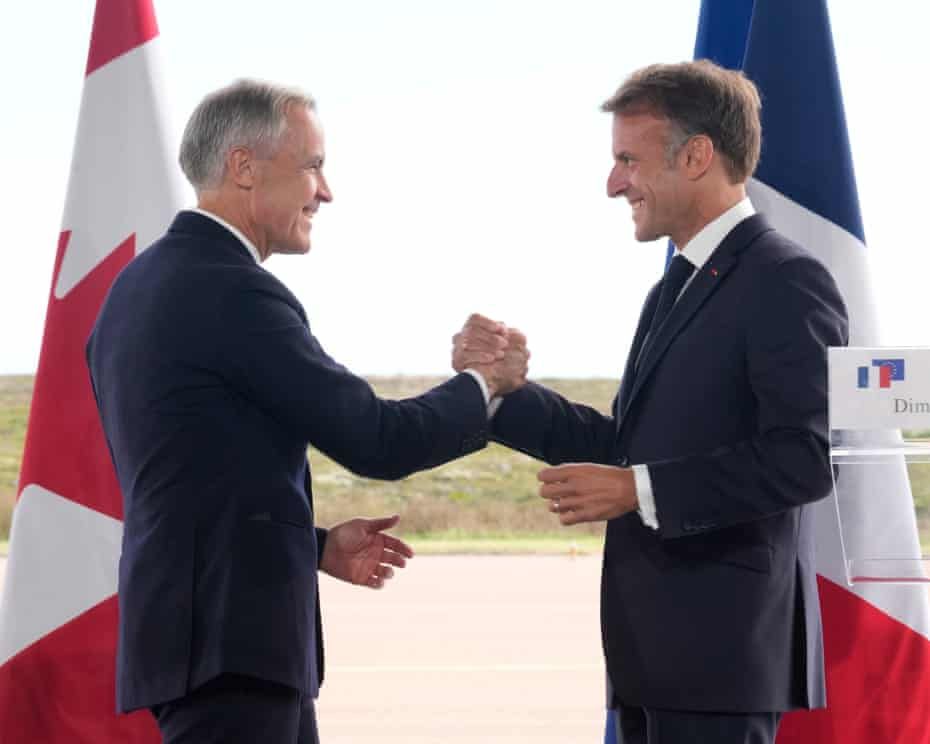
The meeting was held in Saint-Pierre and Miquelon, a small French territory located off Canada’s Atlantic coast, giving the encounter particular geographical and diplomatic significance.
It was Macron’s first visit to the territory since 2014 and the first visit there by a Canadian prime minister, according to the report published by The Guardian, which cited Reuters.
A symbolic meeting amid US tensions
The visit took place only weeks after US President Donald Trump posted an image depicting Canada, Saint-Pierre and Miquelon and several other parts of North America under a United States flag.
The social media post added a sensitive political backdrop to Macron’s meeting with Carney, particularly because Saint-Pierre and Miquelon remains French territory despite its location close to Canada’s eastern coastline.
Asked about the implications of Trump’s post, Macron dismissed suggestions that France’s sovereignty over the territory needed repeated reaffirmation.
The French president said he did not need to reaffirm the territory’s status every day simply because “people have strange ideas or say strange things”.
Macron’s comments came as France and Canada sought to emphasise their own sovereignty while maintaining cooperation with the United States despite increasingly difficult relations.
For Ottawa, closer relations with European countries have become increasingly important as Canada attempts to diversify its economic and strategic partnerships amid an acrimonious trade dispute with Washington.
The situation has also encouraged Canada to explore deeper institutional and economic cooperation with the European Union, potentially creating new opportunities beyond its traditional dependence on the US market.
France and Canada expand cooperation
Macron said the two countries had agreed to strengthen cooperation across several sectors, including space, climate and energy.
“We both believe in democracy, the rule of law, respect for international law, respect for free and fair trade, science as the basis for our decisions, and the strategic autonomy that we defend,” Macron said.
The statement highlighted areas where Paris and Ottawa see common ground, particularly their commitment to multilateral institutions, international law and cooperation between democratic countries.
The Macron and Carney meeting also focused on practical economic opportunities, with France looking to Canada for additional energy supplies as European countries consider how to strengthen their energy security.
Macron said Canadian liquefied natural gas could play a role in meeting Europe’s energy needs, particularly if Canada expands exports towards European markets rather than concentrating primarily on Asia.
“Canadian liquefied natural gas projects can help. They are important for Europe,” Macron said.
The comments reflected France’s interest in strengthening energy links with Canada while European governments continue to examine alternative sources of energy and broader strategies for reducing vulnerabilities.
Energy becomes a key area
The energy discussion carries particular importance for France because Macron’s government is facing domestic pressure over fuel prices and the wider cost of energy.
Macron said the discussions with Carney had created an opportunity for bilateral talks aimed at producing concrete agreements between the two countries.
Canada possesses significant energy resources and has been seeking new international markets, while European countries have increasingly focused on securing reliable supplies.
The proposed expansion of Canadian LNG exports to Europe could therefore become part of a wider economic relationship involving energy security, investment and infrastructure.
The two governments are also exploring cooperation in strategic sectors where technological capabilities and access to resources have become increasingly important.
Space cooperation, climate policy and energy security are areas where the two countries can pursue joint initiatives without requiring political integration.
Canada and the European Union
Another major issue discussed by Macron and Carney was Canada EU relations, particularly the European Union’s proposal for Canada to become its first associate member.
The proposal would represent a new form of relationship between Canada and the bloc, although the concept has raised questions because associate membership does not currently have a defined status under EU treaties.
Macron said France supported the proposal, placing Paris among the European governments backing closer institutional cooperation with Ottawa.
The issue has become more politically significant following Carney’s recent visit to the European Parliament in Strasbourg, where he welcomed the possibility of deeper cooperation between Canada and Europe.
Carney has said Canada wants stronger cooperation with the EU in areas including critical minerals, artificial intelligence, defence, energy security, digital trade and space.
He has also argued that closer relations should strengthen the ability of Canada and European countries to protect their strategic interests in a changing international environment.
However, the proposed Canada EU associate membership arrangement faces practical and political questions before it could become a formal framework.
Canada is not seeking full EU membership, and the proposed arrangement would therefore need to establish what additional rights, responsibilities and areas of cooperation would distinguish it from existing EU partnerships.
Existing trade agreement remains unresolved
The potential expansion of Canada-EU relations also comes against the background of the Comprehensive Economic and Trade Agreement, known as CETA.
The EU and Canada agreed CETA more than a decade ago, while provisional application began nine years ago, but several EU member states have yet to complete ratification.
France is among the countries that have not yet fully ratified the agreement, illustrating some of the institutional challenges facing any attempt to build a significantly deeper relationship.
The issue means that closer political cooperation between Canada and Europe could develop alongside unresolved questions surrounding an existing major trade agreement.
Carney has nevertheless continued to advocate closer strategic cooperation, while European officials have explored ways to deepen ties without necessarily creating full EU membership.
Trump’s response adds another dimension
The push for closer Canada-EU relations has drawn a strong response from Trump, who criticised the EU’s proposal to make Canada an associate member.
Trump described the proposal as “laughable” and threatened the European Union with “serious tariffs” if the bloc moved forward with the plan.
He also warned that Washington could “stop trading with Europe”, adding another layer of uncertainty to already strained relations between the United States, Canada and European governments.
Trump later said that if the proposal had “a good intention”, it would be acceptable, but warned that Washington would respond with “very heavy tariffs” if it believed the move had a negative purpose.
The remarks have added pressure to an already complicated economic relationship involving the US, Canada and the EU.
For Canada, strengthening ties with Europe provides another avenue for economic and diplomatic engagement as Ottawa seeks to respond to changing trade conditions.
For France, closer cooperation with Canada offers opportunities in energy, technology, climate policy and strategic industries while reinforcing bilateral relations with a major North American partner.
What the new partnership could mean
The emerging France Canada relations agenda extends beyond the immediate diplomatic symbolism of Macron’s visit to Saint-Pierre and Miquelon.
The two countries are discussing practical cooperation in areas that could influence trade, energy security, technological development, defence-related capabilities and environmental policy.
Their shared emphasis on sovereignty also gives the relationship an additional political dimension at a time when territorial security and strategic independence have become increasingly prominent international issues.
The meeting does not, however, resolve the broader disputes between Canada and the United States or guarantee that every proposed Canada-EU initiative will become a formal agreement.
Instead, it represents another step in Canada’s effort to broaden its international partnerships while maintaining existing relationships with the United States and other major economies.
Macron’s support for deeper Canada-EU cooperation also demonstrates France’s interest in developing closer links with Ottawa at a time when Europe is reassessing its economic and strategic relationships.
The energy discussions could become particularly significant if Canadian LNG exports to Europe increase, potentially creating new commercial opportunities for both Canadian producers and European buyers.
Space cooperation could likewise develop into a longer-term area of partnership as governments invest in satellite technology, launch systems and strategic infrastructure.
Climate cooperation offers another avenue for joint action, especially as both countries seek to balance economic growth with emissions reduction and energy security.
The leaders’ emphasis on democracy, international law and free trade also provides a broader framework for the relationship, although practical agreements will ultimately determine how far the partnership develops.
For Canada, the evolving relationship with France and the wider European Union comes as Ottawa seeks to strengthen its position in a changing global economic environment.
Read also: Russia Nato threat: European spy chiefs warn Moscow may take more decisive action against Nato
For France, closer ties with Canada provide access to a major North American partner with significant natural resources, technological capabilities and strategic interests in the Arctic and Atlantic regions.
Saint-Pierre and Miquelon consequently served as more than the location for a diplomatic meeting, providing a backdrop for a discussion about sovereignty, cooperation and the changing relationships between North America and Europe.
The next stage will depend on whether the commitments announced by Macron and Carney translate into concrete agreements covering energy, space, climate, trade and other strategic sectors.
For now, both leaders have signalled that France and Canada intend to deepen their relationship while navigating wider geopolitical and economic pressures involving the United States and the European Union.