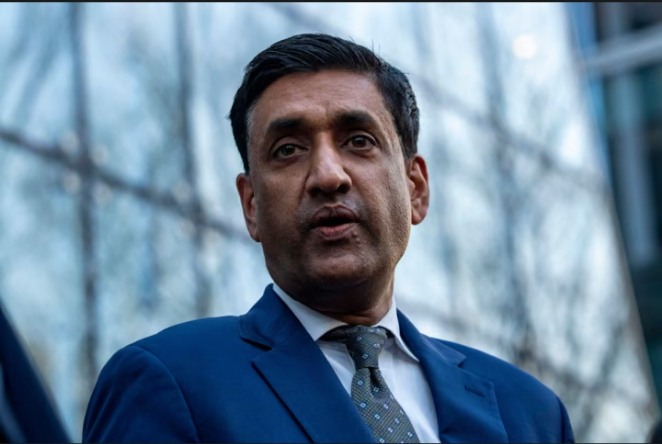
Earlier this month, California Democratic Representative Ro Khanna publicly read a list of six names on the House floor, asserting that they were “wealthy, powerful men that the DoJ hid” in the recently released Epstein files.
Khanna argued that these names had been unlawfully redacted in federal documents connected to the investigation of the late financier and sex offender Jeffrey Epstein, sparking national attention and political debate.
The files in question were released in unredacted form following pressure from Khanna and Kentucky Republican Representative Thomas Massie, who has long advocated for full transparency in federal investigations involving high-profile figures.
After questions from the newsmen, the Department of Justice clarified that four of the six men Khanna named had no apparent ties to Epstein.
Instead, their names appeared in a photo lineup assembled by the Southern District of New York (SDNY) as part of an unrelated investigation.
The photo lineup included men and women who had interacted with the New York City legal system, and some had minor criminal histories, but there was no connection between these individuals and Epstein’s criminal activities.
The inclusion of their photos in the files appears to have been a standard investigative measure rather than an indication of guilt or complicity.
Khanna and Massie had both pressed the DoJ to unredact the names after arguing that selective redaction hid information that should be publicly available.
Massie posted on X that he had successfully forced the justice department to release a file containing 20 names, birthdays, and photos, including those of Epstein and Ghislaine Maxwell, his long-time associate and convicted co-conspirator.
While two of the six men named by Khanna—Sultan Ahmed bin Sulayem, the Emirati billionaire and former CEO of DP World, and Leslie Wexner, the American retail magnate—have high public profiles and were mentioned multiple times across the files, the remaining four men had no public prominence or known ties to Epstein.
A spokesperson from the office of Deputy Attorney General Todd Blanche explained that the document Khanna cited was a photo lineup used for investigative purposes. “Rep Ro Khanna and Rep Thomas Massie forced the unmasking of completely random people selected years ago for an FBI lineup – men and women.
These individuals have NOTHING to do with Epstein or Maxwell,” the spokesperson said.
This clarification underscores the risk of misinterpretation when investigative documents are released without sufficient context, particularly when they include photographs of individuals who are not connected to the case’s central subjects.
Two of the men whose names Khanna read on the House floor strongly denied any connection to Epstein. Salvatore Nuarte, from Queens, New York, expressed shock after learning his name had been publicly linked to Epstein in Congress.
Nuarte explained that he had been arrested by the NYPD years ago for a minor, unrelated offense, which likely explains how his photo appeared in the lineup. “I don’t know if they know what they are doing over there at the justice department,” Nuarte told the Guardian.
“But how can I clear my name?” Nuarte also contacted Khanna’s office, which responded by emphasizing that the DoJ had not adequately explained the context of the document.
Similarly, Leonid Leonov, whose name was incorrectly recorded as Leonic Leonov in the files, confirmed that he had no connection to Epstein, describing himself as an IT manager with no personal or professional links to the disgraced financier.
The two other men Khanna named, Zurab Mikeladze and Nicola Caputo, could not be reached for comment.
The confusion surrounding the unredacted files also highlights the ongoing debate about the balance between transparency and the protection of innocent individuals.
The Epstein Files Transparency Act, spearheaded by Khanna and Massie, aimed to make federal investigations more open, particularly regarding individuals with substantial influence who may have been shielded from scrutiny.
While the act succeeded in compelling the DoJ to release additional information, the unintentional inclusion of individuals with no ties to Epstein demonstrates how such transparency initiatives can have unintended consequences, including reputational damage to people who are entirely uninvolved.
Massie has been vocal about the inconsistencies in the DoJ’s release of the files. Some versions of the documents showed certain victims’ names unredacted, while names of wealthy associates were redacted in places, creating confusion over who was directly implicated in Epstein’s network.
Analysis of the multiple versions revealed that 11 of the people listed represented a cross-section of New York City residents, many with minor misdemeanor arrests, and several women resembled Maxwell, while some men resembled Epstein.
The four men cited by Khanna appeared in the files only once and did not have their names repeated elsewhere, unlike Wexner, whose name appears nearly 200 times, and Bin Sulayem, whose name appears more than 4,700 times in the documents.
Legal representatives for Wexner have confirmed that he was viewed as a source of information for federal authorities and never as a target of investigation.
Wexner cooperated fully with investigators, providing background information on Epstein’s activities, and was never contacted again after 2019.
Bin Sulayem resigned from his position at DP World after emails emerged in which Epstein referenced him, though there was no allegation of wrongdoing on his part.
These developments illustrate the complex interplay of high-profile business, politics, and criminal investigations, where mere associations or communications can be misinterpreted when documents are made public.
The broader implications of the case extend beyond the four men mistakenly named by Khanna. Experts in legal transparency stress that releasing documents without sufficient context—especially those containing photos or personal identifiers—can harm innocent people and mislead the public.
While full disclosure is crucial for accountability, particularly in cases involving sexual exploitation and abuse, clarity about the role of individuals listed in such files is equally important.
Investigators and lawmakers must navigate the delicate balance between public interest and personal reputations to prevent unwarranted stigmatization.
The situation has prompted renewed scrutiny of both the Department of Justice’s handling of the files and the political strategies employed by Khanna and Massie.
While the goal of promoting transparency is widely supported, the incident has shown that aggressive disclosure tactics may inadvertently amplify misunderstandings.
Some observers suggest that future releases should include detailed explanations of each individual’s presence in investigative documents, differentiating between witnesses, minor participants, and those with no connection to alleged crimes.
This approach would help maintain credibility for transparency efforts while protecting individuals who are wrongly associated with criminal cases.
Read also: Britain’s “Brexit years” are over: Starmer urges Europe unity amid US tensions
In summary, the four men named by Ro Khanna in the unredacted Epstein files have no documented ties to Jeffrey Epstein.
Their inclusion in a photo lineup compiled by the SDNY appears to have been purely procedural, unrelated to criminal activity involving Epstein or Maxwell.
While two of the six men named by Khanna have public profiles and appear repeatedly in the files, the other four remain unrelated individuals whose names were mistakenly linked to the case.
The controversy underscores the need for careful contextualization of investigative documents, particularly when released to the public, to ensure transparency does not inadvertently harm innocent people.
The ongoing debate also highlights the political pressures surrounding high-profile criminal investigations and the challenges lawmakers face in balancing disclosure, accountability, and fairness.
About The Author