

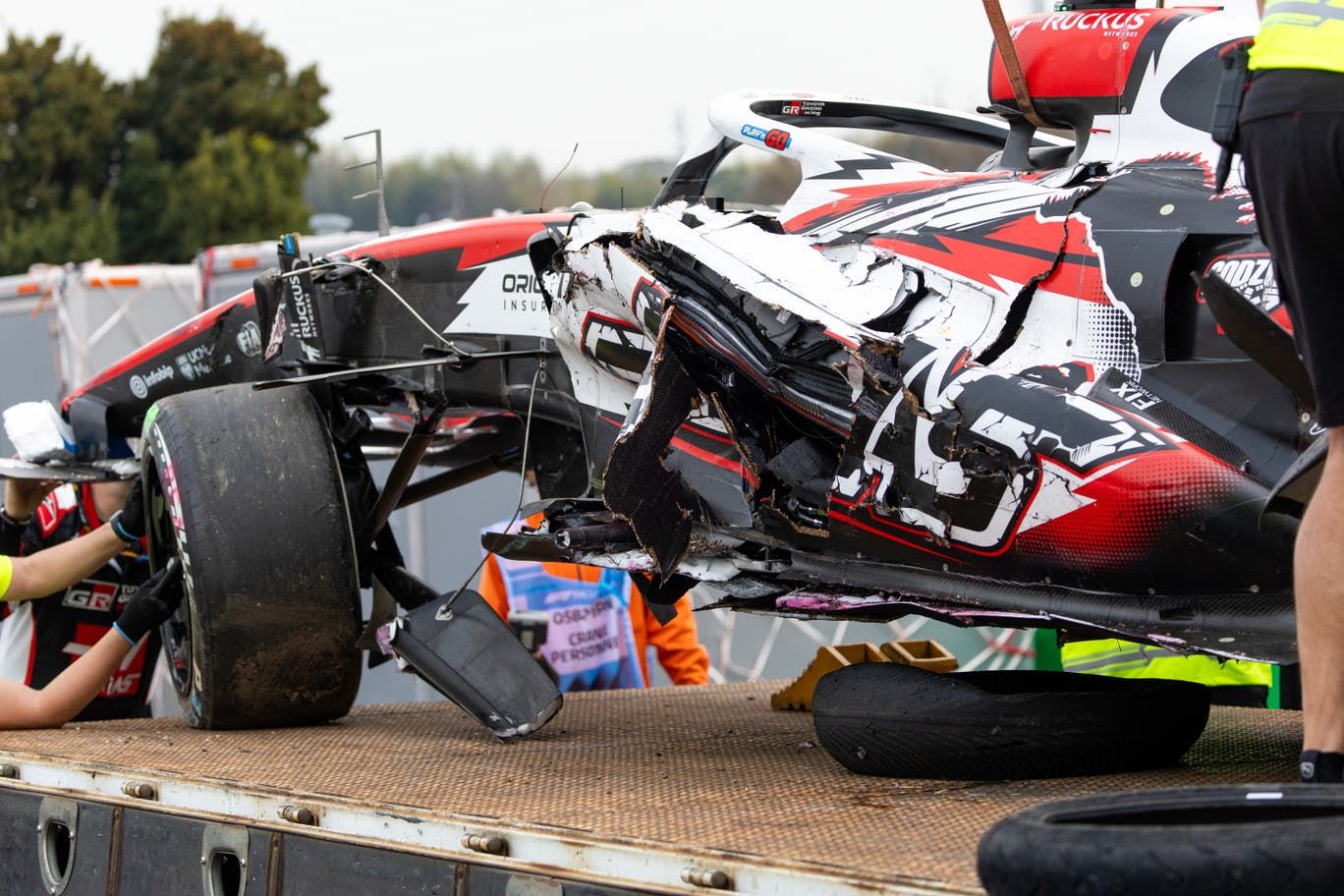
Formula 1 faces a safety emergency after Ollie Bearman’s 191mph crash at the Japanese Grand Prix, raising serious concerns about the 2026 regulations, high-speed impacts, and the ability to protect drivers during extreme race conditions.
Bearman, only 20 years old, collided with a barrier at 50G after a sudden speed surge, limping from his Haas VF-26 cockpit with assistance, demonstrating both the risks and effectiveness of modern driver safety measures.
The impact echoed previous high-profile crashes, such as Max Verstappen’s 2021 shunt at Silverstone, showing that despite advanced cockpit protection, energy management systems and overtaking dynamics can unexpectedly create life-threatening scenarios.
Trackside safety features, including the halo device and expanded run-off zones, were credited with preventing major injury, though Bearman did suffer a right knee contusion, highlighting that even small injuries can have long-term consequences for drivers.

Drivers and teams now face scrutiny over energy deployment regulations, as sudden surges in speed, combined with turns like the Spoon Curve, may exceed reaction thresholds and create unavoidable collisions in the current 2026 formula.
Carlos Sainz of Williams and GPDA director warned post-race that the crash was foreseeable, calling for immediate assessment of race protocols, energy systems, and safety standards to prevent similar incidents in upcoming events.
Fernando Alonso also highlighted systemic issues, noting that high-speed overtaking often occurs accidentally, forcing evasive maneuvers that can lead to catastrophic crashes if regulations do not account for energy management limitations.
The FIA’s response has been to schedule meetings in April to review regulations, including energy deployment and fuel flow limits, acknowledging the 191mph crash as a tipping point necessitating swift, precise changes to maintain safety.
Haas team principal Ayao Komatsu described the crash as “scary,” while emphasizing that Bearman’s survival without fractures underscores the progress of safety systems, yet reinforces the need for additional measures in regulation refinement.
Bearman’s evasive action to avoid Alpine’s Franco Colapinto illustrates the challenges of split-second decisions at extreme speeds, highlighting the fine margin between successful overtakes and disastrous impacts under current regulations.
The five-week gap before the Miami GP provides drivers recovery time and regulatory review opportunity, but it also emphasizes the need for preemptive adjustments to energy deployment systems before high-speed races in urban circuits like Baku or Vegas.
Max Verstappen likened the sudden speed surge to a video game “mushroom” button, demonstrating the disconnect between virtual perceptions of racing and the tangible, high-risk consequences drivers face in real-world Formula 1 conditions.
Safety concerns extend to young drivers, such as 19-year-old Kimi Antonelli, who became the championship leader post-race, highlighting that inexperienced competitors face the highest risks from high-speed incidents and unpredictable overtaking scenarios.
The Grand Prix Drivers’ Association stresses the importance of evaluating all new 2026 regulations, noting that energy deployment rules, battery management, and differential boosts may contribute to unforeseen acceleration spikes that threaten driver safety.
FIA’s acknowledgment of “high closing speeds” demonstrates awareness but also indicates the reactive nature of regulation adaptation, emphasizing that proactive design and safety enforcement are critical to prevent recurring emergencies.
Bearman’s accident underscores the role of track design, including polystyrene speed boards and grass run-offs, in mitigating crashes, yet also reveals that high-speed corners demand stricter oversight to ensure driver survival margins remain sufficient.
Medical teams on-site provided immediate clearance, showing that emergency response infrastructure has improved, though long-term implications of repeated high-G incidents remain a concern for athlete health and career longevity.
The incident raises broader questions about Formula 1’s energy-focused regulations, which were intended to improve racing but may inadvertently create situations where excessive battery deployment exceeds safe operational thresholds on corners or short straights.
Carlos Sainz, reflecting on previous personal crashes, emphasized that the current pace of 2026 cars exceeds historical standards, suggesting a critical reassessment of speed-to-safety ratios and energy management limitations is now necessary across all tracks.
Ollie Bearman’s survival without fractures is credited to safety advancements, yet even minor injuries, such as knee contusions, demonstrate that physical consequences of 50G impacts remain non-trivial, especially for future races and cumulative driver health.
The FIA’s meetings aim to consider regulation refinements including energy deployment tweaks, fuel flow modifications, and potential speed caps at high-risk corners, with all changes intended to enhance both driver safety and competitive fairness.
Fernando Alonso’s pre-race observations about accidental overtaking highlight systemic issues: when battery surges create unavoidable speed differences, drivers are forced into evasive maneuvers that increase collision risk, requiring regulation interventions.
Track conditions, such as the Spoon Curve’s banking and surface grip, contributed to Bearman’s trajectory, showing that technical assessments of track design and car setup are equally important as energy regulations for maintaining safe racing environments.

Haas engineers and FIA stewards acted quickly post-crash to ensure no penalties or blame were assigned, acknowledging that incidents can be unavoidable, while still signaling the urgent need for regulation evaluation to mitigate future risks.
The Miami GP will be a critical test for regulatory adjustments, as urban circuits with limited run-off areas present unique challenges, reinforcing that lessons from Japan must directly inform rule changes for safer racing conditions.
Driver associations, FIA, and team principals now face the task of balancing competitive spectacle with safety imperatives, ensuring that energy deployment systems do not turn tactical advantages into lethal hazards during races.
Spectator safety also comes into focus, as high-speed impacts pose secondary risks to nearby fans if crash containment measures fail or debris reaches spectator areas, highlighting the importance of integrated track and barrier planning.
F1 engineers are reviewing telemetry and crash data to understand reaction times, acceleration peaks, and vehicle dynamics that led to Bearman’s accident, forming the basis for potential software, hardware, and regulatory interventions.
The incident has prompted debate among commentators, drivers, and fans, with calls for immediate reforms in energy management, safety protocols, and track design to prevent any recurrence of 191mph crashes that could result in severe injury.
FIA’s proactive statement on reviewing regulations is a positive sign, signaling that the governing body acknowledges the crisis and is willing to adjust rules mid-season to ensure drivers’ well-being remains the top priority.
Bearman’s crash may become a defining moment for the 2026 season, setting a precedent for regulation review cycles, highlighting the necessity for continuous risk assessment, and potentially shaping future generations of Formula 1 safety standards.
Energy deployment regulations, while central to Formula 1’s technological innovation, must be tempered by safety limitations, ensuring that driver decision-making is not compromised by systems that can inadvertently accelerate cars beyond controllable limits.
The balance between spectacle and safety is delicate; Bearman’s 50G impact shows that even state-of-the-art protection systems have limits, reinforcing that regulatory adjustments, emergency preparedness, and engineering solutions must evolve together.
Formula 1 faces a safety emergency that demands immediate attention, with Bearman’s crash serving as a cautionary tale that reinforces the interconnected responsibilities of drivers, teams, engineers, and regulators in safeguarding the sport’s future.
Read also:Igor Tudor leaves Tottenham job: Spurs begin urgent search for new manager