Nigeria’s push to close its electricity access gap has gained momentum as the Federal Government rolls out a $750m renewable electrification programme designed to expand power supply through solar mini-grids and off-grid infrastructure nationwide.
The initiative, which is expected to mobilise more than $1.1bn in private sector investment, forms part of a broader strategy to deliver electricity to millions of Nigerians who remain without reliable power supply.
Managing Director of the Rural Electrification Agency, Abba Aliyu, disclosed details of the programme on Thursday in Abuja while hosting a delegation from the National Judicial Institute at the agency’s headquarters.
According to him, the project represents one of the most ambitious renewable energy interventions ever undertaken by the government to address the country’s longstanding electricity deficit.
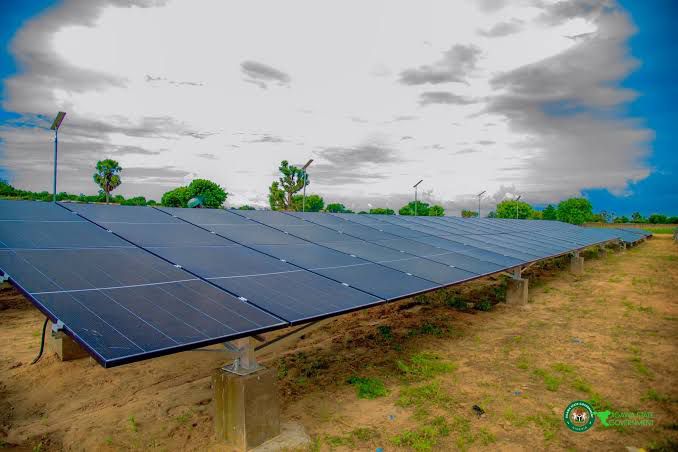
Aliyu explained that the initiative would involve the deployment of 1,350 solar mini-grids across Nigeria, including about 250 interconnected systems that will feed electricity directly into the national grid.
He described the programme as a landmark effort aimed at strengthening power infrastructure while promoting cleaner and more sustainable energy sources.
“The administration is implementing a structured programme to address electricity access challenges across the country,” Aliyu said.
“For the first time, Nigeria is witnessing the implementation of one of the largest publicly funded renewable electricity programmes globally. The $750m initiative is expected to catalyse about $1.1bn in private sector investment for the deployment of 1,350 mini-grids nationwide.”
Industry observers say the project could significantly expand electricity access in underserved communities, particularly in rural and semi-urban areas where grid connectivity remains limited.
$750m solar mini-grid project to expand electricity access
Under the $750m solar mini-grid project, the government plans to deploy renewable electricity systems that will provide stable power to communities, institutions, and businesses currently relying on costly diesel and petrol generators.
Aliyu said the initiative would not only improve electricity availability but also contribute to Nigeria’s transition toward cleaner energy solutions.
He added that the REA is simultaneously executing several solar power initiatives targeted at universities and teaching hospitals through its Energising Education Programme.
According to him, the programme has already delivered 15 solar power projects across federal universities and medical facilities, providing dedicated electricity to campuses and research centres.
“In some institutions, we have deployed large-scale solar systems capable of powering the entire campus, including teaching hospitals and water treatment facilities,” he said.
Aliyu listed beneficiary institutions to include the University of Maiduguri, Federal University Gashua, Federal University of Agriculture, Akure, and several universities across Nasarawa, Kogi, Imo, Ebonyi, Rivers, Akwa Ibom, and Cross River states.
He also revealed that another eight solar projects are currently awaiting implementation, including installations planned for the University of Lagos, University of Ibadan Teaching Hospital, University of Nigeria, Nsukka, University of Benin, Federal University Wukari, and Federal University Dutse.
Public institutions to benefit from solarisation programme
Beyond universities, the Federal Government has also approved N100bn for the National Public Sector Solarisation Initiative, aimed at reducing electricity costs for government institutions struggling with unstable power supply.
Aliyu said installations have already begun in several agencies and public facilities.
These include the Department of State Services, the Economic and Financial Crimes Commission, the Independent Corrupt Practices and Other Related Offences Commission, and the National Hospital in Abuja, among others.
“The goal is to provide sustainable electricity solutions for institutions that face challenges paying for grid electricity or depend heavily on generators,” he explained.
The REA boss assured the visiting delegation from the National Judicial Institute that the agency would consider the institute for solar electrification after conducting a technical energy audit to determine its power needs.
Power deficit continues to challenge Nigeria
Nigeria continues to face one of the largest electricity access deficits in the world, with millions of citizens lacking reliable power supply.
Despite an installed national grid capacity of more than 13,000 megawatts, actual electricity generation often fluctuates between 3,500MW and 5,000MW, far below the country’s growing demand.
As a result, households and businesses spend billions of naira annually on petrol and diesel generators.
Stakeholders believe expanding off-grid renewable energy systems such as solar mini-grids could play a crucial role in bridging this gap.
President of the National Industrial Court, Justice Babatunde Adejumo, who led the visiting delegation to the REA, noted that reliable electricity remains critical for economic productivity and institutional efficiency.
He stressed that modern institutions such as hospitals, training centres, and courts rely heavily on stable electricity to function effectively, particularly with the increasing use of digital technologies.
Adejumo commended the agency’s progress in expanding electricity access and urged it to extend similar interventions to the National Judicial Institute, which trains thousands of judges and magistrates annually.
Experts say the expansion of solar mini-grid infrastructure could stimulate economic activity, improve public services, and reduce the country’s dependence on fossil-fuel generators.
With the $750m solar mini-grid project, the Federal Government hopes to accelerate electrification efforts, boost renewable energy adoption, and provide sustainable power solutions to communities across Nigeria.
About The Author