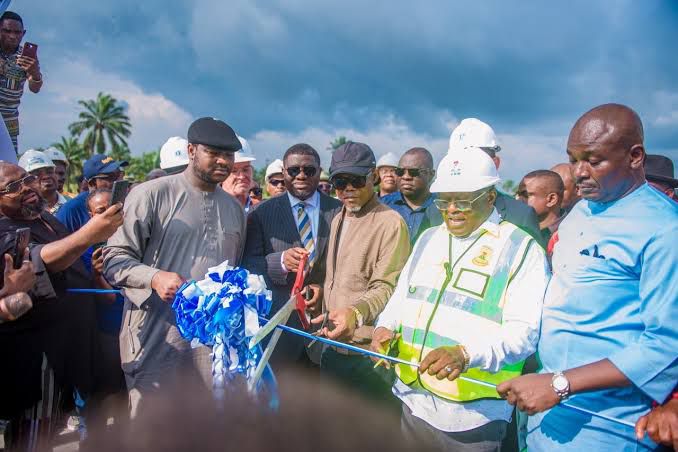
The Federal Government has temporarily opened the long-awaited Bodo-Bonny Road, offering relief to residents, commuters, and businesses in Rivers State as Nigerians prepare for the Christmas and New Year celebrations.
The decision, announced ahead of the yuletide, is aimed at easing transportation challenges and improving connectivity between coastal communities that have endured years of isolation due to poor infrastructure.
President Bola Tinubu, represented by the Minister of Works, David Umahi, approved the temporary opening of the strategic route following sustained appeals from host communities and key stakeholders in the Niger Delta.
The move marks a significant milestone in the execution of one of Nigeria’s most complex road construction projects, which cuts through swampy terrain and ecologically sensitive areas.
Bodo-Bonny Road opens after years of delays and engineering challenges
Speaking at the site during the ceremonial opening, Umahi acknowledged that the Bodo-Bonny Road project had experienced prolonged delays, largely due to technical difficulties, environmental conditions, and earlier disagreements between contractors and host communities.
However, he said sustained dialogue and cooperation had helped the project reach its current advanced stage.
According to the minister, the 35.7-kilometre road, which includes multiple bridges and reinforced concrete structures, is now safe for controlled use, even as construction work continues toward full completion.
“This road has been a long journey,” Umahi said.
“There were moments when the project was threatened, but the patience and cooperation of the communities made it possible to reach this important milestone. What we are seeing today is the result of persistence and commitment.”
He commended construction firm Julius Berger Nigeria Plc for what he described as the quality, durability, and engineering excellence evident along the corridor, adding that the completed Bodo-Bonny Road would rank among Nigeria’s legacy infrastructure projects.
Temporary opening comes with strict operational conditions
The Federal Government stressed that the opening of the Bodo-Bonny Road is strictly temporary and designed solely to accommodate festive traffic. Umahi disclosed that vehicular movement on the road would be regulated daily between 7:00 a.m. and 7:00 p.m., with night travel prohibited to minimise safety risks.
Heavy-duty vehicles have also been barred from using the road until construction is fully completed. The minister explained that unfinished sections and remaining concrete barriers make it unsafe for articulated trucks and other large vehicles, which could cause breakdowns and disrupt traffic flow.
In addition, motorcycles and tricycles are not permitted on the route for now. Julius Berger has been directed to mount roadblocks and deploy traffic control measures to enforce compliance with the restrictions.
“These measures are necessary to protect lives and preserve the integrity of the work already done,” Umahi said.
“This is not yet a fully commissioned road, and Nigerians must understand that safety comes first.”
Economic and social lifeline for riverine communities
The temporary opening of the Bodo-Bonny Road has been welcomed by residents of Bodo, Bonny Kingdom, and surrounding riverine communities, who see it as a long-overdue breakthrough.
For decades, movement between the mainland and Bonny Island relied heavily on boats, making travel expensive, risky, and time-consuming—especially during festive periods.
Local traders, fishermen, and small business owners say the road will significantly reduce the cost of transporting goods, boost commerce, and improve access to healthcare, education, and other essential services.
Analysts also note that the road has broader economic implications for Nigeria, given Bonny Island’s strategic importance to the oil and gas sector, including liquefied natural gas operations and export facilities.
Umahi emphasised that once permanently opened, the Bodo-Bonny Road would enhance national productivity, strengthen regional integration, and improve safety for both residents and industrial operators.
President to commission Bodo-Bonny Road upon completion
While the temporary opening has generated excitement, the Federal Government made it clear that the official commissioning of the Bodo-Bonny Road would be carried out by President Tinubu upon full completion of the project.
“The Niger Delta people are expecting the President next year,” Umahi said.
“He will come to commission this road properly—for the convenience of the people, for their safety, and for the economic benefit of Nigeria.”
As part of the final works, the minister directed Julius Berger to embark on environmental and aesthetic enhancements along the corridor.
These include planting two rows of trees along both sides of the road at 10-metre intervals and installing solar-powered streetlights every 30 metres.
He insisted that these features must be completed before the final handover, describing them as essential to sustainability, security, and climate resilience.
Julius Berger recounts construction journey
Earlier, the Project Manager of Julius Berger Nigeria Plc, Tim Nippert, provided an overview of the construction journey, highlighting the technical complexity of building a major highway through marshlands and tidal zones.
Nippert credited improved collaboration between the Federal Ministry of Works, host communities, and the contractor for the recent progress recorded on the Bodo-Bonny Road.
“The cooperation we have received has made a significant difference,” he said. “This project demonstrates what is possible when stakeholders work together with mutual respect and shared objectives.”
A symbolic yuletide boost for Niger Delta residents
Beyond its practical benefits, the temporary opening of the Bodo-Bonny Road carries symbolic significance for Niger Delta communities, many of whom view the development as a sign of renewed federal attention to long-neglected infrastructure in the region.
As families travel home for Christmas and New Year celebrations, the road is expected to transform movement patterns, reduce travel stress, and create a festive atmosphere across communities linked by the corridor.
For residents, the message is clear: while the journey to completion is not yet over, the Bodo-Bonny Road is finally becoming a reality—one concrete slab at a time.
About The Author