

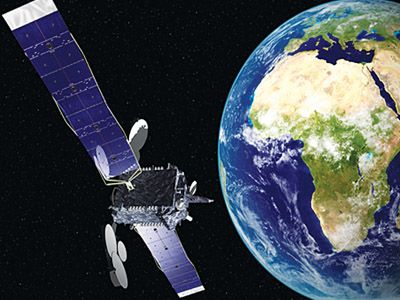
Nigeria is advancing its space and digital infrastructure ambitions as the Federal Government has fixed 2028 and 2029 for the deployment of two new communication satellites under an expanded national programme.
The initiative, which centres on the FG sets 2028, 2029 for new satellites launch agenda, is expected to significantly strengthen national security architecture, improve broadband penetration, and enhance regional connectivity across West Africa.
The Managing Director of Nigerian Communications Satellite Limited, Jane Nkechi Egerton-Idehen, disclosed that the satellites—NigComSat-2A and NigComSat-2B—have progressed beyond procurement stages into active implementation.
According to her, NigComSat-2A is scheduled for launch in 2028, while NigComSat-2B will follow in 2029. She noted that the development reflects a shift from planning to execution, marking a critical milestone in Nigeria’s long-term digital and security strategy.
Security at the Core of FG Sets 2028, 2029 for New Satellites Launch
A key pillar of the FG sets 2028, 2029 for new satellites launch initiative is its focus on strengthening national and regional security. The satellites are designed to deliver real-time data collection, surveillance, and intelligence capabilities to support security agencies.
Egerton-Idehen explained that modern communication satellites provide seamless connectivity regardless of geographical barriers, making them essential for intelligence gathering and coordinated operations.
Security experts have consistently emphasised the growing importance of space-based infrastructure in addressing evolving threats such as terrorism, insurgency, and cross-border crimes. The new satellites are expected to enhance Nigeria’s capacity for rapid response and situational awareness.
The Chief of Army Staff, Olufemi Oluyede, reiterated this position, noting that space technology is now central to military operations globally. Represented by senior military leadership, he highlighted the integration of satellite-based systems into Nigeria’s defence strategy.
Expanding Digital Connectivity Nationwide
Beyond security, the FG sets 2028, 2029 for new satellites launch programme is poised to transform Nigeria’s digital landscape by bridging connectivity gaps, particularly in rural and underserved communities.
The Minister of Communications and Digital Economy, Bosun Tijani, stated that the satellite programme complements ongoing investments in fibre-optic expansion and telecommunications infrastructure.
He noted that millions of Nigerians, especially those in remote areas, still lack reliable internet access. The new satellites are expected to extend broadband services to these communities, enabling access to education, healthcare, and economic opportunities.
“Satellite technology touches every sector—from how students learn to how farmers make decisions and how businesses operate across distances,” Tijani said, underscoring the broad impact of the initiative.
Regional Influence and Economic Potential
The FG sets 2028, 2029 for new satellites launch plan also carries significant regional implications. By expanding connectivity beyond Nigeria’s borders, the satellites could position the country as a major provider of digital services within West Africa.
According to government officials, neighbouring countries currently pay significantly higher costs for internet bandwidth. Nigeria’s expanded satellite capacity could offer more affordable alternatives, boosting regional trade, collaboration, and economic integration.
Analysts believe this move aligns with Nigeria’s ambition to become a digital hub in Africa, leveraging technology to drive economic diversification and reduce reliance on oil revenues.
Budgetary Realities and Implementation Challenges
Despite the ambitious timeline, the FG sets 2028, 2029 for new satellites launch programme faces financial and operational challenges. Budgetary allocations for the NigComSat-2 project have seen a reduction in the 2026 fiscal year.
Government data shows that funding dropped from over N600 million in 2025 to approximately N420 million in 2026. While the reduction reflects fiscal constraints, officials insist that the project remains active and on track.
Industry stakeholders caution that sustained funding and policy consistency will be crucial to meeting the launch timelines. Satellite development is capital-intensive, requiring long-term investment, technical expertise, and international partnerships.
Replacing Ageing Infrastructure
Another critical aspect of the FG sets 2028, 2029 for new satellites launch initiative is the planned replacement of ageing satellite infrastructure. Nigeria’s existing NigComSat-1R satellite has been operational for years and requires upgrading to meet modern technological demands.
The new satellites are expected to deliver enhanced capabilities, including satellite broadband, direct-to-home broadcasting, telemedicine, and tele-education services. These features are vital for improving service delivery across key sectors.
Experts note that upgrading satellite infrastructure will not only improve connectivity but also enhance Nigeria’s competitiveness in the global digital economy.
Strategic Partnerships Driving Progress
The success of the FG sets 2028, 2029 for new satellites launch programme will depend heavily on collaboration between government agencies, the private sector, and international partners.
Military officials have highlighted the importance of partnerships in advancing satellite-based intelligence and communication systems. Similarly, collaboration with global technology providers will be essential in ensuring that the satellites meet international standards.
Such partnerships are also expected to facilitate knowledge transfer, capacity building, and innovation within Nigeria’s space and technology ecosystem.
Outlook: A Digital Future Anchored on Space Technology
As Nigeria moves closer to the 2028 and 2029 launch timelines, the FG sets 2028, 2029 for new satellites launch initiative represents a bold step toward building a resilient, technology-driven economy.
The satellites are expected to play a transformative role in enhancing security, expanding connectivity, and unlocking new economic opportunities.
However, achieving these outcomes will require sustained commitment, strategic investment, and effective coordination among stakeholders.
The Federal Government’s decision to proceed with new satellite launches underscores its commitment to leveraging technology for national development.
With security, connectivity, and economic growth at stake, the FG sets 2028, 2029 for new satellites launch programme could mark a turning point in Nigeria’s digital transformation journey.
About The Author
