Senator Ali Modu Sheriff, former Governor of Borno State and a founding stalwart of the ruling All Progressives Congress (APC), has taken a swipe at the African Democratic Congress (ADC), describing it as a fragile political coalition built on conflicting presidential ambitions rather than any concrete ideology, national appeal, or organisational structure.
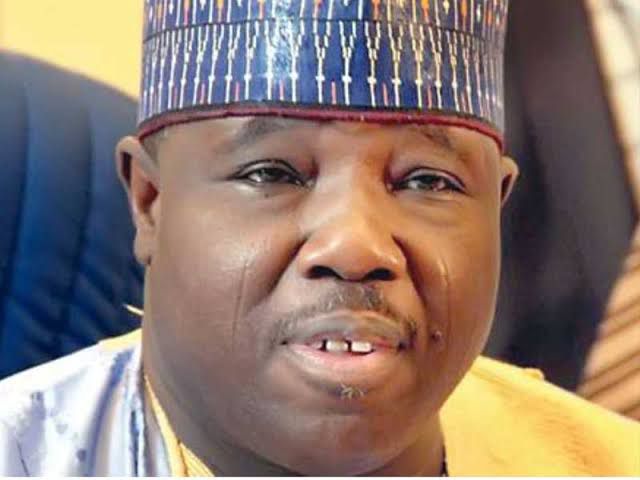
Speaking during a televised interview on Monday, Sheriff addressed swirling rumours linking him with a possible defection to the ADC. With a tone of dismissal and incredulity, he rebuffed the speculations, declaring that the ADC lacks the capacity, structure, or political relevance to warrant such interest.
“You said people are mentioning my name, that I was going to the ADC? That’s wrong. Which ADC? Do they even have a political party?” he asked rhetorically, laughing off the suggestion.

He went further to issue a bold prediction: that the ADC, as currently constituted, would fizzle out within three months. According to him, the party is not built on a solid foundation but is rather a loose collection of ambitious individuals, each eyeing the presidency, with no coherent strategy, unity, or national traction.
“Give them three months. The party will die down. All of them believe they are ‘presidential materials.’ But only one person can be the flag bearer. That’s where their problem will start,” he said.
Sheriff argued that the ADC bears no resemblance to the APC at its formative stage, noting that the APC was the product of a strategic merger between major opposition parties, each bringing political structures, state governors, and a shared objective of challenging the then-dominant Peoples Democratic Party (PDP).

“When we came together to form the APC, there were around 15 state governors involved. Bola Tinubu came in with control of four states. The All Nigeria Peoples Party (ANPP) contributed about five or six. A breakaway faction of the PDP brought four. It was a serious national movement,” Sheriff explained.
He added that the APC’s success was not accidental but the outcome of deliberate political engineering and mass mobilisation across all six geopolitical zones.
He cited APC’s current dominance in the National Assembly—boasting 73 senators and a clear majority in the House of Representatives—as well as its control of over 20 state governments as evidence of the party’s depth and institutional strength.
In contrast, Sheriff painted the ADC as a political experiment doomed to fail. He accused the party of having no real ideology, no electoral machinery, and no political reach beyond television appearances and press statements.
“They all want to be president by force. They are exercising their democratic rights, yes, but in the real political sense of things, they don’t exist. The ADC does not exist,” he said bluntly.
He emphasized that political success in Nigeria cannot be achieved through wishful thinking or media stunts but through grounded grassroots support, tested party structures, and strategic alliances—none of which he believes the ADC possesses.

Sheriff’s remarks underscore the deep divisions and rivalries among Nigeria’s opposition parties, many of which are struggling to gain relevance ahead of the 2027 general elections. With his comments, he joins a growing list of political actors who view the ADC as an unserious platform, lacking both vision and viability.
While his words may come across as dismissive, they reflect the reality of Nigerian politics where personality-driven, short-lived coalitions rarely succeed without a unified front, national appeal, and grassroots mobilisation.
About The Author