Across Europe, protest movements against Israeli products are expanding rapidly, with workers, unions, and state policymakers increasingly joining campaigns advocating Israeli goods boycott movements mushroom
One afternoon in late August, an Irish supermarket worker decided he could no longer ignore images from Gaza on his phone.
The scenes of flattened neighborhoods and buried families followed him to the checkout counter, prompting him to act. He quietly informed customers some fruit and vegetables came from Israel and later refused to scan or sell Israeli-grown produce, stating he could not “have that on my conscience,” a decision that led Tesco to suspend him temporarily.
Within weeks, the story reached Newcastle, County Down, where customers staged protests outside the supermarket. The dispute quickly became a test case across Europe, raising the question: can individual employees transform moral outrage into workplace action?
Eventually, Tesco reinstated the worker in January, moving him to a role without Israeli goods, prompting him to say, “If we get enough people to do it, they can’t sell Israeli goods. A genocide is still going on, and we need to act.”
Unions across Ireland, the UK, and Norway have passed motions stating that workers should not be compelled to handle Israeli products. Retail cooperatives, including Co-op UK and Italy’s Coop Alleanza 3.0, have removed some Israeli goods in protest, reflecting a growing labor-led campaign.
Activists argue that such employee-led pressure can escalate into state-level boycotts and legislative action, influencing broader European policy.
The strategy behind these movements draws historical parallels. In 1984, Dunnes Stores workers in Ireland refused to handle products from apartheid South Africa for nearly three years, contributing to Ireland becoming the first Western European country to ban trade with South Africa.
Damian Quinn, 33, of BDS Belfast, said, “the same can be done against the apartheid, genocidal state of Israel today,” highlighting the continuity between historical and contemporary boycott movements.
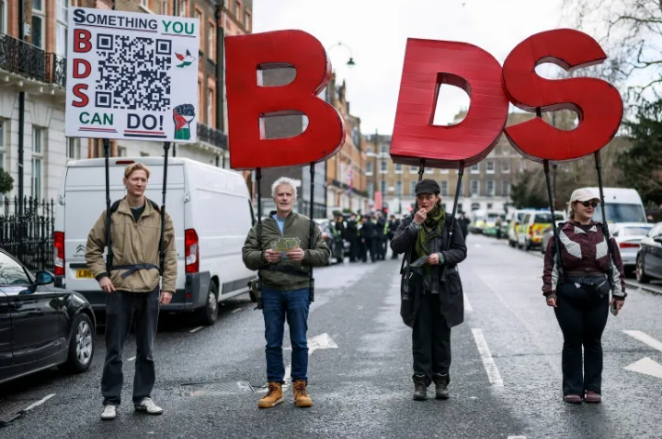
The Boycott, Divestment, and Sanctions (BDS) movement, launched in 2005 by Palestinians, calls for economic and cultural boycotts of Israel until it complies with international law, including ending its occupation of Palestine.
Quinn emphasized, “Where the state has failed to prevent genocide, citizens and workers across the world must refuse Israel and pressure governments to legislate.” Pressure campaigns target Israeli cultural, academic, and sporting institutions, along with banks, local councils, universities, churches, and pension funds.
Supporters argue that these efforts are already shaping European state policy. Spain and Slovenia have restricted trade with Israeli settlements in the West Bank following public protests and political pressure.
Slovenia banned imports from occupied territories in August 2025, and Spain followed in late 2025, formally enforcing the measure at the start of 2026. Both center-left governments openly criticized Israel’s wartime conduct, creating political conditions for legislative action.
In the Netherlands, pro-Palestinian campus protests in 2025 shifted political discourse. Students demanded academic and trade disengagement from Israel, which influenced parliament to consider banning imports from illegal settlements.
Ireland is attempting to advance the Occupied Territories Bill, introduced in 2018, to prohibit trade in goods and services from settlements in occupied Palestinian territory.
Progress has stalled, with pro-Palestine MP Paul Murphy citing “indirect pressure from Israel routed through the US” as the cause for delays, accusing the government of “kicking the can down the road.”
Pro-Israel organizations actively oppose such initiatives. B’nai B’rith International, a U.S.-based organization promoting global Jewish life, submitted an 18-page memorandum to Irish lawmakers in July 2025, warning the Occupied Territories Bill could violate U.S. federal anti-boycott laws, potentially harming American companies operating in Ireland.
The group also “vehemently condemns” UK recognition of Palestinian statehood and has donated military gear to Israel, reflecting its deep engagement in policy debates.
Leaked documents indicate that the Israeli state has been directly involved in countering BDS campaigns across Europe. A covert program, funded by Israeli Ministries of Justice and Strategic Affairs, reportedly hired law firms for €130,000 ($154,200) to monitor boycott-related movements.
Former Sinn Fein MEP Martina Anderson said, “I am proud to have been a thorn in the side of the Israeli state and its extensive lobbying machine, which works relentlessly to undermine Palestinian voices.”
Despite pushback, some European governments have acted against Israeli settlement trade. Spain, Slovenia, and the Netherlands exemplify how sustained grassroots protests and labor-led actions can translate into formal state-level measures.
Quinn noted, “If workers and citizens continue to refuse complicit goods, governments will eventually be forced to align policies with ethical obligations toward Palestinian rights.”
However, Europe also shows strong resistance to these movements. In 2019, Germany’s Bundestag adopted a non-binding resolution condemning BDS as anti-Semitic, withdrawing public funding from supportive groups.
Observers say the resolution conflates criticism of Israel with anti-Semitism, providing political cover to suppress boycott movements.
The European Leadership Network (ELNET), active across the continent, supported the resolution and encouraged further legislative action.
ELNET has influenced UK politics by funding trips to Israel for Labour politicians and staff. Bridget Phillipson, now Secretary of State for Education, declared a £3,000 ($4,087) ELNET-funded visit for a team member, while Wes Streeting attended an LFI-organized mission.
The UK Labour Party imposed a three-line whip against the Economic Activity of Public Bodies (Overseas Matters) Bill, designed to prevent public bodies from adopting BDS-style policies. Phillipson and Streeting abstained, highlighting the internal political tensions.
Luke Akehurst, director of pro-Israel advocacy group We Believe in Israel, called local BDS initiatives “absurd,” arguing they threatened the UK-Israel relationship and advocated closing legal loopholes. The legislation was eventually shelved during the 2024 general election, but it underscores ongoing efforts to limit BDS influence in Europe.
The rising conflict between European labor-led Israel boycott movements mushrooming and state-level resistance exemplifies the global struggle over ethical trade, human rights, and political lobbying.
Grassroots protests, employee actions, and student campaigns show the persistence of citizen-led activism, while pro-Israel lobbying reflects international pressure and strategic interventions shaping European policy.
Activists emphasize that individual choices matter. Quinn stated, “Every refusal to handle Israeli goods is a step toward accountability. Workers and citizens have power; governments respond when people act collectively.”
These campaigns also seek broader awareness of Palestinian human rights violations and the ethical implications of economic engagement with Israel.
The historical precedent of the Dunnes Stores boycott remains a reference point, demonstrating that sustained moral resistance can influence national and international policy. Spain and Slovenia’s legislative measures show that public protests, combined with political advocacy, can result in tangible state action against Israeli settlement trade.
Meanwhile, leaked documents and lobbying campaigns reveal the sophistication and financial commitment of pro-Israel organizations to counter boycott movements.
Critics argue this represents not just advocacy but deliberate interference in European policymaking. Anderson explained, “The Israeli state invests heavily in silencing critics; our resistance is crucial for transparency and justice.”
The ongoing debate in Europe reflects the broader tension between ethical consumerism, labor rights, and geopolitical lobbying. Retail cooperatives removing Israeli products, unions supporting workers’ refusal to handle such goods, and parliamentarians advocating legislation collectively demonstrate the interconnected nature of activism and policy influence.
Pro-Palestinian activists continue to advocate boycotts, divestment, and sanctions, asserting that citizen-led pressure is essential when states fail to act against human rights violations. Quinn concluded, “Citizens and workers across Europe are the moral compass in this struggle. Our persistence ensures that governments cannot ignore the ongoing genocide in Gaza.”
Read also: Ukrainian civilian casualties surged by 26% in 2025 as war intensifies across cities
The Europe-wide dynamics illustrate how grassroots campaigns, ethical consumerism, and coordinated labor action have the potential to challenge entrenched political and economic interests, shaping national policies in response to moral and human rights imperatives. With each protest, boycott, and legislative effort, Israel goods boycott movements mushroom further across the continent.
About The Author