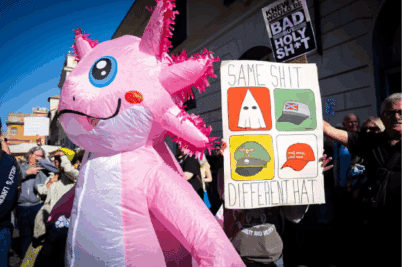
The growing confrontation between Democrats vs Republicans has intensified across the United States as millions prepare for nationwide demonstrations opposing the second Donald Trump presidency and its authoritarian trajectory.
Democratic officials have united behind the No Kings protests, urging Americans to participate peacefully while Republican leaders have dismissed the movement as radical and unpatriotic, deepening existing partisan divisions further.
Senate minority leader Chuck Schumer called on citizens not to yield to intimidation, insisting that the Democrats vs Republicans struggle represents the fight for democracy’s preservation against creeping autocracy.
California governor Gavin Newsom echoed that view, describing the No Kings protests as a “new declaration of independence” and urging demonstrators to engage in peaceful resistance that reaffirms America’s democratic values.
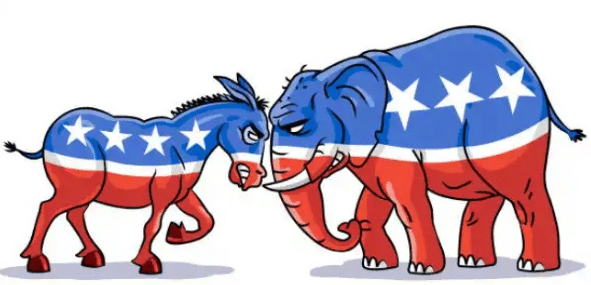
Former vice president Kamala Harris emphasized that “power belongs to the people,” encouraging citizens across all states to protest peacefully for the democracy they still believe must endure.
The Democrats vs Republicans clash has now transcended Congress and spilled into the streets, where political rhetoric has turned symbolic gestures into defining statements about the nation’s moral direction.
Republican leaders have lashed out at the movement, portraying participants in the No Kings protests as extremists and accusing Democrats of endorsing subversive campaigns to undermine the Donald Trump presidency.
House speaker Mike Johnson characterized the rallies as a “Hate America event,” accusing protesters of aligning with “pro-Hamas and antifa groups,” rhetoric fueling the Democrats vs Republicans confrontation.
Republican congressman Tom Emmer claimed Democrats were promoting a “terrorist wing” through these demonstrations, while Steve Scalise alleged that government dysfunction was deliberately engineered to support nationwide anti-Trump mobilization.
Transportation secretary Sean Duffy intensified partisan tensions by calling participants “paid protesters,” suggesting foreign or liberal donors might be secretly financing the growing No Kings protests movement.
Such accusations reveal how the Democrats vs Republicans conflict increasingly frames public expression as treachery, reflecting the erosion of trust between political factions in today’s US democracy movement.
Organizers of the No Kings protests deny any subversive motives, describing their campaign as patriotic, lawful, and grounded in constitutional ideals that reject any drift toward absolute presidential authority.
This national wave of dissent—spanning over 2,500 rallies—has become a powerful visual symbol of Democrats vs Republicans polarization, with both parties claiming to defend America’s founding principles.
While Democrats call for peaceful protest, Republicans denounce the gatherings as orchestrated rebellion, exposing how the Donald Trump presidency has transformed political dialogue into an existential cultural struggle.
Observers say the Democrats vs Republicans divide now determines not only legislative battles but also citizens’ interpretation of patriotism, loyalty, and moral duty in an increasingly fractured nation.
The No Kings protests reflect that divide perfectly: one side sees a constitutional defense; the other sees rebellion against lawful authority and the democratic process itself.
Political analysts warn that framing dissent as treason risks normalizing authoritarian thinking, further inflaming the Democrats vs Republicans rivalry that already paralyzes governance and weakens democratic institutions.
Yet supporters of the US democracy movement insist that peaceful protest remains the most legitimate expression of patriotism, rejecting any attempt to label it dangerous or anti-American.
They argue that democracy depends on civic courage—on people confronting leaders who behave like monarchs—hence the emotional power behind the No Kings protests slogan nationwide.
The Democrats vs Republicans struggle has therefore become not just about policy but identity, pitting differing visions of liberty, truth, and power against each other in an ideological civil war.
For Trump’s critics, the Donald Trump presidency represents a betrayal of democratic restraint, with power centralized, courts undermined, and political opponents portrayed as enemies rather than citizens.
For his supporters, however, the Democrats vs Republicans standoff proves Trump’s narrative that elites conspire to silence his voters, making him appear as the embodiment of anti-establishment defiance.
Such interpretations have deepened the schism, turning every protest, statement, and government decision into a referendum on whether America remains a democracy or succumbs to personal rule.
Participants in the No Kings protests say their demonstrations are acts of civic duty, not rebellion, inspired by the founding rejection of monarchy and concentration of executive power.
The Democrats vs Republicans divide has rarely been so sharp, with both parties claiming to be defenders of freedom, yet interpreting liberty through irreconcilably different ideological lenses.
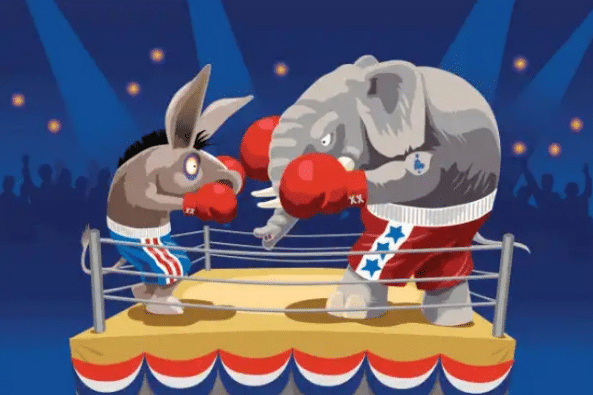
While Democrats call for peaceful resistance, Republican figures warn of unrest and chaos, further entrenching mistrust and heightening national anxiety as election tensions approach.
Trump himself dismissed the rallies, saying “I’m not a king,” but his critics cite authoritarian policies as proof that the Donald Trump presidency contradicts those words entirely.
Analysts suggest that neither side can claim moral clarity in this ongoing Democrats vs Republicans confrontation, though its consequences will shape American identity long beyond the current administration.
The No Kings protests have become a symbolic battleground over who defines patriotism—citizens demanding accountability or leaders claiming exclusive loyalty to the nation’s institutions.
In that sense, the Democrats vs Republicans struggle now mirrors older historical confrontations where the meaning of freedom itself was disputed between competing visions of power and citizenship.
Scholars warn that if dialogue collapses entirely, the US democracy movement could fragment into mistrust and apathy, leaving protest and propaganda as the only remaining political languages.
Despite polarization, millions are still choosing peaceful resistance, proving that dissent can coexist with patriotism, even amid unprecedented hostility between factions battling for America’s moral and political soul.
The Democrats vs Republicans conflict thus defines not only today’s protests but the broader question of who truly governs—the elected representative or the collective voice of the governed.
For ordinary Americans, the No Kings protests offer a chance to reclaim civic pride, reminding the nation that democracy is not inherited; it must be continually defended together.
As streets fill with peaceful crowds, chants of “No Kings” echo a collective determination that democracy’s strength lies in disagreement, not blind obedience to political idols.
The Democrats vs Republicans contest, though bitter, also testifies to democracy’s vitality—proof that people still care enough to argue, protest, and protect what they believe freedom means.
Even amid anger, exhaustion, and disillusionment, the US democracy movement remains alive, embodied by millions who refuse to surrender to cynicism or authoritarian despair.
The persistence of peaceful resistance amid polarization underscores a truth older than any presidency: that American democracy endures not through perfection but through perpetual civic struggle.

Ultimately, the Democrats vs Republicans battle now raging may one day be remembered not as America’s undoing, but as its reminder that freedom demands courage, vigilance, and unrelenting voice.
When the chants fade and the banners fall, the No Kings protests will have marked a moment when citizens refused silence, insisting that power remains answerable to the people.
Through their collective stand, they reaffirmed that democracy’s foundation endures—not in kings or rulers, but in citizens who still believe debate itself is sacred and necessary.
About The Author