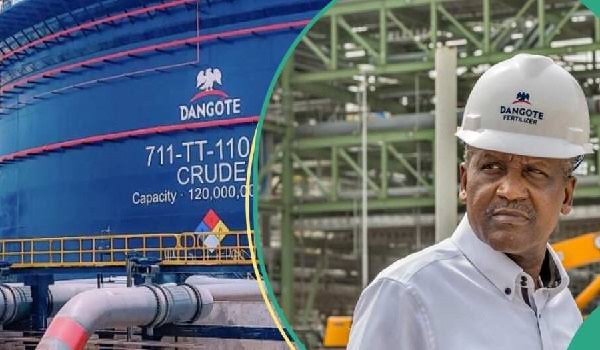

The President of Dangote Group, Aliko Dangote, has announced plans to list between five and 10 percent of the Dangote Refinery listing on the Nigerian Exchange (NGX) within the next year, marking a new phase in the company’s capital market strategy and investor engagement efforts.
The move, according to Dangote, is part of a broader plan to strengthen corporate governance, deepen market participation, and expand access to long-term capital for the refinery’s growth and diversification objectives.
Focus on Dangote Refinery’s Market Listing Strategy
In an exclusive interview with S&P Global, Dangote explained that the partial listing would follow a gradual approach similar to that used for Dangote Cement and Dangote Sugar Refinery, both of which are already publicly traded.
“We don’t intend to hold more than 65 to 70 percent ownership over time. The idea is to make the refinery a publicly trusted company with broad investor participation,” he said.
“The listing will happen incrementally, depending on investor appetite and market depth.”
This development is expected to boost investor confidence and provide local and international stakeholders with opportunities to participate in what is currently Africa’s largest industrial project.
The Dangote Refinery: A Game-Changer for Nigeria’s Energy Future
Commissioned in 2024, the Dangote Refinery is a $20 billion integrated refining and petrochemical complex with an operational capacity of 650,000 barrels per day.
Since its commencement, the facility has significantly reduced Nigeria’s dependence on imported refined petroleum products while positioning the country as a net exporter of diesel and jet fuel.
Industry analysts say the refinery’s partial public offering could mark a historic shift in Nigeria’s industrial investment landscape, enabling ordinary investors to own shares in a project that has already redefined the nation’s downstream oil sector.
According to market experts, the listing could also help attract foreign direct investment, enhance liquidity in the Nigerian Exchange, and set a new benchmark for transparency in privately owned mega-industrial ventures.
New Investments and Expansion Plans
Aliko Dangote revealed that the company recently secured a $4 billion financing deal to support ongoing expansion projects.
Discussions are also underway with investors from the Middle East to co-fund a proposed capacity increase to 1.4 million barrels per day—a development that would make the Dangote Refinery the largest in the world, surpassing India’s Jamnagar Refinery.
“Our business model is evolving,” Dangote said.
“We’re transitioning from a fully privately owned structure to a more inclusive partnership model that welcomes new investors and co-owners.”
He noted that this diversification would not only boost capital availability but also foster technological collaboration and innovation across the company’s supply chain.
The expansion will also increase the refinery’s petrochemical output, especially in polypropylene, a critical raw material for manufacturing plastics and packaging.
Sustainable Operations Amid Industry Challenges
Despite facing temporary operational setbacks earlier in 2025—including a brief shutdown of the Residue Fluid Catalytic Cracker (RFCC) unit due to maintenance and labour issues—Dangote assured stakeholders that the refinery remains fully committed to operational stability and energy efficiency.
He added that all major production units were back online as of September and that ongoing stabilization efforts were showing strong results.
“We have to ensure that every part of the refinery operates optimally,” Dangote stated.
“This is a massive undertaking, but we’re determined to make Nigeria and Africa energy-independent.”
The company’s broader diversification strategy also includes investments in petrochemicals, fertilizers, and power generation, reinforcing its position as a leading player in Africa’s industrial transformation.
Impact on the Nigerian Capital Market
Financial experts say the Dangote Refinery listing could be a major catalyst for renewed investor confidence in the Nigerian capital market.
With the local bourse already witnessing increased trading activity in energy-related stocks, the refinery’s entry is expected to attract both retail and institutional investors.
Economic analysts also suggest that the listing will promote transparency, accountability, and adherence to international reporting standards—factors that could help strengthen Nigeria’s financial ecosystem.
The NGX management has welcomed the announcement, describing it as “a strong indicator of Nigeria’s growing industrial maturity and the willingness of indigenous conglomerates to embrace global governance practices.”
A Vision Beyond Profit
Beyond its commercial value, Dangote emphasized that the refinery’s mission aligns with a broader vision of industrial self-sufficiency and regional economic empowerment.
“Our focus is not just profit,” he said. “We want to create jobs, support small and medium enterprises through downstream linkages, and contribute to the stability of Africa’s energy supply chain.”
Dangote added that the company would continue to pursue its commitment to sustainable operations, innovation, and inclusive growth through strategic partnerships and capital market participation.
As preparations advance for the Dangote Refinery listing on the Nigerian Exchange, expectations are high that the move will not only deepen the country’s stock market but also symbolize a new era in Nigeria’s industrial evolution.
By opening its ownership to public investors, the Dangote Group is reinforcing its long-term commitment to transparency, economic diversification, and national development — goals that could redefine the trajectory of Africa’s largest economy.
About The Author