China travel warning for Japan– Shares in Japan’s tourism and retail companies plunged Monday after China issued a travel warning for Japan, signaling heightened political tensions following Prime Minister Sanae Takaichi’s remarks.
Takaichi suggested Japanese self-defence forces could intervene militarily if China threatened Taiwan, which Beijing claims as its own territory, prompting a swift response from Chinese authorities.
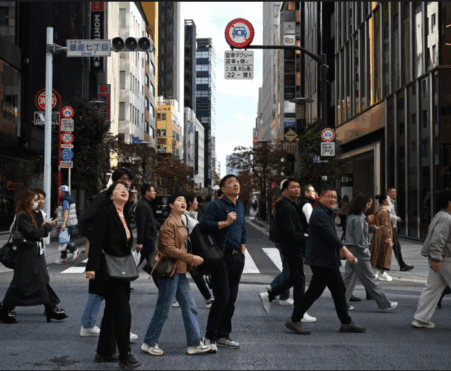
The warning advised Chinese citizens to avoid traveling to Japan and reconsider university enrollments, causing immediate financial strain on department stores, clothing retailers, and cosmetics firms.
Shiseido shares dropped 9%, Takashimaya by 5%, and Fast Retailing, owner of Uniqlo, lost more than 4%, reflecting China’s crucial role as Japan’s largest source of tourists.
Chinese travelers are known for high spending on cosmetics, electronics, and fashion items, so the travel advisory threatens both revenue streams and wider economic confidence.
Japan’s foreign ministry dispatched Masaaki Kanai to Beijing to meet his Chinese counterpart, Liu Jinsong, aiming to de-escalate the conflict and reassure officials of Japan’s consistent security policies.
Kanai emphasized that Takaichi’s statements do not represent a permanent policy shift, and urged China to avoid actions that might damage bilateral relations and trade.
Analysts warn that tensions over Taiwan, which Japan observes closely due to geographic proximity, could continue affecting tourism, retail, and investment flows unless diplomatic channels hold firm.
Beijing’s advisory coincided with a Chinese coast guard patrol through the disputed Senkaku islands, which are administered by Japan but claimed by China, heightening fears of further confrontation.
The islands have long been a flashpoint, with territorial claims intertwined with national pride, regional security concerns, and historic grievances stemming from past conflicts and occupations.
Takaichi has been a vocal critic of China, highlighting the country’s military expansion and influence in the Asia-Pacific region, even before her election as prime minister last month.
Her stance on Taiwan is particularly notable, reflecting a conservative perspective that prioritizes Japan’s security and positions Tokyo as a firm ally of Taipei.
Relations between China and Japan have deteriorated despite strong economic interdependence, with historical mistrust and frequent disagreements over trade, military activities, and regional security complicating ties.
The travel warning is particularly damaging because Chinese tourism accounts for millions of visitors annually, who contribute significantly to Japanese retail and hospitality revenues.
Chinese students, another important demographic, were also advised to reconsider attending Japanese universities, threatening educational partnerships and long-term people-to-people ties.
Japanese retailers rely heavily on Chinese tourism spending, particularly in urban shopping districts and luxury markets, making the advisory a significant economic blow.
Shares in companies with international exposure fell more sharply, indicating investor concern over potential prolonged disruptions in cross-border travel and consumer confidence.
Financial experts note that markets often respond to geopolitical risk with immediate share declines, reflecting uncertainty rather than long-term fundamental changes.
The Japanese government has reaffirmed its commitment to the 1972 joint communique with China, acknowledging Taiwan as part of China while emphasizing Japan’s defensive posture.
This delicate balance allows Japan to maintain formal relations with Beijing while safeguarding strategic autonomy and security commitments in the Asia-Pacific region.
Diplomatic engagement remains critical as Japan’s officials attempt to clarify the nation’s policies and avoid escalation while managing domestic political expectations.
Takaichi’s personal rapport with Taiwan, including visits and meetings with Taipei officials, underscores her administration’s emphasis on bilateral security cooperation and economic partnership.
While China’s advisory impacts immediate travel plans, long-term effects depend on political dialogue, regional stability, and the resolution of misunderstandings between Tokyo and Beijing.
Tourism operators in Japan are scrambling to adjust marketing strategies, refund policies, and operational logistics to mitigate losses from canceled bookings and reduced visitor numbers.
Retail chains, particularly in cosmetics and fashion, are considering temporary promotions and diversification to domestic and non-Chinese markets to offset revenue shortfalls.
Economic analysts caution that prolonged travel restrictions could exacerbate existing pressures on Japan’s tourism-dependent regions, including hotels, restaurants, and cultural attractions.
Japan and China are both major global economic players, making their relationship critical not only regionally but also for broader international trade, investment, and supply chains.
Despite tensions, dialogue channels remain open, with meetings scheduled between Japanese and Chinese officials aimed at reducing misunderstandings and fostering stable engagement.
Observers note that while immediate financial losses are measurable, reputational impacts and long-term visitor confidence could take months to recover if tensions persist.
China’s warning demonstrates how geopolitical disputes can ripple through financial markets, affecting companies far removed from direct political engagement.
Experts stress that clear communication, mutual reassurance, and careful diplomacy are key to preventing further market volatility and maintaining bilateral cooperation.
Japan’s approach emphasizes readiness to act in defense while avoiding provocative actions that could escalate conflicts with China or other regional powers.
The international community is closely watching developments, as Japan-China tensions could influence trade, security alliances, and regional stability across East Asia.
Tourism and retail companies face the immediate challenge of sustaining revenues, while policymakers work to manage the broader implications of the travel advisory.
Investors are assessing exposure to sectors most affected by Chinese travel reductions, including cosmetics, clothing, electronics, and hospitality, seeking to balance risk and opportunity.
China travel warning for Japan, while politically motivated, underscores the economic interconnectedness of the two nations and the sensitivity of markets to diplomatic tensions.
Diplomats hope that forthcoming meetings and reassurance from Japan will help restore confidence, ensuring that travel, trade, and educational exchanges continue with minimal disruption.
Japanese officials maintain that their Taiwan policy remains defensive, focused on existential threats, while promoting dialogue to prevent escalation and preserve bilateral economic ties.
If tensions ease, tourism and retail markets may recover gradually, but uncertainty persists until both governments can clarify intentions and reassure citizens and investors.
The current situation reflects the complex interplay between security concerns, historical rivalries, economic dependence, and political signaling that defines Japan-China relations.
China travel warning for Japan serves as a stark reminder of how fragile regional stability can influence both global markets and ordinary citizens’ mobility.

Both countries are under pressure to demonstrate responsible leadership, balancing national interests with the economic and social consequences of unilateral policy actions.
Ultimately, the resolution of tensions will depend on diplomatic skill, adherence to international norms, and willingness to maintain channels of communication despite political differences.
About The Author