


Former staff member of the Broadcasting Corporation of Oyo State (BCOS), Kayode Olagunju, has criticised the Seyi Makinde administration over the condition of the state-owned media organisation, questioning how successive government budgets have translated into tangible improvements in the corporation.
Olagunju said the continued concerns over workers’ salaries, welfare, infrastructure and the general state of BCOS raise fundamental questions about the management of public resources under the Oyo State Government.
He argued that BCOS should not be treated as a private organisation because its workers are employees of a government-owned institution who have spent years serving the state through television, radio, news production, public enlightenment and other broadcasting activities.
According to him, the central question is why BCOS continues to experience operational and welfare challenges despite being captured in the state’s annual budget.
“The budgets are there — so where are the results?” Olagunju asked.
Questions over BCOS budget allocations
Olagunju noted that the Oyo State Government has continued to present large annual budgets, with the 2025 budget reportedly put at about ₦684 billion and the 2026 budget approaching ₦892 billion.
He said the size of the state’s budgets makes it reasonable for citizens to demand accountability over how allocations to individual government institutions are implemented.
According to budget information cited by Olagunju, he also questioned the funding and implementation of successive budgetary provisions for BCOS, arguing that the key issue should not only be the amount appropriated but also how much was actually released, what it was spent on, and the measurable improvements recorded at the corporation.
An earlier 2025 budget-performance report cited by Olagunju showed no expenditure recorded against an ₦850 million provision at that reporting point. However, the Oyo State Government’s later 2026 Citizens Budget records ₦587.58 million as BCOS’s actual expenditure for 2025.
Olagunju said the reported zero-per-cent expenditure performance raises questions that the government should clarify.
He asked whether the funds had not been released at the time, whether they were released later, whether there had been changes to the budget or whether bureaucratic processes were responsible for the situation.
“The real test of a budget is not the figure announced but its implementation,” he argued.
What has changed at BCOS?
Olagunju also questioned the level of transformation recorded at BCOS after years of government budgeting.
He asked where the modern studios, upgraded broadcasting facilities, digital broadcasting infrastructure, modern cameras, editing equipment and other technological investments required to make the corporation competitive were.
He also questioned why concerns about workers’ welfare and the payment of statutory salaries continue to emerge from the corporation.
According to him, government cannot simply point to the inclusion of BCOS in annual budgets as evidence of support without demonstrating what the allocations have achieved.
The former staff member called for a clear assessment of what was budgeted, what was approved, what was released, what was spent and what was ultimately achieved.
BCOS workers are Oyo State workers
Olagunju further raised concerns about the welfare of BCOS employees, stressing that they are Oyo State workers and should not be treated differently from other public servants.
He said the government’s responsibility should include ensuring that workers receive their statutory salaries and legitimate entitlements promptly.
His comments come amid concerns raised by BCOS workers over delayed salaries and welfare.
Olagunju maintained that a temporary wage award cannot substitute for regular salaries, outstanding allowances or improved working conditions.
He said government-owned institutions must be adequately funded and properly managed if they are expected to deliver quality public services.
BCOS needs more than salary intervention
The former BCOS staff member said the corporation’s challenges should not be viewed solely as a payroll problem.
He argued that the media industry has changed significantly, with traditional television and radio stations now competing with digital platforms including YouTube, Facebook, TikTok, podcasts, streaming services and online news platforms.
According to him, BCOS requires strategic investment in technology, content production, staff training and digital platforms if it is to remain relevant.
He also said the corporation has the potential to generate revenue through advertising, sponsorship, programme production, digital content and other legitimate commercial activities.
Olagunju therefore called for greater transparency concerning BCOS’ finances, including its annual revenue, expenditure, salaries, equipment purchases, maintenance costs, digital investments, debts and other liabilities.
Questions over Makinde’s governance
Olagunju’s criticism also extends to the wider question of governance under the Makinde administration.
He argued that government performance should not be assessed only by completed projects and new policy announcements, but also by institutions that continue to experience unresolved challenges.
He questioned why BCOS workers were still raising welfare concerns after more than seven years of the Makinde administration and why a government-owned media organisation continued to face questions over modernisation and financial sustainability.
He also linked the discussion to broader concerns over workers’ welfare, including complaints from other categories of public servants and pensioners.
Wage award raises further questions
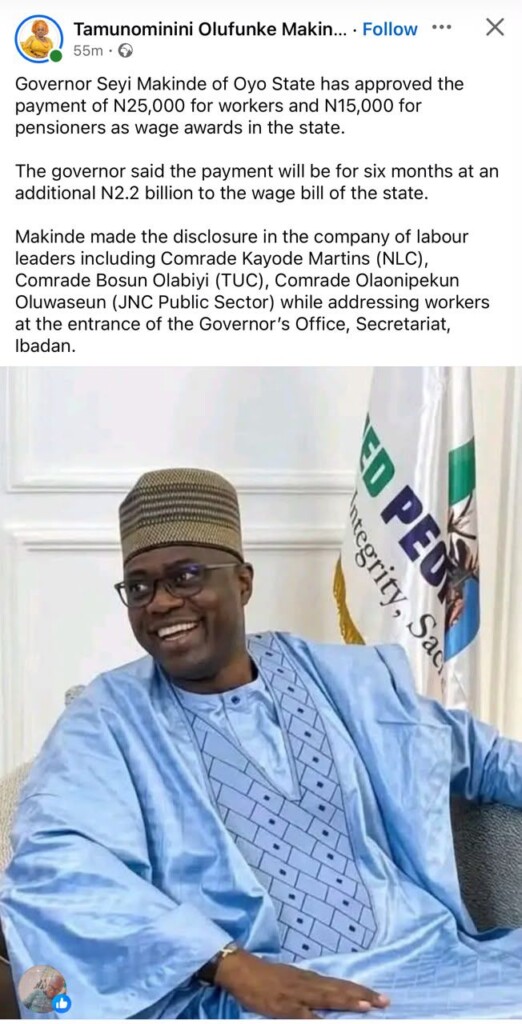
Olagunju also questioned the latest six-month extension of the state’s wage-award arrangement, under which workers receive ₦25,000 and pensioners ₦15,000 monthly.
When the wage-award arrangement was originally introduced, the Oyo State Government said the intervention would add about ₦2.2 billion to the state’s wage bill.
While acknowledging that the intervention could provide temporary relief, Olagunju questioned its timing, particularly because the six-month period extends into February 2027, when political activities ahead of the 2027 elections will be intensifying.
He said citizens were entitled to question whether the intervention was purely a welfare measure or whether political considerations could also be involved.
However, he stopped short of presenting vote buying as an established fact, stressing that the timing and structure of the policy were legitimate subjects for public scrutiny.
Call for comprehensive BCOS review
Olagunju called for a comprehensive review of BCOS covering several years.
He said such a review should establish the corporation’s annual budget proposals, approved allocations, actual releases, expenditure, completed projects, internally generated revenue, staff salaries and outstanding allowances.
He also called for an assessment of equipment purchased, equipment still required, outstanding liabilities and the level of government intervention in the corporation.
According to him, the findings should be made available to the public.
“If funds were approved but not released, the government should explain. If funds were released but not properly utilised, management should explain. If funds were properly utilised but the institution remains incapable of delivering, then both government and management must explain,” he said.
“Where are the results?”
Olagunju stressed that his concerns should not be interpreted as an attempt to destroy BCOS or undermine its workers.
Rather, he said the objective should be to strengthen the corporation, protect its workers and ensure that public funds allocated to it produce measurable results.
He argued that BCOS should be viewed as a case study in budget implementation, workers’ welfare, institutional management and public accountability.
“The people of Oyo State deserve more than annual budget presentations. They deserve implementation, transparency, accountability and institutions that work,” he said.
Olagunju ultimately challenged the Makinde administration to provide clear answers on the state of BCOS and the utilisation of funds allocated to the corporation.
For him, the issue goes beyond one broadcasting organisation.
It is a question of whether public allocations are translating into improved institutions and better welfare for the people they are intended to serve.
“BCOS workers are Oyo State workers. BCOS is an Oyo State institution. The people deserve to know what happened to the money approved for it,” he said.
About The Author
