


Baruwa unseats MC Oluomo as NURTW president
A prolonged leadership crisis within the National Union of Road Transport Workers took a decisive turn on Monday as Tajudeen Baruwa formally assumed control of the union’s national secretariat in Abuja, effectively displacing Musiliu Akinsanya following a series of court rulings that redefined the union’s leadership structure.
The development marks a significant milestone in a dispute that has lingered for nearly two years, raising questions about governance, compliance with judicial decisions, and the broader implications for one of Nigeria’s most influential transport unions.
Baruwa, who addressed journalists shortly after taking over the secretariat, maintained that his actions were firmly rooted in the rule of law.
According to him, multiple court judgments—spanning both the trial and appellate levels—had affirmed his position as the duly elected president of the union.
He emphasised that the takeover was carried out peacefully and in strict adherence to legal directives, describing it as the enforcement of judicial pronouncements rather than a power grab.
“Our presence here today is not about confrontation but about compliance with court orders,” Baruwa stated.
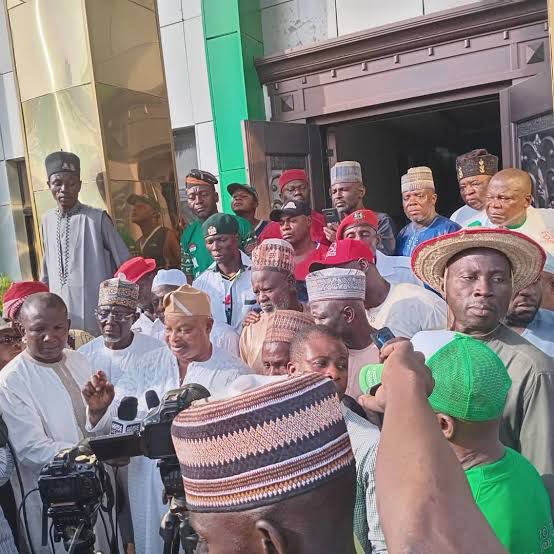
“For nearly two years, we exercised restraint, expecting that all parties would respect the decisions of the courts. Unfortunately, that was not the case.”
Court rulings reshape leadership structure
The leadership tussle within the NURTW has been largely shaped by decisions of the judiciary, particularly rulings delivered by the National Industrial Court and later upheld by the Court of Appeal.
In its judgment, the lower court recognised Baruwa as the legitimate president of the union, a position that was subsequently reinforced by the appellate court, which dismissed challenges filed by rival claimants aligned with Akinsanya.
The appellate panel ruled that the appeal lacked merit, thereby validating the earlier decision and awarding costs against the appellants. This effectively cemented Baruwa’s claim to the presidency and provided the legal foundation for Monday’s takeover.
Legal analysts note that the case underscores the increasing role of judicial intervention in resolving internal disputes within labour unions and other organised groups in Nigeria.
Police notification and delayed enforcement
Baruwa disclosed that the union had formally notified law enforcement authorities ahead of the takeover, submitting certified copies of the court judgments to facilitate a smooth transition.
However, he expressed disappointment over what he described as a lack of proactive support from the police, alleging that repeated assurances were not matched with decisive action.
Despite the initial hesitation, Baruwa said the union proceeded with its plans after issuing a final notice, reiterating its commitment to a peaceful process.
“We made it clear from the outset that we were not interested in violence,” he said. “Our objective has always been to reclaim what rightfully belongs to us through lawful means.”
Tensions linger despite peaceful takeover
While the takeover was largely described as peaceful, there were indications of lingering tensions between rival factions within the union.
Baruwa alleged that one of his supporters was attacked during the process and is currently receiving medical attention.
However, he insisted that the situation remained under control and did not escalate into widespread unrest.
The General Secretary of the union, Suleiman Musa, echoed similar sentiments, noting that all necessary steps were taken to ensure transparency and accountability.
“We invited the media to witness today’s events so that the public can see that this is a lawful and orderly process,” Musa said. “Despite multiple appeals, those occupying the premises refused to vacate, leaving us with no choice but to enforce the court’s decision.”
Implications for Nigeria’s transport sector
The NURTW plays a critical role in Nigeria’s transport ecosystem, particularly in urban centres where it regulates operations at motor parks and interfaces with government authorities on transport policies.
As such, leadership instability within the union has far-reaching implications, including potential disruptions in transport services, revenue collection, and stakeholder coordination.
Industry observers believe that the resolution of the leadership crisis—if sustained—could restore stability and improve operational efficiency within the union.
However, they caution that reconciliation between the rival factions remains essential to achieving long-term peace.
Path to reconciliation remains open
Despite the sharp divisions that have characterised the dispute, Baruwa signalled a willingness to pursue reconciliation with opposing factions.
He stressed that the union remains open to dialogue and is committed to fostering unity among its members.
“We are not here to fight anyone,” he said. “Our doors remain open for reconciliation because, at the end of the day, we are all working towards the same goal of strengthening the union.”
A test of institutional compliance
The unfolding events within the NURTW highlight broader issues surrounding institutional compliance with court orders in Nigeria.
Experts argue that the delayed enforcement of judicial decisions in this case reflects systemic challenges that extend beyond the union, touching on governance, accountability, and the rule of law.
As Baruwa settles into his role, attention will likely shift to how effectively he consolidates authority, manages internal divisions, and steers the union towards stability.
For now, the takeover of the secretariat represents a turning point in a prolonged power struggle—one that underscores the decisive influence of the judiciary in shaping organisational leadership in Nigeria.
Caught between classes and stumbled upon FarPlay; the Filipino heritage vibe is wild! Just need to verify that farplay slot download link works before my GCash hits. Can’t wait to try those live casino games later tonight when I’m free!