

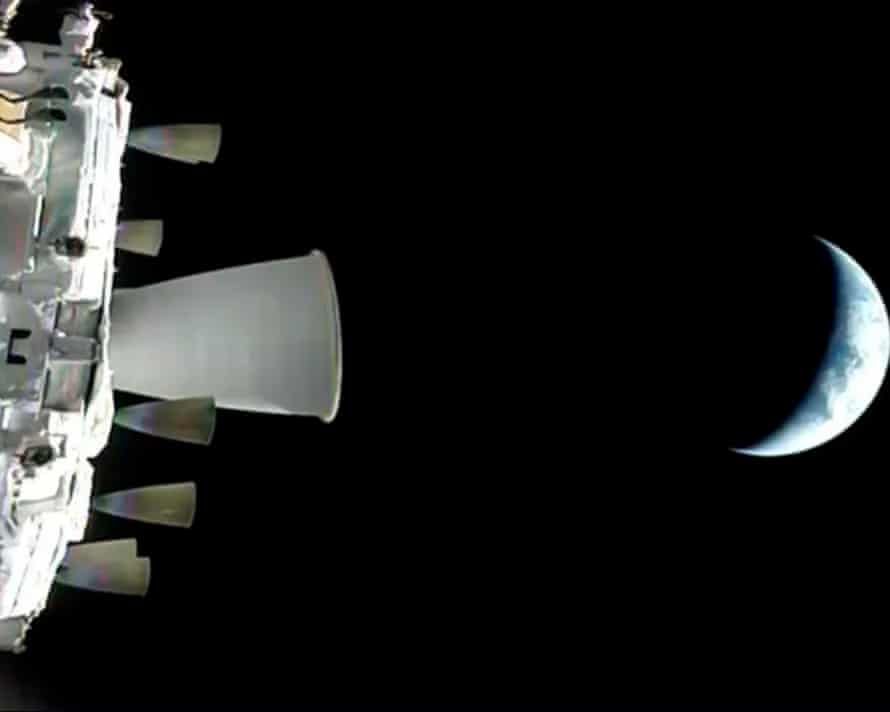
The four Artemis II astronauts passed the halfway point between Earth and the moon, marking the first human lunar mission in over fifty years since Apollo 17 in 1972.
NASA’s Orion spacecraft, carrying the crew, is now more than 136,080 miles from Earth, with real-time tracking displayed on the agency’s online dashboard, demonstrating mission progress and precise navigation toward the lunar flyby.

Commander Reid Wiseman captured the first downlinked images, showing a curved Earth slice, with oceans, clouds, and a glowing green aurora, offering breathtaking visuals visible only from deep space.
Mission Specialist Christina Koch and pilot Victor Glover were seen working inside Orion, maintaining systems, while astronauts admired Earth’s illuminated features, reflecting humanity’s shared home from the unique lunar perspective in real-time.
NASA’s Lakiesha Hawkins described the mission as progressing well, highlighting that Earth, as represented in the imagery, connects all humans, emphasizing unity and scientific accomplishment during this historic space exploration milestone.
The crew will swing around the moon in a free-return trajectory, venturing approximately 4,000 miles beyond, then perform a U-turn, returning safely to Earth while experiencing unprecedented lunar far-side views.
Orion’s main engine fired flawlessly Thursday night, setting the precise course for the lunar flyby and enabling astronauts to witness spectacular phenomena like the terminator, where night and day divide across Earth.
The mission includes the first person of color, the first woman, and the first non-American on a lunar voyage, marking Artemis II as the inaugural crewed flight of NASA’s Space Launch System rocket.
Astronauts follow daily routines including thirty-minute exercise sessions on the flywheel device to counteract bone and muscle loss from prolonged microgravity, maintaining physical health throughout the journey beyond Earth’s orbit.

Artemis II continues NASA’s long-term lunar objectives, aiming to establish a permanent base that supports sustained exploration and acts as a platform for future deep-space missions, including Mars preparation and scientific research.
Despite delays and cost overruns, NASA launched Artemis II in April 2026, overcoming technical setbacks, such as rocket repairs and maintenance, ensuring crew safety, and reinforcing the program’s reliability in human spaceflight operations.
The Artemis program competes with China’s lunar ambitions, projected to land humans by 2030, driving technological innovation and national investment, with NASA officials acknowledging international space rivalry as a motivating factor.
Astronauts encountered a minor onboard toilet malfunction, resolved with guidance from mission control, emphasizing the importance of life-support and survival systems in maintaining safe, habitable conditions during extended space missions.
Crew members described the view of Earth as “breathtaking,” showing illuminated continents, lunar glow, and atmospheric phenomena, prompting reflection on planetary unity and human fragility, inspiring awe throughout the spacecraft.
NASA projects that Artemis II astronauts will set distance records, venturing further from Earth than any humans in history, exceeding 250,000 miles, showcasing the mission’s pioneering role in space exploration milestones.
The mission also serves as a testing platform for future long-duration lunar flights, allowing astronauts and engineers to evaluate equipment, operational procedures, and human adaptability beyond low Earth orbit.
Astronaut Victor Glover emphasized global unity from space, noting that from Orion, humanity appears as one entity, reinforcing perspectives on shared environmental responsibility, international cooperation, and peace beyond terrestrial divisions.
The Artemis II mission demonstrates the strategic integration of human exploration, scientific observation, and technological advancement, reaffirming NASA’s commitment to pushing the boundaries of space travel, lunar research, and Earth observation programs.
Astronauts are prepared with survival suits maintaining oxygen, temperature, and pressure for up to six days, ensuring safety during emergencies, depressurization events, or cabin malfunctions while deep in space, far from Earth.
NASA continues monitoring Artemis II closely, providing technical support, scientific guidance, and real-time telemetry, ensuring mission objectives are met safely, while maximizing data collection for research and future lunar mission planning.
Read also: Iran Hormuz chokehold intensifies global oil pressure